Archived Parish Priest Stories
NOVEMBER 2018 PRIEST OF THE MONTH - REV. JAMES HARTWELL
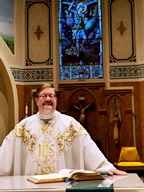
Dispelling any myth that might exist about where priests come from, Fr. Jim Hartwell exclaimed, “I came from a Catholic family, I didn’t fall out of the ‘priest tree.’ I came from a family!”
That family began in Erie, PA. Father Jim grew up in the large parish of St. George in the Diocese of Erie. It was the largest parish, with a large school housing three classes of each grade level with thirty students per class. They also had three priests assigned to the parish. Father Jim recalled that when he was younger he thought all Catholic parishes were big and bustling and bursting at the seams with life and activity. By the time he was ten years old, his father had tired of driving to Buffalo for work each day so the family moved to Amherst. He spent two years at St. Leo the Great School. He, his younger brother and their parents then moved to Grand Island.
The first time he considered the priesthood was when he was in second grade. Of course, back then he wanted to be lots of things like a fire fighter, astronaut, etc. Thoughts of the priesthood returned when he was in the seventh grade. He recalls that these thoughts occurred during pivotal moments in his life. He made his First Reconciliation in the fall of second grade and his First Communion in the spring. Entering into new Sacraments can trigger thoughts of religious life. When his family made the move from Amherst to Grand Island, he started to attend public school for the first time in his life and he missed that Catholic connection. He considered priesthood again when he made his Confirmation.
After graduating from high school, he went to St. John Fisher College in Rochester, NY. There he found a group of faith-filled friends. He studied Pre-Med and Gerontology with a focus on Business Administration. He worked during those years as a Certified Nurses’ Assistant. Within his group of friends, 7 of the 14 went on to become priests and 7 got married and had families. He assessed, “It all came down to helping each other try to find out where God is calling them.” He added that, “God works through our faults and failures as well as our strengths and weaknesses.” He decided after his third year at St. John Fisher to leave and enter Wadhams Hall Seminary in Ogdensburg, NY in order to finally give more serious thought to becoming a priest.
He went on to study at Christ the King Seminary and was ordained in 2002. Having no other classmates that year, he truly was “in a class by himself!” Father Jim was first assigned to Infant of Prague Parish for three years. After that, he took a short leave of absence to deal with a few questions he had. As he put it, “Discernment is an ongoing process.” He returned to ministry at Nativity of Our Lord Parish for two and a half years. It was then that St. Michael in Warsaw was looking for a pastor and Fr. Jim applied. He was assigned to St. Michael and has been there for nine years.
Father Jim’s hobbies depend on the season. In the warmer months he likes to golf and in the fall and winter he enjoys archery and shotgun hunting. He appreciates living in Warsaw where there are lots of places to hike and hunt. He likes being out in nature and away from phones and technology for a while. Getting together with friends and brother priests is something he enjoys year round.
He delights in being with the people and believes that instead of having a family of his own, he is a part of everyone’s family. Father Jim also enjoys working with wedding couples. It is fulfilling to journey with them through dating, engagement, marriage and eventually to see them raise families of their own. He noted that, “The relationship between celibate priest and married couple is complementary because we show each other what the ideal is in each other’s ministry. The lived reality of marriage is that it can be very difficult and challenging at times. A priest can hold up the ideal that marriage should be a complementary self-sacrificial love between husband and wife. As a married couple they don’t understand what it’s like to be a celibate priest. Not even so much the absence of a partner in life but more the constant expectation that the priest should be available all the time for the needs of the parishioners. The married couple through their faithful love of each other inspires the priest to realize what his well-lived priesthood does for them.” Father Jim believes that there is a correlation between the divorce rates increasing causing the break-up of families and the number of vocations to the priesthood declining. He added, “The idea of ‘life-long vocation’ deteriorates as people fail to stay together in marriage.
Keeping a good balance is something Fr. Jim struggles with from time to time. He lamented, “It’s so easy to see all there is to do and get discouraged.” He attends meetings at the parish as well as in the community where he serves on several local boards and committees. He is also on the Presbyteral Council for the Diocese of Buffalo and Vicar Forane for the Genesee-Wyoming Vicariate. He sometimes thinks to himself, “When can I just be a normal parish priest again?” He sees the temptation to skip his day off but knows that would not be a good idea in the long run. He believes that priests who slack in their prayer lives and don’t take quiet time or proper time for meals or exercise can wind up suffering some mental, physical, emotional and spiritual burn out.
In advising those considering the priesthood, Fr. Jim counsels, “Remember that a calling from God is also on God’s time, not your time. If God is calling you to a religious vocation, be it priesthood, religious or diaconate; keep an open mind and an open heart. There could be experiences God is calling you to before you get to the point of actually entering formation for religious life.” He went on to advise that once you are serving in your ministry, you may recall the experiences you had before that are now helping you deal with current issues. He values every experience he had that led up to his ordination and he believes, “It will be evident what God is calling you to if you keep that open mind and heart.”
OCTOBER 2018 PRIEST OF THE MONTH - REV. TIMOTHY KOESTER
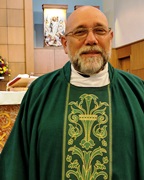
The name, Fr. Tim Koester, may not be very familiar to some people. Ordained for the Diocese of Buffalo in 1983, Fr. Tim has been serving our country outside of Western New York for the past 28 years. He recently returned to serve locally again bringing with him a multitude of experience and insight from his many adventures throughout the world.
Father Tim began his Christian journey at his baptism at St. Paul Church in Kenmore. He spent the first four years of elementary school at Blessed Sacrament and the last four years at St. Andrew Parish. In the second grade, Fr. Tim recalls that he was impressed and inspired by his parish priest commenting, “He always had kind and gentle words.” He considered becoming a priest then but ended up putting those thoughts on the back burner for a while.
He wanted to attend the Diocesan Preparatory High School but was advised to try another school until he was sure about the call to priesthood. He enjoyed his high school years at Cardinal O’Hara, a co-ed school. He dated and had many friendships but realized that the call to priesthood was still there. After high school he spent a year working as a custodian in an elementary school and spent the summer working at Camp Turner. He then entered Wadhams Hall Seminary in Ogdensburg and went on to Christ the King Seminary in East Aurora continuously working the summers at Camp Turner. He was ordained September 10, 1983 and just recently celebrated his 35th anniversary of priesthood. Father Tim recalled, “I always prayed that there would be this big bright light that would come on in the middle of the night and a booming voice would say, ‘Tim, I want you to become a priest!’ I’m still waiting! Funny, I said that after I was newly ordained but it’s still there. In a positive way, the whole idea of a call to me has been – it’s every day. The more I learn, the more I understand, the more I embrace life and truly appreciate my vocation and the vocation is dynamic!”
Father Tim valued the experience of caring for the poor and needy during the year he spent as a deacon at Holy Cross Parish on the West Side of Buffalo. His first assignment as a priest was to St. Elizabeth Ann Seton in Dunkirk which he enjoyed very much. From there he was asked to minister at the Diocesan Youth Department which enabled him to continue spending summers at Camp Turner. He noted that, “If you can help the young people understand and feel good about themselves then you’ve got at least three generations because the parents and grandparents will always respond to you.” Father Tim did a lot of retreat work, young adult education, communication workshops and camps. He went back and forth during the summers from his office in Buffalo to Camp Turner (for boys) and at the time, Camp Mary Glen (for girls). He lived with the Christian Brothers at St. Joseph Collegiate Institute in Kenmore and helped out as chaplain there for three years.
After that, Fr. Tim was assigned to SS. Peter and Paul in Jamestown. He liked the size of that city. It was also his first experience of being in an area where there were many different faiths, not just Catholics. This ecumenical experience came in handy for the next chapter in his life. In 1990 Bishop Head asked him to join the Navy Chaplain Core. With permission from his diocese, Fr. Tim was “on loan” to the Archdiocese of the Military. He attended officer school and was commissioned to the U.S. Navy as an officer chaplain.
His first assignment was to the Marines at Camp Lejeune in Jacksonville, North Carolina. He was deployed to Saudi Arabia for eight months to minister during Desert Shield, Desert Storm and Desert Clean Up. He returned to the U.S. and was deployed again, this time to Guantanamo, Cuba. There was a camp set up there to keep people from using boats to cross from Cuba to the U.S. because of the danger it posed to them.
Another assignment included 45 days north of the Arctic Circle in Norway and then he was sent to Norfolk, VA where he was assigned to a ship that was still being built. In his experiences as chaplain he learned how important people’s faith was to them. He said, “In all of this what I’ve really found is that the call of God is in our everyday life and everyone has it. It’s just that we all need to find it in our own way and that’s what a chaplain has always been about.”
In 1995 Air Force Pilot, Scott O’Grady was shot down over Bosnia and Herzegovina and forced to eject from his F-16C into hostile territory. After nearly a week of evading the Serbs he was eventually rescued by the Marines. Father Tim was aboard that ship in the Adriatic Sea and was called to spiritually minister to the rescued pilot. He then went on to serve as the chaplain in Washington, DC in Henderson Hall as the support element to all Marines in the DC area. He ministered to people who lived and worked off that base. He also worked at the Pentagon and the Navy Annex and helped out one day a week at Arlington National Cemetery doing funerals. That turned into three days a week and added up to over 600 funerals. Father Tim commented that often in the process of doing the funerals he would find a link to Western New York.
It was then back to Guantanamo Bay as Command Chaplain for another two years. After that, Fr. Tim was assigned to the U.S. Naval Academy in Annapolis, MD where he worked with one of the battalions. He found it to be, “a great place where you’re influencing people who are going off into the future.” He mentioned that it was almost like working in a cathedral because every Sunday there would be 1,500 – 2,500 people packed in the chapel. He enjoyed it very much and called it, “an eye opening experience.”
Father Tim then joined up with the Marine Air Wing out of Cherry Point, NC and deployed for the second time with them to Iraq. He recalled, “The rule of thumb was, you fly at night with the Army and you fly in the daytime with the Marines.” He covered a good number of bases there. He was assigned to a particular air base, Aliased in the Province of Iraq. He crossed over the Euphrates River a number of times to cover a base. They were once trapped at the base for a few days and took mortar fire.
Back again in the United States he was assigned to a ship out of San Diego with the Marines. There were 5,000 people on board between the Marines and Navy. Father Tim was pastor for all the people on board, Catholics and other faiths, and mentioned, “You become very close. Ultimately, you are a city out at sea for six to ten months or longer. You do everything; you make your own water, you make your ship move, the sewage system has to work, everyone has a job and each job is important. I learned the sense of community”.
He then served in Hawaii where he said, “It was beautiful but the job was one of the most challenging jobs I’ve done.” He had the task of being involved in merging two bases together; Pearl Harbor and Hickam. They spent one and a half years merging and one and a half years managing the merger. Father Tim was the pastor of all the faiths which included the third largest synagogue of all the Hawaiian Islands as well as communities of Buddhists and even Wiccans.
Father Tim was then sent to an aircraft carrier in Norfolk, VA. They deployed for a year and then came back to work in the shipyards. Deployment was easier for them because they had a certain date when they would return. Being in the shipyards was more difficult because people came and went for uncertain time periods. It wreaked havoc on married people because it took them away from their families without clear start and finish dates. Cell phones were prohibited while in the shipyard which made communication difficult.
Boot camp in Paris Island, South Carolina is where Marines are made. That was Fr. Tim’s most recent and final assignment as chaplain. Throughout his years spent in the Marines, he would return home from time to time. While back in Buffalo he always made it a point to introduce himself to the new bishop and ask to continue in service to the Marines. For 28 years he was granted that opportunity but Bishop Malone expressed an interest in having him return for good. Upon his return he found an opening at St. Joseph Parish in Gowanda and St. Mary in Cattaraugus filling in for the pastor, Fr. Joe Porpiglia, while he’s on sabbatical. He was assigned as temporary administrator for five months and has been enjoying meeting new people as well as re-connecting with some of the friends he made in that area when he served there years ago.
Father Tim has an older sister who lives in the Buffalo and younger brother in New York City as well as nieces and nephews from both siblings. He enjoys bike riding and kayaking which he did a lot of during his Camp Turner days. He also has an interest in older cars.
The people he ministers to make his priesthood what it is. For better or for worse, it’s the people who influence his experience as a priest. Father Tim mentioned that, “In the military you are one of them. You do the things that they do; get up early, work out, etc. There’s something different about being the chaplain. You offer that link with God that everyone needs to have. It was a beautiful role of priesthood for me. Back here it’s not different except you have separate living quarters but you are still instrumental in spiritual interaction. It’s the people who make that difference. They give you the life and the vibrancy especially now as I see the challenges we’re facing. It has a lot to do with communication and how we interpret things. Not just in church but across the U.S. We need to be that level head that brings peace back to situations. We need to slow down.” He also feels that morality needs to be brought into every situation. Sometimes moral law is in step with civil law and sometimes it is in conflict with it. He added, “We have to find the balance; to live in the present, for the future, from the past.” Communication can sometimes present a problem. Too much technology – cell phones, computers, etc. can be an obstruction to communication rather than an enhancement. He added, “The link between people goes beyond simply the physical to the spiritual. That’s an important part of our life and I think that’s what the priesthood is all about. Maybe one of the greatest challenges we have is communicating better.”
When advising men considering the priesthood, Fr. Tim recommends that they be open and listen. He tells them, “God is speaking to you right now. God is speaking to you all the time. When communicating with military recruits, he advised, “Finish out your commitment to the Navy. If God is calling, he will keep calling and you will know it when your military commitment is over. You will be more sure of your response when your time is through.” He was likely reminded of the advice given to him to attend a high school other than the Diocesan Preparatory. God calls everyone to something. We have to listen and that’s what makes the difference.
SEPTEMBER 2018 PRIEST OF THE MONTH - REV. DENNIS J. J. MANCUSO
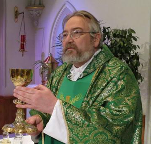
Born the fourth child in his family of ten, Fr. Dennis grew up in Fredonia, NY where he and his family were parishioners of St. Joseph Church. He recalled, “The call to priesthood was something that was always there in the background from the time that I was a little boy and it just kept coming up over and over again. There was a moment when I was in my late twenties when I couldn’t ignore it anymore.”
He spent three years in the Navy and worked as a janitor and as a freelance artist doing sign work. Tragedy struck the family when his brother died in an accident while serving in the Navy. Father Dennis said, “It was his death that really set off my thinking about what I was going to do with my life. When someone close to you passes away like that you kind of get a sense of your own mortality. It got me thinking about priesthood again.” After spending a few years at Wadhams Hall Minor Seminary, he entered Christ the King Seminary and was ordained to the priesthood in 1996.
Father Mancuso’s first assignment was to All Saints Parish in Buffalo as a deacon and then for the first year of his priesthood. After that he spent five years as a parochial vicar at Fourteen Holy Helpers parish under the leadership of Msgr. David Slubecky. From there he was sent by Bishop Mansell to Allegany County in the Southern Tier. He began as pastor of St. Mary in Belmont, St. Joseph in Scio and Sacred Heart in Angelica. This was the beginning of his role as pastor of many parishes at once. He remarked, “I’ve only pastored multiple parishes, never just one.” Through closings and mergers, he learned the art of being a shepherd of many flocks. Today he pastors two St. Patrick parishes, one in Belfast (with St. Mark in Rushford as an oratory) and one in Fillmore both of which have cemeteries named “Holy Cross,” and Our Lady of the Angels in Cuba, NY. His conical territory is forty percent of Allegany County which encompasses 400 square miles.
Daily Mass for all his parishes rotates throughout the week to different locations. Some Masses are in the morning and some in the evening. On the weekends Fr. Mancuso gets help from retired priests in the area. The winter makes getting help more difficult as most priests have to drive through a snow belt to get to him. He provides Mass at two different nursing facilities as well.
While studying at the seminary, Fr. Mancuso recalled that they emphasized “building community” in parishes. He believes that, “In rural parishes you don’t have to build community, it is already there. The same families have been there a long time. Others have moved in but by and large you have extended families, not new ones. There is more of a need for evangelization. The people are out there, you just have to appeal to them through the people you’ve already got. With large extended family ties, evangelization here is not about getting new people, but about getting the people who are out there who are not attending. The necessity is to know how to gently draw them and invite them and at the same time not get pushy. Realizing that God’s grace is in the middle of this, the most important thing is not to get in God’s way. God is the one who is already trying to draw them back to Himself. He uses situations in their lives in order to do that. We can’t get in His way.” Father Mancuso also believes that part of evangelization is getting current parishioners to understand that they have a role in bringing people back to the faith as well. He points this out by saying, “Shepherds don’t make sheep. Sheep make sheep. Evangelization is our mission not by ordination but by baptism.”
In 2007 Fr. Mancuso’s parish, St. Patrick in Fillmore, began campus ministry at Houghton College. He was involved heavily in the beginning but now relies on others to provide this service as his parish responsibilities have increased. Many students from the college attend Mass at St. Patrick Church and get involved in ministry there.
Father Dennis loves saying Mass and administering the Sacraments. He adds, “There’s nothing that I don’t love; even the difficult things that come every once in a while, those things have been moments of grace for me.” He finds that due to the many parishes he oversees, the closeness he once felt with parishioners has been stretched. He added, “I can’t be as present as I would want to be in every circumstance. I try, but there’s a limit to what you can do.” He feels that his parishioners are very understanding because they have been in the situation of sharing a pastor for a long time. He is happy they know, “I am just a phone call away.”
Even though it is a two hour drive to the city of Buffalo, Fr. Mancuso is a member of the Presbyteral Council and the College of Consultors of the Diocese.
Vacation time usually consists of a day off here and there instead of one long break. Father Dennis has a pet dog named, Lady, who was a rescue dog. He doesn’t like the idea of putting her in a kennel as he feels she has already been through a rough life. He finds it very relaxing just spending time at home.
Producing the ads for the church bulletin provides him with an outlet for his gift of artistic talent in pen and ink and watercolor. Father Dennis also finds that there is a creative outlet even in the way that one celebrates the Liturgy but, of course, always according to the book.
Father Mancuso believes that prayer is the most important aspect for anyone considering the priesthood. “It’s important that your prayer life is already set as you are entering into the seminary because prayer is how we hear the voice of God. Prayer is also essential to sustaining one’s priesthood. Priests get into trouble when their prayer life slumps. If you’re not praying or too busy to pray you need to find time. I would also suggest a daily Holy Hour early in the morning before things get too busy.” Community prayer is also important according to Fr. Dennis. He regularly prays the Liturgy of the Hours with parishioners after daily Mass.
AUGUST 2018 PRIEST OF THE MONTH - REV. JEROME KOPEC
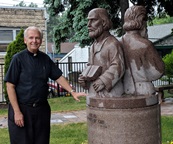
Even though he felt called to the priesthood at a very young age, Fr. Jerry Kopec noted, “I always say my priesthood is a surprise because where God sends me so many unexpected things happen!” He gives a priest at his childhood parish of St. Andrew in Kenmore credit for inspiring his desire for that vocation. “He was such a kind, gentle, soft spoken man.” This led him to think he would like to consider priesthood for himself.
He attended St. Andrew Elementary School but when the time came for high school, he decided to go to Canisius instead of the Diocesan Preparatory High School. Priests, whose opinions he valued, advised him to broaden his horizons. They knew he was interested in the priesthood and wanted him to explore other learning experiences before entering the seminary. He went on to graduate from Canisius College and then pursued a Master’s Degree in Sociology at Catholic University of America in Washington, DC. Never having lost his desire to become a priest, he thereafter entered Christ the King Seminary and was ordained in 1979 by Bishop Edward Head.
Father Jerry’s first assignment was to St. John Kanty Parish on Broadway in Buffalo. He stayed there for two and a half years and then moved on to St. Gregory the Great Parish in Williamsville for another two and a half years. After that Bishop Head asked Fr. Kopec to return to Catholic University to study for a degree in Canon Law. Two years and one Canon Law Degree later, Fr. Jerry returned to Western New York and worked in the Tribunal at the Catholic Center in Buffalo. He spent four and a half years there full time when the bishop unexpectedly assigned him to St. John Kanty as pastor.
While at St. John Kanty he was asked to chair the Commission for Pastoral Reorganization of the East Side. Due to the diminishing number of priests and declining population, there was a need to restructure the church’s presence in East Buffalo. Although it was not an easy task, Fr. Jerry saw the positive side of his work. He felt he learned a lot working with Sr. Regina Murphy, Bishop Grosz and Bishop Head in this experience. He discovered that if you have a process where the people are really engaged, they will come to a decision that they can embrace as their own. Although the engaged parishes were sad to leave their church building behind, they understood the need to change so the Church could move forward.
Father Kopec then returned to the Catholic Center as Priests’ Personnel Coordinator. Along with this responsibility he was asked to co-chair the New Visions Program which was a diocesan-wide process of pastoral re-organization. Once again he embraced the challenge and saw the positive side of the mission. He enjoyed working again with Sr. Regina as well as with Kathy Heffern. Father Jerry recalled, “We traveled to all different parts of the diocese and it was amazing how parishioners would work and be so dedicated to the process. They would come up with great recommendations. I treasure that experience. If you trust in people and give them the opportunity to study and learn, they develop wonderful creative ideas that you might not otherwise discover.”
After three years in that position, Fr. Jerry was assigned as pastor of St. John de LaSalle in Niagara Falls. While he was there he really enjoyed the close knit community in the LaSalle area. In 2005 he was assigned to SS. Peter and Paul Parish in Williamsville where he currently resides.
In the winter Fr. Jerry likes to ski and in the summer he likes to hike. He loves to travel. After his first few years at SS. Peter and Paul, Fr. Kopec took a three month sabbatical to Rome. He traveled every weekend and visited many places including Austria and France. One of the highlights of his European experience was going to Poland where he was able to connect with some of his relatives. He learned that one of his cousins was a close confidant of Lech Walesa. His cousin was at the docks when the strikes occurred and was even imprisoned. When Mr. Walesa became president, Fr. Jerry’s cousin was named chief of staff. Father Jerry recalled, “My cousin had magnificent stories to tell yet he was such a humble man. He had never before told us about the heroic work he was doing.” When they walked through town, people would come up to his cousin, kiss his hands and thank him for all he did for them.
When asked about his favorite part of priesthood, Fr. Kopec replied, “It’s the surprises! You have an image of the priesthood in the seminary and you think that’s the way it’s going to go…boy was I wrong!” He never imagined he would study Canon Law and he added, “Everywhere I’ve been God has really directed me to the unexpected. I so appreciate how I have been opened to experiences I would never have predicted.”
Like many other pastors, Fr. Jerry finds the administrative side of parish work to be challenging. Even with such challenges, Fr. Jerry looks at the bright side exclaiming, “God provides! I have learned so much since ordination from the lay people that I work with.” He added that he feels blessed to be surrounded by dedicated people who work in the school because they believe in the mission of Catholic education. The same goes for pastoral associates and other staff who assist him. He believes, “They are passionate people and I learn so much from them.”
In advising those interested in the priesthood, Fr. Jerry commented, “learn as much as you can. Get a good education. If you have an interest in another field besides religion, you should develop that skill because that’s God’s gift to you and that’s going to be part of your priesthood. Keep an open mind. Don’t be afraid of those experiences that say – ‘That’s not me.’ You’ll be surprised where the Lord leads you.”
JULY 2018 PRIEST OF THE MONTH - REV. MSGR. DAVID LEE
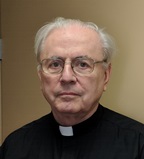
The gifts and talents each priest receives from God are always taken into account when decisions are made about where and how they will serve the diocese. Monsignor David Lee earned a Master’s Degree in English from Buffalo State College before entering the seminary. His love of reading and talent for teaching led him on a path which would accommodate both.
He grew up in Buffalo and attended Canisius High School and Canisius College. After earning a Master’s in English from Buffalo State College, he entered St. John Vianney Major Seminary (now Christ the King) in East Aurora. Ordained to the priesthood in 1968 he was first assigned to St. Brendan Church in Almond, NY. Of that he said, “It was a very nice assignment and I liked it very, very much but I was only there six months when they called me up to teach at the seminary.”
The seminary at which he first taught was the Diocesan Preparatory Seminary on Dodge Street which was a high school geared towards young men who were considering priesthood. There Msgr. Lee taught English and was eventually asked to teach British and American Literature at St. John Vianney Major Seminary as well.
Monsignor Lee then went on to become the chaplain at Erie Community College, North Campus. While he was there he would often put out religious literature at different events. He recalled that one young man, who was raised without religion, began looking over the material. He then asked Msgr. Lee if he could speak with him about the Catholic Faith and over the course of time Msgr. Lee administered the Sacraments to him bringing that young man into the Catholic Church. Over the years, they lost touch until recently when a letter arrived in the mail from the man. He informed Msgr. Lee that he had become a deacon for the Church. It was very edifying to Msgr. Lee that this man would take the time to write and tell him that not only was he still practicing his Catholic Faith but that his Faith was continuing to grow.
While still chaplain at ECC, Msgr. Lee was asked to become Director of Communications for the Diocese as well. He did that for twenty-two years after which he was assigned as pastor of St. Ambrose. He remained there for sixteen years until he retired.
As a pastor, he found the work load was sometimes overwhelming but the joy of saying Mass was, and still is, uplifting and energizing. He believes that presiding at Mass, “is the whole purpose of the day.” One nice thing about retiring from active ministry as a priest is that you have more time to do the things you really enjoy. Monsignor Lee assists his brother priests by saying Mass at different parishes and he loves to spend time reading, especially history.
Monsignor Lee advises those considering priesthood to, "Pray! Pray about it and give it lots of time. Allow it to be lifted up to God in prayer and let that be over a good period of time. Also, talk to a priest whom you admire, whose opinion you value and whose example you admire. Get involved in the parish where you are, in whatever way you can help. This gives you an insight and point of view for what it's all about."
JUNE 2018 PRIEST OF THE MONTH - REV. DENNIS FRONCKOWIAK
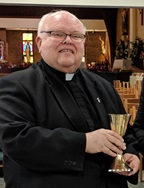
Born the only child of Ann and Frank Fronckowiak, Fr. Dennis grew up on the east side of Buffalo. He was baptized at St. Stanislaus but not long after, his parents moved and they became parishioners of St. Luke Church. There he celebrated all his Sacraments and eventually his first Mass as a priest.
As a young altar server, he felt a call to the priesthood. He made his intentions known concerning his plan to become a priest and visited the Diocesan Preparatory Seminary High School in anticipation of attending. When the time came to declare his high school choice he chose Bishop Fallon. His eighth grade teacher, a Felician Sister, said, “I thought you wanted to become a priest.” To which young Dennis replied, “I do, but I don’t think I want to go to that seminary high school because it will be too difficult.” She sent him to see the parochial vicar at St. Luke’s who convinced him to try the seminary high school. He told him, “If you don’t like it, you can go somewhere else afterword.”
He ended up attending the seminary high school followed by studies at Wadhams Hall Minor Seminary in Ogdensburg. He didn’t care for his experience there and told his father about it when he was home on a break. His father said, “This is going to be your life. You choose what you want to do. You’ve always said you wanted to be a priest so don’t let this school determine who you’re going to be.” He took his father’s advice, finished up in Ogdensburg, continued on to Christ the King Seminary and eventually ordination, earning himself the status of “A lifer.”
Father Dennis was ordained in 1977. He recalled, “It was a rainy Friday night but there was something really special about being in the cathedral with all of the other priests present, especially that moment when you’re kneeling there and they were coming up to you and imposing their hands on you. I think that was the moment I realized that this was real. I was being ordained as a priest!”
His first assignment was to St. Margaret Parish on Hertel Avenue. It was there that he met Norm Paolini. He remarked, “Norm and I have been best friends for some years.” He and Norm took many college age students on pilgrimages to Fatima, Portugal. Norm would play guitar and sing at Mass as well as when they were together in the evenings. Father Dennis recalled that, “It was a special, spiritual time.” Eventually, Norm went on to found St. Luke’s Mission of Mercy at the then closed St. Luke Church where Fr. Dennis grew up. Norm passed away on April 30, 2018 and Fr. Dennis was given the honor of preaching the homily at his funeral.
Father Dennis spent twelve years at St. Margaret’s and then moved to Blessed Sacrament Church in Kenmore. When an opening for a pastor became available at Our Lady of Czestochowa in North Tonawanda, Fr. Dennis applied and was accepted. He was the pastor there for thirteen years and then left in 2010 to become the pastor of St. Timothy Parish in Tonawanda where he currently resides.
When he finds time to relax, Fr. Dennis heads for a condominium he purchased as a home away from home. He likes to travel and recently visited Poland with seminarian Patryk Sobczyk and his family.
The celebration of the Holy Eucharist brings great joy to Fr. Dennis. He exclaimed, “To know that you are bringing Jesus to that holy altar and sharing Him with the people who are present there, I think is the greatest miracle of priesthood.”
One of the greatest challenges Fr. Dennis faces as a priest is attracting young people to be a part of the church community. He sadly notes, “They have so many things they are involved in with their own lives that somehow church becomes the bottom part instead of one of the priorities. It’s hard to convince them that God is to be the center of their lives and with God, the church.”
He believes that those who feel a call to priesthood should look into it. “They shouldn’t just let it go and think it’s not there. They should pursue it. In doing so they are really going to be able to discern if it’s for them.” Father Dennis is very glad he listened to the priest who told him to try the seminary high school and his father who told him to stick to it when the going got tough. “Here I am today 41 years later! It’s hard to believe the time has passed so quickly.”
MAY 2018 PRIEST OF THE MONTH - REV. LUKASZ KOPALA
Reflecting on a key moment in his life, Fr. Lukasz recalled, “My First Holy Communion Day affected me very deeply. I strongly felt the presence of Jesus and asked him to accompany me throughout my life, no matter what happened.” Although sometimes he felt closer to Jesus than at other times, he believes Jesus granted his request and has been with him through both good and difficult times.
He grew up in the small town of Ropczyce, Poland with his parents and two brothers. He walked to school, which was five minutes from his house, each day. Although it was a public school, the Catholic Faith was taught by a priest. Poland is a very Catholic country which is reflected in its culture. Young Lukasz was raised in a multigenerational home which included his grandmother who herself was raised in a home with her grandparents, parents and siblings. He explained, “Each generation brought up their family with the cultural values and traditions that were passed on to them.” They spent a lot of time in the kitchen which was considered the heart of their home. Meals were prepared and shared together and prayer was a big part of their lives. Tradition is important in his family. Father Lukasz recalled, “When we sat down to Christmas dinner we set the table with one extra place setting because tradition tells us we need to be ready if someone who is poor should knock on our door. My job was to set the table.” His faith was influenced heavily by his mother and grandmother who passed along many of their Catholic beliefs and traditions. He recalled his father providing the biggest lesson of prayer when he would walk into the boys’ bedroom each night after work. “He knelt before the image of the Lord Jesus carrying the cross. My father would be kneeling and whispering. I did not know what he was saying, but remembered that he did not go to sleep until he said something to God.”
Father Lukasz was first an altar server and later a lector at Mass. He has many wonderful memories of those experiences of serving. As he grew into his teenage years, he went to church out of habit but found that he spent the time thinking about everything but the Mass. He recalls that one of the most difficult times for him was when his father died suddenly just after arriving home from work at the age of 54. Father Lukasz was 26 years old at the time. His father’s death led him to question the meaning of life. He also wondered how his mother would cope now that his dad was gone. He concluded, “The experience I went through following my father’s death gave me a better understanding of those afflicted. It taught me a life of compassion and wisdom.”
Several years later he attended a retreat in Krakow. It changed his life forever. He recalled, “I felt a significant improvement in my life. God is now the most important thing for me, and He directs my life.” His first memories of becoming a priest were in elementary school as an altar server. “I pictured myself on the altar celebrating Mass.” He considered the priesthood in college and found himself praying often to know God’s will for him. He was concerned about pursuing that vocation for fear that it might not be the right thing for him. After much prayer, he decided to enter the seminary in Poland. He also considered the option of serving God somewhere other than Poland. “After I finished my theological studies in Poland at the University of Blessed John Paul II and knowing that the United States currently has very few priests, I decided to come here to serve as a priest.” He began at Orchard Lake Seminary in Michigan where many men from Poland study, but found that it was difficult to learn English because everyone spoke to each other in Polish outside of classes. He decided to enter Christ the King Seminary in East Aurora in order to immerse himself in the English language and American culture.
Father Lukasz was ordained to the priesthood in 2015 and is currently serving at his first assignment, St. John Vianney Parish in Orchard Park. He enjoys celebrating the Eucharist for people every day and believes that one of the most important and touching ministries for him is the ministry of the sick. When reflecting on the Sacrament of the Sick, Fr. Lukasz said, “It’s important to visit people, anoint them, give them hope and show them that they are not alone. People at the end of their lives truly appreciate that someone like me, who wants to be with them, is there. It’s a great opportunity to bring Christ to their lives.” Coming from a very devoted family and culture where generations of people live together, he finds it difficult to understand how some people die alone.
He also enjoys being involved in the parish school and finds that there is no end to the opportunities available to him. “If I, as a priest, want to be busy and doing things, I will always find millions of opportunities to work. If you truly want to dedicate your life for Christ and for His people, you will find many ways to do it.” Sometimes he is so busy with daily activities he feels his prayer life suffers. “There are so many things going on and everyone wants a piece of you and you cannot be everywhere. I always wish to have more time to pray. I was ordained to be with people and help them but also to take care of my own spiritual life. If my spiritual life is not strong, it will be more difficult to help others with their spiritual lives.”
When he has some free time, Fr. Lukasz likes relaxing with a chair, a book and a cup of coffee near the lake in the warmer months. He also enjoys exercising outdoors if the weather is nice or indoors at the YMCA if the weather is not cooperative. Listening to classical music at the philharmonic, spending time with friends, watching movies or going out to dinner are also relaxing and enjoyable activities for him. Seeing as his family is so far away in Poland, he likes to connect with them on Skype whenever possible.
He advises seminarians and anyone who may be thinking of a vocation to priesthood it is worth all the work you will have to do to get there. “As a priest, I tell seminarians this is truly, truly joy! God is preparing you for something different, something better. Sometimes we have to suffer a little bit. God tells us it is not going to be easy to follow Him. Even though there are challenges at the parish, every evening I realize that I am in the right place. I can’t see myself doing anything else.”
APRIL 2018 PRIEST OF THE MONTH - REV. COLE WEBSTER
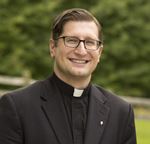
Pope St. John Paul II was famous for quoting the phrase Jesus used often, “Be not afraid,” in many of his writings. Fr. Cole Webster found that quote very inspiring in his life. Those words helped him find the courage to pursue his dreams.
Cole Webster was born the only child of parents who left their Catholic upbringing to worship in protestant denominations. He was raised in Amherst and attended private Christian School. While in school he found lots of friends and became involved in youth groups, etc. His upbringing instilled in him a love of Jesus Christ. He would spend Christmas, Easter, weddings and funerals with his extended family of grandparents, aunts and uncles in the Catholic Church. It was those experiences of Catholicism that appealed to his sense of worship.
As he grew older, he started learning about his Polish heritage. Father Cole related, “I’m a big history buff. For Poles, church and everyday life is so linked. All of its traditions are Catholic traditions that you bring in the home and participate in.” He began asking lots of questions and after learning more about the Catholic Faith he recalled, “I felt that was where my heart was calling me. I loved the universality of the Church and the liturgy which was more of a formal ritual than what I was used to at the protestant churches.” He reasoned that the Catholic Church has been around from the time of Jesus and the apostles for about 2000 years whereas the oldest protestant denominations could only claim to have been in existence for the past 500 years or so. He felt, “If I’m going to really put my faith in something, I think the people who have been doing it the longest probably have the most wisdom.” At the age of 18 years old, Cole entered the RCIA at St. Christopher Parish in Tonawanda and joined the Catholic Church.
He graduated from Buffalo State College with a degree in Hospitality and Tourism. He worked at the former Holiday Inn on Niagara Falls Blvd. which has since been demolished, for six years. After that he spent another year and a half at the Holiday Inn Express near the Buffalo Airport as the guest service manager. Father Cole described feeling called to the priesthood even before he became Catholic. When he would attend Mass with relatives as a young person, he was impressed by so much of what went on. He noted, “Following a ritual along with the universal church as well as the reverence all throughout with kneeling, crossing yourself before the Gospel, and other body language was something awe inspiring to me that I could picture myself doing. I was always in awe of priests even when I was a kid.”
He had goals set to finish college, build his resume and become a department head in the hotel industry. All the while, the thought of becoming a priest was in the back of his mind. Within a few years, all his goals had been reached. He recalled, “God’s funny because that all happened much quicker than I thought it would. So I had to say, ‘OK God, you got me!’ When the time is right, the time is right.” After contacting the vocation director and spending a lot of time in prayer before the Blessed Sacrament, he considered, “If not me, then who? God’s not knocking on everyone’s door. If he did, the seminary would be full. I’m feeling this tugging and if I say no and others who may be called say no, who is left?” After giving notice that he intended to leave his job in a month, he found out that his former hotel property had been sold and his “work family” would be disbanded. This made it a little easier to leave. Then his computer crashed and everything was lost. He knew this was a sign from God to move forward with plans to look into the seminary. “God talks to you in ways that you will understand.” Father Cole believed God was reinforcing his decision to join the seminary by clearing a pathway for him. He knew of people who felt called to the priesthood but went in another direction. They love their family but always had it in the back of their minds wondering what the priesthood would have been like. He said, “I thought I was young enough to say, if the priesthood doesn’t work out, there are always going to be hotels.”
“One day at a time!” That was his moto after starting at Christ the King Seminary in 2010. It was overwhelming to think he would be there for seven years. One day at a time, one semester at a time, and before he knew it, seven years brought him to June 3, 2017 and his ordination to the priesthood. He was assigned to SS. Peter and Paul Parish in Hamburg where he currently serves.
Father Cole loves to read, ski, rollerblade and ride his bike. He has a house in Buffalo and enjoys visiting Delaware Park when he has time off. His friends are also very important to him and he likes to join them for dinner, the movies and attending the Buffalo Philharmonic Orchestra.
He feels that as a priest he is right where God wants him to be and that makes Fr. Cole very happy. He loves meeting new people and getting involved in a variety of areas of the parish. He said, “I love my Faith and I want other people to have a similar love.” He believes he is in a unique position as a priest to share the beauty of the Catholic Faith with others through the Sacraments, sharing in discussions and teaching.
With a parish the size of SS. Peter and Paul where the pastor and other parochial vicar have been there for six years, the staff even longer and parishioners even longer than that, Fr. Cole finds himself searching for where needs may exist. He asks, “What are we not doing that we could be doing? Who do you tap into? How do you get to know other parishioners who may not be active to try to get them involved?” He feels that being the new guy trying to break in and maybe create something different or new can be challenging.
Father Cole advises those considering priesthood to… Be not afraid! He believes, “Our Lord is there with you, he walks right next to you. Put your trust in that relationship. If your heart is tugging you toward priesthood take it one day at a time.” He also points out that those who enter the seminary are not signing up right then and there for priesthood. They have time to discern if the call is growing within or if it’s something that’s not really for them. They may end up discerning that God is calling them elsewhere. He recommends, “If it’s something you feel strongly about exploring, continue to explore it.”
MARCH 2018 PRIEST OF THE MONTH - REV. JAMES CROGLIO
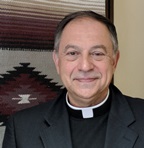
Men who feel called to become priests have gifts and talents that God wishes for them to use in their ministry. Sometimes these gifts and talents are easy to spot and develop and other times they are more difficult to identify. After his ordination as a transitional deacon, Fr. Jim Croglio didn’t feel quite ready to enter into the priesthood. He spent a few years developing his gift for counseling which ended up serving him and our Buffalo Diocese very well.
“My parents tell me that I always told them, even when I was in kindergarten, that I wanted to be a priest.” recalled Fr. Jim. He grew up in a very faith-filled Catholic home on the Westside of Buffalo. They were very involved at Holy Angels Parish. When he, his parents, two brothers and two sisters moved to Cheektowaga, the family joined St. Aloysius Gonzaga Parish where young Jim attended elementary school. He noted that his sixth grade teacher, Sr. Mary Glose, SSJ is still living at the Sisters of St. Joseph Motherhouse in Clarence.
He entered the Diocesan Preparatory Seminary High School bound for the priesthood. After that it was on to St. John Vianney Major Seminary which, while he was there, transitioned to become Christ the King Seminary in East Aurora. After his ordination to the diaconate, he felt he was not ready to continue on the path to priesthood. Deacon Jim spent six months at Mount Saviour Monastery near Elmira, NY. “While I was there I still wanted to become a priest but also wanted to go back to school.”
From there, he went to SUNY Plattsburgh and earned a Master’s Degree in Counseling. Father Jim recalled, “I spent two years there and it was a great experience. It solidified my desire and decision to become a priest.” While at Plattsburgh he served as a Residence Hall Director which he thoroughly enjoyed. He also spent time as a marriage counselor on an air base as part of his field education experience.
He returned to the Buffalo area in 1979 and spent another year as a deacon at St. Vincent de Paul Church in Derby, NY. Father Jim was ordained to the priesthood at his home parish in 1980. He spent six years as a parochial vicar at St. James Church in Jamestown, NY and two years at Infant of Prague in Cheektowaga.
In 1988 Fr. Jim was assigned to the Diocesan Counseling Center for Church Ministries. The center has been open since 1974 and was staffed by sisters and lay people. It is funded by the diocese and by Catholic Charities and is part of the Msgr. Carr Institute. Father Jim was a perfect fit given his educational background. He was happy to be able to put his gifts and talents to use in this way. That September, while working at the counseling center, he went back to school once again. After two years he earned a Master’s of Social Work Degree from the University of Buffalo.
Along with his appointment to the Diocesan Counseling Center in 1988, Fr. Jim was also assigned as Chaplain at St. Joseph Collegiate Institute High School and for the Christian Brothers. He still serves at those positions as well as being named Vicar for Priests.
Father Jim has a large extended family with many nieces, nephews and cousins. He enjoys spending time with them around the holidays and at family events. He is blessed to still have his mother at 96 years old. He also likes to spend time with other priests golfing in the summer and practicing his swing at a golf dome in the winter. Father Jim and his friends are part of a book club. He explained, “I feel it’s important to continue reading and educating ourselves. It’s a big part of my life.” They try to get together about once every two months as their schedules permit.
Father Jim expressed, “My priesthood, (for the past 30 years), has been centered on the healing ministry that we at the Counseling Center do. Working with priests, sisters and lay people at the Counseling Center has been my work and it has been great work.” He also enjoys helping out his brother priests when they need him by saying Mass in different parishes on the weekends.
While he finds priesthood to be a wonderful vocation, Fr. Jim also recognizes that, as in any vocation or occupation, the biggest challenge is making sure that it doesn’t become stale. He believes that a big part of that is prayer. Another big part is making sure that you have good relationships with God’s people so that the work you are called to do is the work of the Church and of God. It is not good to be too isolated or alone. He added, “Make God’s people part of the work you do.”
Father Jim believes, “If anybody wants to be challenged and be part of an institution that goes back millennia and is filled with God’s love and God’s people, that person couldn’t choose anything better than priesthood. It has its demands but the core is following Jesus and being a part of the ministry He began.”
FEBRUARY 2018 PRIEST OF THE MONTH - REV. ROBERT GEBHARD
 He almost had his Ph.D. He was so close and yet God had other plans for Robert Gebhard. Father Bob explained, “I took a leap of faith, as they say, and entered the seminary and it was a whole different world.”
Young Bob Gebhard was born in Buffalo and baptized at St. Ann Church on Broadway. By the time he was in third grade, his family had moved to West Seneca and he finished out his elementary school years at Fourteen Holy Helpers Parish School. He went on to graduate from St. Mary High School in Lancaster and entered into the Biology program at Canisius College. He graduated with a BA in Biology and started working on a PhD at the University of Buffalo in Natural Sciences.
Thoughts of the priesthood hadn’t even occurred to him until he met Fr. Lary Werner at his home parish of Fourteen Holy Helpers during his college years. As Fr. Bob recalls, “He was just a little older than me and we became good friends. I saw a side of priesthood I never saw before that was attractive to me and so that’s what led me there. When I was in the Doctoral Program it became one of the most difficult times of my life because I began to think about priesthood. Everything on the surface looked perfect; coming towards the end, looking at job security, house, white picket fence, dog in the yard, wife and children…but there was just something that was very unsettling inside of me and I just struggled with that for a long time.”
So he took a leave of absence from the program and decided to give Christ the King Seminary a try. He continued to do research while starting the program at CKS, testing the waters on both ends and the testing resulted in favor of priesthood.
Father Bob was ordained July 3, 1987 at St. Amelia Parish in Tonawanda where he had been assigned as a Deacon. At that time, men were ordained either in their home parish or the parish of their diaconate. Father Bob recalls, “St. Amelia was the perfect place for anybody to start. There were lots of young families, lots of young kids, lots of activity and outstanding clergy role models.”
After ordination his first assignment was to St. Philip the Apostle in Cheektowaga which was very close to where he grew up. After about three years, he was reassigned for a few years to the Newman Center and then to St. Mary in Swormville. Father Bob’s first pastorate was at St. James Parish on Bailey and Kensington where he ministered for almost 15 years. He then spent a few months helping out at the unusual location of the island of St. John next to St. Thomas in the Caribbean because they hadn’t had a resident pastor there for a few years. After he returned, he was asked to go to Christ the King Seminary to help with the formation of seminarians for priesthood. In May of 2012 Fr. Bob began his current assignment as pastor of St. John Vianney Parish in Orchard Park.
“My hobbies are the outdoors. I love to camp and hike. I used to do backpacking and now occasionally do some day hiking.” Father Bob owns a cabin in the Southern Tier near Allegany State Park. He exclaimed, “That’s my salvation. We’re off the grid so there’s no TV, stereo, internet, etc. I do have my cell phone if there is an emergency.”
Administration is a challenging part of priesthood for Fr. Bob. He said, “It’s overwhelming and gets more and more complex all the time.” He knows retired priests who are happy to be able to return to ministry without all the worries of being in charge of a parish.
He views the diversity of ministry to be the best part of priesthood. He explained, “It’s not the same routine day in and day out. There are just so many different opportunities to meet God; going to the hospital, nursing facility, meeting people in their homes or going to a night meeting. When I’m having a bad day I just go down to the school – the children are absolutely incredible!” He also enjoys preaching on the weekends and finds it to be, “a real blessing.”
In advising someone who is interested in becoming a diocesan priest, Fr. Bob suggests, “Be open and recognize that this priesthood has a lot of guys who come with a lot of different experiences and backgrounds. Find your niche. There’s room for everybody in priesthood in the Diocese of Buffalo.” Father Bob added a great perspective on the formation program that seminarians are required to undertake. He explained, “When you’re going through the formation program it’s something that everyone seems to hate but, in hindsight, what a wonderful opportunity. Nobody gets the chance to examine their life like guys who go through the seminary or women who go through vocational training. That whole discernment in life and the ability to look at yourself in a raw kind of way, to have people there to help you through it and to be able to treasure coming to know yourself in a very honest way is, I think, a gift.”
Even if the discernment process leads a man to understand that God is not calling him to the priesthood, the gift of self-understanding remains.
JANUARY 2018 PRIEST OF THE MONTH - REV. DAWID KRZESZOWSKI
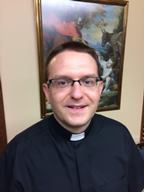
Saints can often be very influential in the lives of those who know them. Their example often reaches far and wide. Fortunately for him, Fr. Dawid didn’t have to go very far to experience the influence of one of the greatest saints of our modern times. Born in 1981 in Gorlice, Poland, he grew up about 100 miles east of the city of Wadowice, the birth place of Pope St. John Paul II. Gorlice is also located about 80 miles northeast of Krakow where St. John Paul II (then Fr. Karol Wojtyla) carried out his ministry as a priest, bishop and cardinal. His only other sibling, a brother, is also a Catholic priest residing in Poland. Father Dawid remarked, “I consider it a blessing to have lived in the part of Poland which was so dear to our Holy Father. When we were kids, my brother and I loved to cantor and serve Mass.” These activities made his parents, Adam and Maria, very proud.
He attended public elementary school in Gorlice which like all public schools in Poland, was Catholic. That included four years of music school. He recalls, “After school I liked to spend my free time playing soccer, basketball and baseball with friends. Sometimes I would help my parents with chores on our small rural property.” He went on to secondary school where he studied Economics and Finance for four more years. His vocation began at an early age. “From the time that I started serving Mass at the age of 9, I loved being in the sanctuary and close to the altar. Serving Mass was an adventure.” When he was 19, he decided to enter the seminary. He added, “My parish priests were a good example for me. They helped me make this very important decision in my life.”
Seminary life was very fulfilling. Father Dawid commented, “In addition to the intellectual and mental demands of the classroom, the seminarians in Poland must also perform physical and manual tasks: tending the seminary gardens, cleaning the seminary halls, gathering agricultural produce offered by farmers in the area.” He believes that, “It made us feel useful and complemented our intellectual work.” Father Dawid completed his seminary studies and graduated from the Pontifical School of Theology, University of Krakow. At the age of 25 he was ordained to serve in his home diocese of Rzeszow.
His decision to come to the Buffalo area was influenced by the fact that he had several relatives, including priests, on both his mother’s and his father’s side of the family, who had lived in the United States for many years. His uncle, John E. Joniec, was a World War II veteran who was serving in Oahu, Hawaii when Pearl Harbor was attacked. He visited Fr. Dawid’s family in Poland several times and recently passed away on February 4, 2015. His Uncle John’s family still lives in suburban Philadelphia. In 2007 Fr. Dawid visited his friend, Fr. Benedykt Pazdan in Chicago. He recalled, “We visited Niagara Falls but I never thought I would be living in Western New York.” He started serving as a priest in the Diocese of Buffalo on August 27, 2012 and is very grateful to Bishop Malone, Bishop Kmiec, Msgr. Paul Litwin and Fr. Jozef Dudzik, who made this possible for him.
His first assignment was to Nativity of Our Lord in Orchard Park. He had a lot of help from parishioners who volunteered to work with him on his English language skills. He said, “They were, for me, more than just teachers. They were like mothers and fathers to me. They treated me like their son. Because of this I used to say, ‘I have only one mother and father in Poland, but in the U.S. I have many American moms and dads.’” In 2013 Fr. Dawid was assigned to serve at St. John the Baptist Parish in Kenmore where he currently resides. He commented that, “The pastor, Fr. Michael Parker, is known for his great kindness toward priests from various parts of the world. The rectory at St. John’s is often called ‘The International Rectory’ because it hosted priests from Poland, Ghana and Mexico. The parishioners are very devoted to the parish. They are very friendly and kind to me. They are also very patient with me because they know I’m still learning English.”
In 2014 Fr. Dawid entered the Intensive English Program at the English Language Institute of the University of Buffalo in order to improve his English. He studied with students from many other countries and at this time he considers the most challenging part of the priesthood to be mastering the English language.
Father Dawid enjoys, “hearing confessions and reconciling people with our merciful Father.” He added, “As a priest I am happy to be able to give Jesus to many people.” This is certainly true in many ways as Jesus comes to us through the sacraments. He also said, “I love visiting my friends and seeing new interesting places with them on my day off.” He is also able to keep in touch with friends and relatives back in Poland through Skype and Facebook.
When Fr. Dawid was ordained, he chose a priest’s motto taken from the Gospel of St. John 8:32; “You will know the truth, and the truth will set you free.” He added, “I strongly believe that my faith is able to grow as long as I live in the truth before Jesus and myself. If somebody is interested in becoming a priest, he should develop his faith by living in the truth which can be attained by daily prayer, the Word of God, and the sacraments, especially the sacrament of Reconciliation.”
DECEMBER 2017 PRIEST OF THE MONTH - REV. JOHN KWIECIEN
“I always liked history and had a special interest in the Civil War.”, remarked Fr. John. You would think weekends are busy enough for priests but he finds time to reenact Civil War events during the summers. He noted that, “Thirty years ago I started visiting Civil War sites and just kind of got into it.”
His history began in Buffalo. He then moved to Tonawanda where he, his sister and two brothers grew up. John attended All Saints and Blessed Sacrament elementary schools in Kenmore. He was an altar server and had good relationships with the priests whom he encountered. When he was in the eighth grade he recalled that a vocations presentation was given and he thought, “Why not?” From there he entered the Diocesan Prep Seminary which was on Dodge Street but is now closed. Then it was on to St. John Vianney Seminary (now Christ the King) and he was ordained to the priesthood in 1976. He is considered a “Lifer,” the term used to describe men who went directly into studies for the priesthood after elementary school.
He was assigned to St. Joseph Parish in Gowanda and Annunciation Parish on the West Side as a young parochial vicar. He then taught Religion and European Cultures for a year at Archbishop Walsh High School. For about three years, he spent time looking into the possibility of becoming an order priest with the Glenmary Home Missions. After living and working with them in rural areas of Georgia, Oklahoma, Tennessee, Kentucky and North Carolina, Fr. John decided not to leave diocesan priesthood. He recalled, “They wanted me to get a taste of the missions and, if at the end of three years I liked them and they liked me, I would have stayed with them. It was a great three years and I still have some friends in Glenmary parishes but we have rural here.”
He went on to serve at St. Ambrose in South Buffalo and St. Paul in Kenmore before being assigned as pastor of three parishes; St. Joan of Arc in Perrysburg, St. John Fisher in South Dayton and St. Louis in Cherry Creek. At least those three were located relatively close together. Compared to his time spent with the Glenmary Missions where he would have three parishes in two or three different counties, he remarked, “Traveling and managing that number of parishes was nothing new to me.” After 12 years as pastor of those three parishes, he spent six years as pastor of St. Aloysius in Springville. He then spent four months studying at the Vatican II Institute outside of San Francisco and returned to spend five years as pastor of Holy Spirit Parish in North Collins. Seven years ago he was assigned as pastor of Most Precious Blood Parish in Angola where he currently resides. Most of his time has been spent in rural settings and he is just fine with that.
Father John is part-time chaplain at Collins Correctional Facility and he has been chaplain during the summer for Camp Turner. He proudly stated, “I have been working at Camp Turner for over 50 years. I started when I was in the seminary and continued straight through.”
Father John enjoys singing, playing his 1850s guitar and reproduction banjo. He uses his musical skills when participating in reenactments of the Civil War. Recently in Cedar Creek, VA for the 153rd anniversary of that battle, he has also been to Gettysburg, PA, Mumford, OH and many other places, including schools, in his Civil War attire. Luckily for him, he has a few retired priests in the parish who are more than happy to help out with weekend Masses when he’s gone. He attends national events of Civil War reenactments as chaplain for a large group called the United States Volunteers. He commented, “It’s another parish as far as I’m concerned.” With no school at his parish, he looks forward to the fall when things slow down a bit. He said, “Most people think summer time is our time to relax. That is one of the busiest for me!”
Father John relates that, “Just being out there for the people, being there when they have a need,” is an important part of priesthood for him. He continued, “Sometimes your response is just being there because you represent God’s presence. You might not have anything to say, they may not want to hear anything but just being there, it means something.” He believes that someone considering becoming a priest should, “Know your heart. Make sure this is what you want. Like anything there are good and very rewarding parts, there are also challenges to the vocation. Sometimes being on call is a challenge as well as realizing your own limitations. We want to be able to help everyone and you can’t.” Like any commitment in life, Fr. John advises, “Hang in there. Seminary can be challenging.”
It’s nice to know that the gifts and talents God has given to men, as well as the things they have taken an interest in, can still be pursued and enjoyed while living out their vocations as priests.
OCTOBER/NOVEMBER 2017 PRIEST OF THE MONTH - REV. CHARLES SLISZ
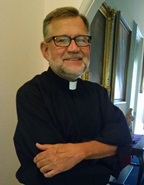 Recalling his earliest thoughts of becoming a priest, Fr Chuck Slisz remembers at the age of five years old, “sitting in a little chair all by myself and saying, ‘God, could I be a priest when I grow up?’ I saw priests at church but didn’t know anything about how that happens.” Whenever people asked what he wanted to be when he grew up he would respond – a priest. It was always there in the back of his mind.
He was the only one of his siblings to be born in a hospital. When he came into the world his oldest brother was 18 years old, his next brother was 15 and his sister was 10. He attended St. Mary Magdalene Parish Elementary School and made his First Holy Communion and Confirmation there as well. A member of the first class to go through Bishop Turner High School, he graduated in 1963. Young Chuck enjoyed high school. He had lots of friends, went to dances and had a steady girlfriend. Accepted at three colleges he planned to get a degree in History, graduate, get married and teach history. He recalled sitting at a desk at home doing homework during his senior year and hearing a voice in his head say, “I thought you wanted to be a priest.” Fr. Chuck recalled, “It just wouldn’t let go! I couldn’t eat. I couldn’t sleep. I was a mess!” So he went to see the guidance counselor at Turner High School who happened to be a diocesan priest. He set young Chuck up for the Diocesan Seminary entrance exam and the rest, as they say, is history!
Ordained in 1971, Fr. Chuck said his first Mass on the anniversary of his First Communion at his home parish, St. Mary Magdalene. His began his priestly ministry at Holy Spirit in North Buffalo. From there he was assigned to St. Amelia Parish in Tonawanda, St. Vincent de Paul in North Evans, Immaculate Conception in East Aurora and SS. Peter and Paul in Hamburg. He was then assigned as pastor for the first time to St. Mary and St. Mark in Holley and Kendall. He was there for 8 or 9 years and then moved on to become pastor of St. Josaphat in Cheektowaga for 6 years, St. Andrew in Kenmore for 8 years and St. Christopher in Tonawanda for 9 years. Fr. Slisz retired two years ago from St. Christopher and then “un-retired”, as he put it, this past July to become Rector of St. Joseph Cathedral in Buffalo where he currently resides. He shared, “For retired priests there are always places to go. Priests need help all the time. I’d be gone all over the place. Saved a lot of gas since I’ve been here!”
Father Chuck enjoys the theater. He and his friend, Fr. Jim O’Connor, attend shows in Stratford, New York City and the Kavinoky Theatre in Buffalo, to name just a few. When St. Christopher and St. Edmond Parishes merged they wondered what they would do with the worship space at St. Edmond. A group came along and asked if they could rent the space. It became the Ellicott Creek Play House and Fr. Chuck has had the opportunity to do some acting there as well.
Some of the best moments of priesthood occur, in Fr. Chuck’s opinion, “whenever you’re able to facilitate someone’s reconnection with or new awareness of God in their lives. You get a call to a hospital emergency room, you may have no idea who they are but they let you come in and share this most intimate moment.” Preaching is also something he enjoys very much.
The priesthood has its difficult moments as well such as, “dealing with expectations and demands of people that are often times quite unrealistic. I don’t like conflict so when there are staff conflicts, when you have to confront someone with something or, God forbid, fire somebody, that’s the kind of stuff that is really tough.”
For men considering priesthood, Fr. Chuck recommends…Pray! “Pray real hard! Get together with a priest you know to get a sense of what he does in the course of the day.” Fr. Chuck believes it is sometimes possible to have a kind of idealistic view of priesthood that might not be quite accurate and spending time with a priest could clear up any misconceptions.
As far as his priesthood is concerned, Fr. Chuck exclaimed, “I love it! I never regretted it a day in my life. It’s a joy dealing with people. I praise God for the grace he has given me to be understanding and compassionate, to meet people where they are and not place any unrealistic expectations on anyone.” To quote an old Jimmy Stewart movie, “It’s a wonderful life!”
SEPTEMBER 2017 PRIEST OF THE MONTH - REV. MSGR. SALVATORE MANGANELLO
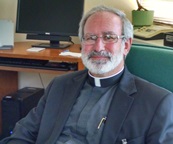
Having been told in the seminary to focus on being a parish priest, Fr. Sal Manganello has had that experience plus a whole lot more.
Young Salvatore Manganello grew up in Cheektowaga with a twin brother and two sisters. He attended Infant of Prague Elementary School and then entered the Diocesan Preparatory Seminary. After graduating from there he went to Wadhams Hall Seminary College and then the North American College in Rome. His earliest thoughts of becoming a priest began in elementary school. He was curious about the prospect and found a card in church with information. He filled it out and sent it in. His parents didn’t know about it until they saw the correspondence in their mail box. Father Sal recalled, “My parents encouraged me and all my siblings in whatever we were doing. They didn’t single anyone out for what they were interested in. They let me follow my own decision and whatever I decided was going to be fine with them.”
Father Sal was ordained by Bishop Head in St. Joseph Cathedral on September 17, 1982. After ordination he returned to Rome to finish school for the first year of his priesthood. Upon returning to the Diocese of Buffalo he was assigned as parochial vicar to St. Paul Church in Kenmore. He then spent some time as a parochial vicar at St. Joseph Parish in Niagara Falls.
That was the end of being a parish priest for a while. Father Sal then returned to school in Rome to study Canon Law. He worked at the Tribunal in the Catholic Center in Buffalo during the summers when school was not in session. Returning from Rome he was assigned as a judge and defender of the bond for the Tribunal. About a year and a half later he was appointed the Judicial Vicar for the Diocese. During this time he was also in residence and assisted at Blessed Sacrament Parish in Buffalo.
Father Sal still practices Canon Law for the Diocese of Buffalo some 26 years later. For the past 13 years he has also been the pastor of St. Louis Church across the street from the Catholic Center. He enjoys being a part of the lives of his parishioners as well as the people he works with. He said, “It’s a different sort of experience every day depending on what’s happening in people’s lives.”
The administration end of being a pastor is challenging. It isn’t something you are taught in the seminary. He shared that, “Every time you turn around something has to be done and you’re always the one who has to answer the questions. You have to approve everything and that can be very challenging at times. Most priests have to deal with being the plant manager, business manager, maintenance man, janitor, construction manager, etc.”
When he gets some free time, Fr. Sal enjoys gardening, running, walking, bike riding and reading; all things that help him to relax and work off some of the stress of the day.
He would encourage those considering priesthood to keep going even when things seem difficult and to enjoy the process. He added, “When you’re in the seminary it’s a lot of work and studying but you have to remember to enjoy what you’re doing. If you don’t, you won’t be very effective. As a priest, one day you’re helping someone deal with the loss of a family member, the next, you are celebrating a joyful moment in their lives. You never know what each day will bring.” He advises that if you enter into every situation with the heart of a parish priest, you will be able to deal with everything through the grace of God. In conclusion, he stated, “I consider myself to be blessed and fortunate.”
AUGUST 2017 PRIEST OF THE MONTH - REV. DANIEL SERBICKI
Sometimes God uses seemingly inconsequential moments to call our attention to the big picture he has in mind for us. For Fr. Dan Serbicki, it was the look on the priest’s face as he was washing the vessels after distributing Holy Communion during a Mass that caught his attention.
The oldest of five children, young Dan was born in Greece, NY, a suburb of Rochester. His parents both worked for Kodak but after the children came along, his mother stayed home to raise them full time. The Serbicki family moved to Holley, NY when Dan was six years old which also moved them from the Diocese of Rochester to the Diocese of Buffalo. In addition to raising their children full time, Dan’s mother also home schooled them through high school. Father Dan recalled his earliest thoughts of becoming a priest occurred one day at Mass. “After Fr. Frank Skupien distributed Holy Communion he was standing at the altar, ‘doing the dishes’ (purifying the vessels). What caught my attention was this little smile he had. I was probably around junior high school age at the time. Something about that smile just clicked for me – that he just shared something so beautiful with everyone. He had connected everyone with Christ at that moment and it was clear that he loved what he did. So it started with Mass but strangely at a time (doing the dishes after the meal) when you would least expect!”
Young Dan had enjoyed many a youth conference at Franciscan University in Steubenville, Ohio. He considers that a big part of his religious experience growing up; so much so, that he decided to go there for college. By this time he had discerned that God was calling him to the priesthood. He entered into a Pre-Theology program which was a sub section of the university geared towards those interested in priesthood. He believes, “It was a way for me to take college classes while praying with a community of people who were thinking about priesthood. It was a wonderful, supportive experience.” As part of his college experience, Dan got to spend a semester in Austria. While abroad he visited Rome and Assisi in Italy. He prayed a lot about what path God wanted him to follow in his priesthood. Was he called to become a diocesan priest or to join an order? The life of St. Francis of Assisi was always very attractive to him. Most people are impressed by his life of poverty and concern for the poor but Fr. Dan exclaimed, “I saw in him someone of great boldness who took the gospel and his love of God very seriously and was willing to do even crazy things or look crazy (like trying to stop a crusade by converting the Muslim leader to Christianity, etc.) because he believed this was what God was asking him to do. Young Dan even took Francis as his Confirmation name and when he visited Assisi he thought for sure God would reveal to him which path of priesthood he should choose. But Assisi was empty in the sense that he did not have a spiritual experience that lead him to believe God was calling him to become a Franciscan and so he pursued diocesan priesthood.
He struggled to see himself as a future priest because he was shy and he thought he might not be effective at such a public ministry. He thought to himself, “Okay, God, I’m not really sure I can do this but I trust that you know what you’re doing.” After undergraduate school, Dan spent the next five years at Christ the King Seminary in East Aurora. He was ordained at the age of 26 and considers himself a modern day “Lifer” like the priests who attended the Diocesan Preparatory High School and went right into the seminary after. His first assignment was to Queen of Heaven Parish in West Seneca where he spent three years as a parochial vicar. He was then assigned for another three years to South Eastern Allegany County with Fr. Sean DiMaria who is the pastor of seven worship sites including Alfred, Andover, Almond, Bolivar, Belmont, Wellsville and an oratory in Scio. Father Dan was recently named pastor of St. Maximilian Kolbe Parish in Corfu, NY.
He enjoys fixing things like computers as well as construction and home repair. When he was home schooled he spent time helping teach his younger siblings. He remarked, “I think that’s something that has helped me a bit in ministry, those experiences of sharing knowledge, teaching and encouraging when I was growing up.” Fixing computers and home repair work have helped him cultivate patience. His parents have an old farm house so there has been plenty of opportunity to become proficient in repair skills. He learned a lot from working with his father on these projects and finds these skills very useful now that he is a pastor. Both patience and the ability to fix things come in handy for a priest in charge of a parish.
Father Dan also enjoys board gaming with friends. He played a lot of board games with his family growing up and finds that while playing there is also time to have conversations which lead to great bonding experiences. His father also instilled in him a love of the outdoors. Father Dan recalled that his dad was always saying, “Let’s go for a hike! Let’s go for a bike ride…” Every year his family travels to the Adirondacks over the Independence Day weekend for a family reunion with extended relatives. They stay in cottages, tents, and enjoy the great outdoors as well as each other’s company.
There are two aspects of priesthood that Fr. Dan enjoys the most. He noted, “The first is obviously the Mass – to stand there at that altar and hold the one you love in your hands is incredible!” The second is actually the Sacrament of Confession. He explains, “There is an anxiety about going to Confession that we all share but being on the other side of it, you’re not seeing people at their worst (they think that’s the way the priest sees them, their burdens, struggles, etc.) The experience of the priest on the other side of it is usually the opposite. I see people who are moved by grace to face the struggles they’ve been having and who have found the courage to go to Confession, to be open about this, to try to move ahead in their struggles. It’s been for me an encounter of profound hope and I had not expected that when I got ordained. It’s so encouraging as a priest to see people who are having these struggles say, ‘I can’t deal with this on my own, I need God’s help.”
Concerning advice on priesthood to those who may be discerning, Fr. Dan believes that, “It’s a relationship with God, with a diocese or a religious order and ultimately it’s a relationship with God’s people. It’s not something that you can force or you can just decide – I’m doing this, but I also think that in the end it’s not something you can decide – I’m not doing this. If God is calling, the Hound of Heaven will track you down. The stronger your relationship is with God and with his people, the more clear it will be what God is asking you to do.”
JULY 2017 PRIEST OF THE MONTH - REV. RICHARD DIGIULIO
Every once in a while, the call to priesthood comes in the form of one of those St. Paul “falling to the ground” moments. This was the case for Fr. Richard DiGiulio. He recalled that he never thought about the possibility of becoming a priest until he was “struck” by the Holy Spirit while studying for a high school Latin test.
Father DiGiulio was born on the West Side of Buffalo and attended Nativity Parish. He spent his elementary school years in public school and then went to Canisius High School. He was not really enthusiastic about church while he was growing up recalling, “I was drifting away as I was getting to be an older teenager and quite possibly would have left the church after a while the way I was going.”
During a senior year retreat, a priest spoke about vocations to the priesthood. That was when the idea first entered his mind about becoming a priest but quickly left after the retreat ended. The Monday after the retreat, on November 1, one month before his 18th birthday, he was studying for a Latin test. He put the book down and immediately had an encounter experience with the Lord. He said, “I can only describe it because I can’t put my finger on what it was. All I know is that I got up from the table in my parents’ living room and I felt like I was never loved before like that, ever by anybody! It was unbelievable, that love!” Up until that point he was introverted and shy. After that experience, Fr. DiGiulio exclaimed, “It changed my life, changed my outlook on life, made me realize that the Lord is really real and this Faith is worthwhile living.” It was then that he believed that the best way he could serve Jesus would be to become a priest.
Fresh from that experience he walked into the kitchen, sat down, and told his mother he was going to become a priest. She was not happy. When she relayed the message to his father, he was not happy either. His father worked many hours in a restaurant so young Richard didn’t see him much. His father said, “You can’t do that, it’s a waste of a life.” And his brother told him, “You are out of your mind.” Looking back, Fr. DiGiulio surmised that they just didn’t understand. His parents thought he would eventually drop the idea, however, that opposition made him more determined than ever to become a priest. Eventually after he was ordained, his father had a conversion experience. He went to confession and started attending church on a regular basis. At his father’s funeral, Fr. DiGiulio remarked during the homily that, “My vocation was the calling of my family back to the church, not just for me.”
He started out studying Mechanical Engineering at the University of Buffalo but during that first semester he felt like there was something missing. He sought the counsel of a priest from Canisius High School who sent him to see the Rector of the seminary. He made an application and was accepted the same day but had to wait from then (December) until August to begin classes. He did not return to UB the next semester but instead got a job to pass the time. When summer rolled around, he wondered why he hadn’t heard from the seminary. Upon calling to inquire, he discovered that they were waiting to hear from him to make sure he was still interested. And interested he was!
He began his studies at the minor seminary on Dodge Street in 1960 for the first two years. After that he was supposed to start at St. John Vianney Seminary (now Christ the King) but took a slight detour. He became interested in the Josephite Fathers and entered his Year of Noviciate with them in Walden, NY. He enjoyed that experience very much. It was a very strict environment but he felt that was just what he needed. They prayed several times a day, worked five hours a day and studied as well. As he explained, “We lived like monks.” Before that year he was a smoker but the order did not allow that so he quit cold turkey on the day he entered. He said he prayed and gave himself to the Lord and to the rule of life there and didn’t experience any withdraw symptoms at all.
After two more years with the Josephites, studying in Washington, D. C., he received a Bachelor’s Degree in Philosophy and was then evaluated by the order. They felt that he was more suited to become a diocesan priest so he returned to East Aurora, NY and began studies at St. John Vianney Seminary. He was ordained a priest for the Diocese of Buffalo in 1969.
Father DiGiulio began his priesthood by spending one year each at St. Columba in the city of Buffalo, St. John / St. Mary parish in Lancaster and St. Francis of Assisi in the Love Joy district. He then served for eight years at Coronation of the Blessed Virgin Mary on the West Side. It was there that Fr. DiGiulio became involved with the Charismatic Renewal Movement.
He then spent time serving at Infant of Prague and in 1987 was granted his first pastorate at Holy Trinity in Dunkirk where he served for seven years. It was then on to St. Aloysius Gonzaga Parish in Cheektowaga for a few years after which Fr. DiGiulio was named Director of Charismatic Renewal for the Diocese of Buffalo. In this position he had an office at the Catholic Center in the city and he was also assigned to three parishes in Belmont. The travel back and forth became too difficult so he was then assigned pastor of St. Francis of Assisi Parish (where he had served earlier) for nine years.
After serving as Director of Charismatic Renewal, he spent a few months as administrator of St. Teresa of Avila in Akron and then two years with Fr. Paul Seil at St. Bernadette Parish in Orchard Park until he retired in 2010.
Upon retiring, he founded Burning Bush Healing Ministry where he provides physical and spiritual healing assisted by members of Charismatic Renewal. He noted, “It’s bad out there. There’s a lot of need. I just can’t say no to anyone. As long as I’m breathing I still have to help out. To see people helped and you’ve been instrumental in helping them is the greatest sense of satisfaction in the world.”
Not everyone responds well to the help they need. Father DiGiulio remarked, “I think the challenge is seeing so many people not going to church and frustrated. You’d like to do something but you can’t, your hands are tied because people have freedom. Even in the healing ministry, it’s frustrating. One lady was coming along and we told her, ‘These are the things you need to do to help yourself’ and she refused to do them. We had to say, ‘We can’t help you anymore.’”
Father DiGiulio is a big sports fan. He exclaimed, “I’m a sports nut so I go to games.” He especially enjoys hockey and football. He admitted he also likes to play golf but doesn’t get out much.
He advises men thinking about becoming priests to, “Learn how to develop a relationship with Jesus Christ. It’s the most important thing. Not whether you should be a priest or not but to do God’s will. Follow Jesus Christ and he will lead and teach you how to live your life.”
Father DiGiulio often reaches back to that high school experience he had for his strength. He said, “I’ve had a lot of difficult moments in my life but the thing that always gives me strength and encouragement is that I think back on my experience with the Lord and I realize that He is real and He loves me. He always puts me back on track. I’m so happy being a priest. I’d be happy being anything because of the Lord Jesus. The realization of His love is what makes for happiness. Being his priest, being of service to Him is just a joy beyond belief!
JUNE 2017 PRIEST OF THE MONTH - REV. SAMUEL GIANGRECO
Father Sam Giangreco remembers thinking about becoming a priest as early as age 7. His family experienced a physical miracle which inspired him to want to serve either as a priest. He credits the love and religious formation of his family and parish of St. Gregory the Great with providing him the graces and blessings he needed to bravely ask God what he should do with his life.
After his early consideration of the priesthood, Fr. Sam recalls that the feeling left him around the eighth grade. Social pressures pushed out his thoughts of a religious life and he was able to hide that away from his friends and from himself. After graduating from St. Gregory the Great Elementary School, he attended Clarence High School. He said, “I went to Mass every week but I wasn’t really on fire with my faith at all.” He decided to go to the University at Buffalo to pursue a degree in Sociology.
During the first semester of his freshman year while dorming at UB, he felt the call to priesthood return. “I was praying in my room and was overcome with this enormous sense of love. I remember thinking to myself that I wanted to give my whole life up for God. That’s when the idea of priesthood came back in my mind.” He thought about taking a step in that direction but found it a frightening proposition. His life had gone off in another direction and he didn’t want it to change just yet. Much like St. Augustine, he felt called to holiness…but not right now.
Most students in their senior year of college will tell you it is a time of big decisions. The pressure is on to do something with all those years of preparation and Sam was no different. Having done his best to plan a path that didn’t include ordination to the priesthood, something was still tugging at him to reconsider. He turned to his Catholic faith in order to get some answers and found that going to confession, attending Mass even during the week, and Eucharistic Adoration were just what he needed. He recalled, “I was begging God to please let me know what He wanted me to do with my life. I remember kneeling in front of Jesus in the Eucharist and saying, ‘Jesus, I will do whatever you want me to do with my life, just let me know what it is and I’ll do it.’” While he prayed those words, he experienced the same feeling he had when he prayed in his dorm room that first semester as a freshman. He was overcome again by that enormous feeling of love only this time he lost the fear of doing something about it and he took the first steps to enter the seminary. After contacting Fr. Walt Szczesny, the Vocation Director at the time, and discussing the details involved in becoming a seminarian, Fr. Sam said, “I didn’t need much convincing. Jesus made the choice easy when I put all my trust in Him.”
When thinking about his May 28, 2016 ordination, Fr. Sam recalled being so happy that his family and friends could share in that special day with him. It was such a big moment, very similar to a couple’s wedding day, and he felt blessed to have shared it with so many people who supported him throughout his time at Christ the King Seminary. They continue to support him with their love and prayers to this day.
His first and current assignment is as a parochial vicar at Our Lady of Victory Basilica in Lackawanna. He feels privileged to hear people’s confessions expressing, “It’s so humbling and a highlight of the priesthood because I get to share God’s mercy with people. I get to tell them the enormous mercy God has for even the worst sinner, and that He’s so eager to forgive them and never gets tired of forgiving no matter how many times we sin in the same exact way.”
Father Sam finds it challenging to get up and speak in front of people. He said, “I never liked the spotlight and now I’m permanently in the spotlight because that’s part of the priesthood. It’s the most trying part for me.” However, Fr. Sam also expressed that he loves to preach. He explained, “I get to share the mysteries of God and His love and His mercy for everyone and how ‘on fire with love’ God is for us who are sinners. There is always the profound hope of going to heaven as long as we trust in God’s mercy.” He finds that, “within the most challenging part (of priesthood) is also the most life giving part.”
When he gets some time off, Fr. Sam likes to unwind and relax at his family’s home with his dog. He also enjoys road trips to different places.
Father Sam feels that Christ the King Seminary prepared him well for what he’s doing now as a priest. Speaking from experience he advises anyone considering priesthood (or any path in life for that matter) to, “Get close to Jesus in the Eucharist because that’s the source of life for all of us. That’s where He’s going to tell you what to do with your life. That’s Jesus Christ Himself on earth.”
APRIL 2017 PRIEST OF THE MONTH - REV. ROBERT MOCK
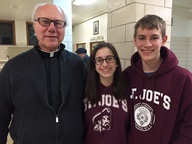 Every man’s experience of the priesthood is a combination of what he brings to his vocation and the opportunities his vocation brings to him. Father Robert Mock has had an abundance of experiences and opportunities that have so far enriched his priesthood and his life.
Young Robert Mock grew up along with two brothers at Christ the King Parish in Snyder. He attended public school and graduated from Amherst Senior High School in 1964. He attended Canisius College briefly, graduated from Bryant and Stratton College and went to work for The W. T. Grant Company – more commonly known as the Grants Stores. He was drafted, joined the Navy and was stationed in Rhode Island for four years doing general administrative work. The government provided servicemen the opportunity to attend college so Robert spent three or four semesters at Providence College where he became familiar with the Dominicans. He decided to enter the order of the Dominicans but ended up leaving after eight months and going back to work for a Grants Store in Syracuse.
Thoughts of the priesthood remained on his mind even after leaving the Dominicans. He left Grants and accepted a position at WKBW (Channel 7) where he worked for five years in the sales and business offices. While he was working there, the Diocese of Buffalo began promoting vocations to the priesthood through the use of billboards. Father Mock recalls, “One was conveniently located right across from my office window so when I stood up, I couldn’t look out my window without seeing that billboard.” Upon hearing that Father Philip Berrigan, a civil rights activist he admired, was speaking at Buffalo State College he decided to attend. He recalled Father Berrigan saying, “If you’re going to do something with your life, do something that’s meaningful for you and makes a difference for others.”
That billboard, coupled with the inspirational message from Father Berrigan was enough to convince him he should at least take another look at priesthood. In 1977, he entered Wadhams Hall Seminary College to begin his studies. He graduated from Christ the King Seminary and on March 16, 1984, Father Robert Mock was ordained a priest for the Diocese of Buffalo. He served in the early years of his priesthood at Blessed Sacrament Parish in Kenmore, Mother of Divine Grace, Nativity in Orchard Park, and was then assigned to help Father Chuck Slisz at Saint Mary and Saint Mark in Holley and Kendall. While he was there he noticed an article in the local paper asking for volunteers to read for the print handicapped at WXXR Reach Out Radio. After he auditioned, he waited to hear back from them but they never contacted him. He recalled, “Finally, I called them and they said they never call, but rather wait to hear from those who auditioned to be sure that they were really interested.” For a year and a half he traveled to Rochester once a week to read the Canandaigua Daily Messenger Newspaper in the studio. While he was in the area he would visit parishioners who were in the Rochester area hospitals. He really enjoyed it and commented, “I met some great people in that whole experience!”
After serving at Queen of Heaven Parish in West Seneca, Father Mock was then assigned to his first pastorate at Saint Mary of the Assumption Parish in Portageville and Saint Mary, Canaseraga. After that he spent six years as pastor of Saint John the Evangelist in South Buffalo. The last two of those years he also served as Pastor of Saint Teresa Parish – just down Seneca Street. Around that time the Journey in Faith and Grace began. With the condensing of parishes there was actually an excess of priests for a short time. Father Mock was invited to apply to become Academic Dean at Trocaire College. He had already been teaching there for 19 years as Associate Professor of Philosophy and Religious Studies. He then served as Associate Dean and then Dean of Health and Human Services for five years.
In 2013 Father Mock was not sure if he wanted to be the pastor of another parish again. He thought he might stay at Trocaire until he retired but when the opportunity became available to lead the flock at Saint Benedict Parish in Amherst, he decided to apply. He thought about what a 21st century parish should look like and he came up with two main objectives. One was to offer multiple opportunities for faith formation for people in the parish and the other was to become involved in outreach opportunities within the surrounding community. Having spent so much time teaching young adults at the college level, Father Mock felt very comfortable engaging that age group at Saint Benedict by offering them faith formation and social opportunities as well as involvement in outreach ministry. He has worked diligently to implement lifelong faith formation programs for people of all ages at his parish. He is very fond of teaching and preaching and mentioned, “I have a magnificent staff who really handle everything, so I am able to do more of the things I want to do like focus on Young Adult Ministry.”
Father Mock has held several positions of service and leadership within the diocese. He was Executive Secretary for the Priests’ Council of New York State, charter member of the Board of Directors of the Saint Joseph Investment Fund, corporate member and treasurer of South Buffalo Catholic School, a member of the Strategic Planning Commission for the Journey in Faith and Grace, served on the College of Consultors, Chair of the Council of Priests and on the Advisory Council for Upon This Rock.
A big fan of live theatre, Father Mock is a member of the Advisory Board of the Kavinoky Theatre which is located on the campus of D’Youville College. He said of the experience, “It’s been an interfaith and ecumenical experience in that there are some Catholics on the Board but not all. I get to interface with Jewish people, Protestants and people of little or no faith.” He also enjoys attending many other theatre venues as well.
In advising men considering the priesthood, Father Mock said, “You have to be very flexible and able to roll with a lot of different things. You have to be attentive and savvy enough to understand the administration side of the parish and yet sensitive enough to be able to handle all the pastoral things. You have to learn to be a little tough on the administrative side and at the same time be much softer on the pastoral side.”
MARCH 2017 PRIEST OF THE MONTH - REV. JAMES CUNNINGHAM
Father James Cunningham grew up on Buffalo’s West Side, the only child of Mathilda and James B. Cunningham, a former Buffalo Police Commissioner. Father Cunningham had a love of reading, which aided him greatly as he attended the former Holy Angels parish school on Porter Avenue, and Bishop Fallon High School.
During his school years, Father Cunningham’s home parish had been St. Joseph’s New Cathedral on Delaware Avenue, which was later re-commissioned as Blessed Sacrament Church when the cathedral building was torn down.
With his eye on a teaching career, he went on to attend Canisius College where he earned a degree in English education and a Master’s degree in secondary education. He taught at Bryant & Stratton College in Buffalo, where he also ran the bookstore. It was during this time that Father Cunningham began to think about the priesthood.
“I hadn’t given any thought to becoming a priest before I began teaching at Bryant & Stratton,” Father Cunningham recalls. “But it was in the back of my mind, and I began asking my mother if she thought I would make a good priest. She would reply, ‘Why, yes! But don’t wait too long; you’re not getting any younger.’”
Father Cunningham remembers reading a vocations issue of the Western New York Catholic newspaper in the early 1980s that featured profiles of various priests in the Diocese of Buffalo. That was a catalyst for the beginning of his journey to the priesthood. He was particularly interested in the story of Father David Gallivan and reached out to the priest to meet for coffee. After many discussions, Father Gallivan introduced him to the vocations director for the Diocese, and Father Cunningham entered the seminary in East Aurora that year.
Coming to his vocation studies later in life, Father Cunningham was one of the older seminarians at the time. But he enjoyed the studies at the seminary and found his fellow seminarians supportive. He was ordained in 1987 and said his first Mass at St. Paul’s Roman Catholic Church in Kenmore.
His first assignment was at Queen of Heaven parish followed by an appointment to Saint Bonaventure Church, both in West Seneca. As he gained experience as a priest, Father Cunningham says his teaching background helped him in sharing the Catholic faith with parishioners. “One of the things I enjoy most as a priest is helping people to practice their faith, teaching and guiding them,” he explains. “My philosophy has always been to be kind and meet people where they are coming from.”
Father Cunningham’s first pastor appointment came when he was assigned to St. Agnes Church in Buffalo’s Lovejoy section. From there he became administrator of Holy Family parish in South Buffalo. He became pastor of St. Teresa’s parish on Seneca Street in 2009 and currently serves in that role.
“We have a wonderful and diverse congregation at St. Teresa’s,” Father Cunningham says. “The challenge – as with any parish today – is to help people find time from their busy lives to engage in their faith.”
For the young men considering the priesthood, Father Cunningham speaks from experience when he advises them to not be afraid to try it. “If you have an interest – even if you are in a career already – look into the seminary,” he counsels. “It’s okay if you decide it is not for you, but you’ll never know if you don’t try it.
FEBRUARY 2017 PRIEST OF THE MONTH - MSGR. FRED VOORHES
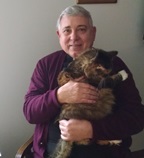
It is very rare these days for a priest from the Diocese of Buffalo to attend seminary anywhere other than Christ the King in East Aurora. Also rare is for a priest from the Buffalo area to work outside the diocese. Monsignor Fred Voorhes has done both.
Born and raised in Buffalo at St. Gerard Parish, young Fred grew up like most boys his age. He attended Catholic school, enjoyed playing neighborhood sports with his friends as well as quiet time reading on his front porch and was open to hearing the call of God in his life. His mother was of Italian heritage and a very devout Catholic. Her brother was Bishop Pius Benincasa, Auxiliary Bishop of Buffalo, to whom he turned when feeling called to the priesthood. He was also influenced and encouraged to follow that call by his eighth grade teacher, Sr. Bernice. She is still alive and they continue to exchange Christmas cards. This past Christmas she wrote, “I never thought I would live to see the day that one of my former students is a retired priest.” To which Msgr. Fred answered her, “I am happy you lived to see this day but, I am semi-retired.” As every retired priest knows, you never really stop helping until you no longer can.
After eighth grade, young Fred entered the Diocesan Preparatory Seminary for high school and two years of college. As a commuter he was referred to as a “day hop.” Other boys who lived further away boarded at the minor seminary and went home on the weekends. He continued on to St. John Vianney Seminary in East Aurora, now called Christ the King, but only spent two years there. At the time seminarians were permitted to apply to study abroad. He chose to apply to Rome and was accepted. He spent three years studying at the Gregorian University, a Jesuit institution, as well as one year at the Angelicom University, associated with the Dominicans. Languages became sort of a hobby for him as he learned to speak his ancestral language of Italian and study Greek, Latin, German and French. He spent one summer in Mexico as an exchange student where he learned Spanish. He played soccer in Mexico which would have come in handy when teams were forming while he was in Rome, but he broke his leg while practicing after colliding with another player and decided not to learn how to ski!
Father Voorhes was ordained in Rome with his classmates in December of 1971 by the Rector of the North American College, Bishop James Hickey. After ordination he returned to Buffalo and was assigned as a parochial vicar at Immaculate Conception Parish in East Aurora where he spent two years. He then ministered for four years at St. Edmund in Tonawanda which is now closed.
Having served six years in parish life, Fr. Fred decided he would like to pursue a Doctorate. He returned to Rome to study Dogmatic Theology but after a month was approached to work at the Vatican in the Congregation for Bishops. He recalled, “That was the furthest thing from my mind when I went back to Rome. I thought I would get my Doctorate, return to Buffalo and work in Family Life Ministry which eventually happened but was postponed by about six years.” He prayed about the offer, consulted his uncle, Bishop Benincasa, spoke with his spiritual advisor, as well as confidentially to his parents and eventually agreed to work at the Vatican for five years.
Once again he found himself far from home. During his second stay in Rome his niece who was just seven years old at the time asked him over the phone, “Is it snowing on the planet where you are?” He described his experience at the Vatican as, “Fascinating.” He was responsible for anything having to do with the bishops in the United States, Canada and Australia such as first appointments, promotions, retirements, boundary changes between dioceses, new dioceses being formed, etc. Father Voorhes tried to have a good rapport with the media even though one superior urged him not to communicate at all with them. There were some things he could talk about and other things he could not. He surmised, “If you stonewall the media about everything, they will fabricate what they think because they have to submit a story.” He has been quoted in the book, Archbishop, Inside the Power Structure of the American Catholic Church by Thomas J. Reese, S.J. concerning appointments made of bishops to certain areas as saying, “He (the bishop appointed) has to be comfortable with mass media, especially in New York, the communications capital of the nation and perhaps even of the world.”
His appointment to the Vatican ended in 1984 and at the age of 37 he was made a Monsignor the day before he left to return to Buffalo. Monsignor Voorhes was then appointed Associate Director of the Family Life Department from 1984-87 and Director from 1987-2001. “Finally,” he said, “I got to do the work I wanted to do!”
In 2001, Msgr. Voorhes was asked by Bishop Mansell to become the pastor of St. John the Baptist Parish in Boston, NY. It would be his first pastorate and he exclaimed, “I felt a certain calling to the hills. It is a very pretty area.” As with any assignment there were ups and downs. After his first term was completed there was talk of merging his parish with another. He thought it would be with Our Lady of the Sacred Heart in Colden but instead it was merged with St. Mary in East Eden which was farther away. He decided not to reapply as pastor of St. John the Baptist and as he neared retirement age, reviewed his options. He thought about going on a sabbatical but couldn’t find a good fit so he decided instead to buy a house. He took a month off to move in and get settled before accepting another assignment.
Monsignor Voorhes agreed to serve at St. Teresa’s in South Buffalo as administrator. Before he began that assignment, he was informed that his father was nearing the end of his life in Florida. He was able to spend some time with his father before he died and after his funeral began his term as administrator.
Monsignor Voorhes spent ten months at St. Teresa’s and also served in Angola, St. John Gualbert Parish in Cheektowaga, St. Martin and St. Thomas Aquinas in South Buffalo and St. Anthony Parish in Buffalo, as well as helping out whenever one of his brother priests needed him.
On November 1, 2016 after 45 years of ordination to the priesthood, he retired from active ministry. He continues to enjoy what he considers to be the best part of priesthood, ministry. One of the perks of retirement is being able to celebrate the Sacraments, Mass, hearing confessions etc. while leaving behind the angst of administrative responsibilities. Monsignor Voorhes enjoys concerts, plays, classical music, swimming, gardening, watching sports, game shows and PBS on TV as well as reading. His cat, Kailee, wandered on to his property and has been a companion ever since. Not a previous pet owner, he is learning how to care for her.
Monsignor Voorhes never misses the opportunity to encourage vocations to the priesthood when he notices young men who would make good candidates. Sometimes, especially when it comes from a priest, that little tap on the shoulder is all it takes to awaken someone to a call from God.
JANUARY 2017 PRIEST OF THE MONTH - REV. MICHAEL LaMARCA
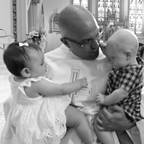
“While Mass is a very powerful thing, hearing Confessions is a very intimate experience and celebrating weddings for friends is such a rewarding, inspiring blessing, my absolute favorite part of priesthood is at the very beginning of the Rite of Baptism, signing the forehead of a child and claiming them as a child of Christ. That simple action of the motion of my thumb on their forehead, there’s just something about it. I feel just as powerful a presence of the Holy Spirit then as I do when I’m celebrating the Eucharist!"
Father Michael LaMarca has been ordained less than a year but has had a close connection to his Catholic Faith all his life. Raised in West Seneca, his early education was through the West Seneca school system. His parents raised him and his older sister and brother as faithful Catholics at St. Gabriel Parish in Elma. It was there that young Michael became very involved first as an altar server then as a lector, extraordinary minister of the Eucharist, Youth Group member, Religious Education instructor and Youth Advisor. He attended St. Bonaventure University for a year studying Business Administration and then moved to Medaille College to pursue a career in Sports Management. A big baseball fan, he left a job at Wegmans to intern with the Buffalo Bisons becoming the right hand man for the Director of Promotions and Entertainment in the summer of 2008 between his junior and senior years.
He was very impressed by the priests who ministered at St. Gabriel Parish when he was a youth. He recalled, “I always had good examples of the priesthood growing up in my home parish. Father Art Mattulke, Fr. Dan Palys, the pastor and Fr. Peter Karalus, made priesthood appealing to me. They were happy priests who enjoyed their service to the people and they were very pastoral.” Throughout high school and college, Michael went back and forth about a career in sports management and the vocation of priesthood. “Working in sports and working in the church, I had to decide on one path to move forward and I thought, ‘Alright, pick one!’ I enjoyed both and I found that I had a real passion for ministry. When I discerned about not being able to have a family but looking at so much that I would gain through the priesthood I said, ‘This is it!’”
In August of 2008 before starting his senior year of college he called Fr. Walt Szczesny, the Vocation Director for the Diocese of Buffalo at the time, and said, “I want to start the application process.” He remembers that he never felt pressured by Fr. Walt or any of the other priests who encouraged him. They let him go at his own pace, discerning in his own way and time. Even after all his paperwork was completed for entrance to Christ the King Seminary he believed, “I was still open to the possibility that a curve ball might be thrown and I might not enter the seminary.” While studying at CKS he would sometimes pray when things got tough, “God, if this is not what you want my life vocation to be, I need help!” And every time he said that prayer, there was an event or an encounter which said, “This is your life vocation.”
Ordained May 28, 2016, Fr. Mike still prays, “Am I doing this right?” And the response comes back in one form or another, “Yes.” or “Make this modification.” He enjoys so much of the priesthood and believes that his sport management and business experience has been helpful with many things he’s been involved with as a priest. His first and current assignment is as parochial vicar at St. John Paul II Parish in Lake View. His early mentor, Fr. Peter Karalus is the pastor there. Father Mike fondly remembers that Fr. Peter “was the first one who asked me, ‘Have you thought about the priesthood?’ Father Peter was very instrumental early on and all throughout in my discernment process so it really is a blessing to be here with him.”
When he gets some free time, Fr. Mike enjoys hiking, working out, playing pick-up sports and generally being outside. He loves to take in a ball game or a hockey game and has recently taken up hunting. He finds it difficult to say, no, not just to things people invite him to but more to people who ask a question and really want the answer to be, yes. He went on to explain that sometimes it wouldn’t be in the best interest of the person or the cause they are trying to promote for him to say, yes. It’s difficult to disappoint people especially when they really feel something would be a good idea. He reasoned, “I want to be pastoral but being pastoral doesn’t mean always saying, yes.”
Having been through the discernment process so recently himself he would advise anyone who is thinking about a vocation to the priesthood or religious life to keep an open mind. He said, “Don’t be so closed minded that the vocation is all you think of or all you try not to think of. If you’re doing that, you’re missing out on something. If the priesthood or religious life is what God wants for you, you’re not going to be able to get off the path. You’ll really have to force yourself off the path.” He also suggests that if a young man hasn’t gone to college yet, he should pursue something he’s interested in. Any field will be helpful to him if he discerns that he should become a priest because priests are involved in so many different aspects of life. They are teachers, business men, event planners, etc. Fr. Mike also suggests that if a man already has a college degree, he should keep himself open to his life experiences and see how God is working through him.
Father Mike describes the priesthood as being both challenging and rewarding. He said, “The experiences I’ve had are ‘once in a lifetime’ already and I’ve only been ordained less than a year. I’m beyond happy and I can’t wait for the next day to see what gets put on my plate. I wake up in the morning thinking, what encounters am I going to have today? You never know what’s going to walk through that door!”
DECEMBER 2016 PRIEST OF THE MONTH - REV. ADOLPH KOWALCZYK
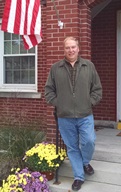
The diocesan priesthood was the furthest thing from the mind of young Adolph Kowalczyk as he began his education at Transfiguration Elementary School. Things changed when a missionary priest spoke to his class. He recalled, “I was in the sixth grade and I really thought about becoming a missionary. That sort of captured my heart and my interest because of the enthusiasm of this priest when he was speaking about the missionary work that they were doing.”
He did a lot of reading about the saints and the world. In eighth grade he read about St. Therese of Lisieux who was a Carmelite Nun often referred to as “The Little Flower.” One of the sisters who taught him spoke about the Carmelites in Niagara Falls, Ontario. They had a high school connected with the order that Adolph very much wanted to attend. His parents were not thrilled with the idea of him leaving the country and living in Canada while attending high school; but after a visit from a priest associated with the school, as well as a visit to the school itself, they gave their consent.
After high school he thought he should take some time away to experience a regular college. It was a difficult decision to leave the Carmelites but he thought it best. He began his studies at St. Mary College in Orchard Lake, Michigan. During his college years he also spent time studying at Iona College in New Rochelle, NY and John Paul II Catholic University of Lublin in Poland. He was there in 1981 when Poland was under Martial Law and described it as a very difficult time. He returned to Michigan and graduated from St. Mary College. He loved his college experience because it gave him the chance to “test” the vocation he thought he had to priesthood, as he put it, “to see if there was still something calling me to be involved in the Church in this particular way.”
Originally he thought he was going to be a missionary priest who would travel far away perhaps as part of the Carmelite Order with different kinds of ministries, but that was not how it turned out. He said, “Ultimately it’s interesting how God works that I ended up being a diocesan priest.” After college Fr. Gene Ulrich, Vocation Director at the time for the Diocese of Buffalo, reached out to Fr. Adolph who recalled, “He had a lot to do with me then thinking about going to Christ the King Seminary.”
He entered Christ the King and four years later on April 30, 1988 was Ordained to the Priesthood for the Diocese of Buffalo. He first served as a parochial vicar at Our Lady of the Sacred Heart Parish in Orchard Park for six years. He then spent four years at Blessed Sacrament Parish in Kenmore and after that was named pastor at St. Agatha’s in South Buffalo where he spent six years.
Father Adolph’s next pastoral assignment was back to the place where he started, Our Lady of the Sacred Heart. He began that assignment eleven years ago and is there currently. He has noticed some changes since the first time he served there, most notably, a decrease in the number of priests. He finds it challenging to minister alone and misses the days when he had two other priests to bounce ideas off of and to share the ministry work. He expressed, “I know the lay people do a great job with some of the areas of parish life but trying to be present to different people at different functions across the board is more challenging than it ever was because of just being by yourself.”
Though not a missionary priest, Fr. Adolph does enjoy traveling! He also likes to read, watch movies and spend time with his friends. He is the youngest in his family with two older sisters. Both his parents and one of his sisters have gone home to the Lord.
As a priest he enjoys, “being with people at some of the most sacred times in their lives. Celebrating the Sacraments with them definitely would be number one and then also the grace of seeing God work in people’s lives. So many people are so faithful to God and it’s great to see how they live out their faith. Also what I learn from people about their faithfulness, the example they are to me.” Father Adolph believes that, “the challenging part is the administrative end; thank God today that we all have business managers!” He finds working with people very rewarding.
He advises those discerning a call to the priesthood to make sure they have a really deep commitment to prayer. They need to take time to discern where God is calling them to be. He believes they should be open to the Holy Spirit. As he himself has experienced, it’s not always what you think it’s going to be. Sometimes God gets your attention in one area so He can lead you somewhere else. Father Adolph has had seminarians from Christ the King Seminary stay with him on summer assignments and currently has a seminarian who is on his pastoral year. It is extra work for a pastor to act as a mentor for men discerning their call to priesthood but so very rewarding for all involved.
NOVEMBER 2016 PRIEST OF THE MONTH - REV. PAUL STELLER
The priesthood encompasses a wide variety of opportunities for ministry. A priest can, on any day of the week, find himself in the position of counselor, office manager, minister of Sacraments, decorator, handy man, advisor, listener, speaker and in the case of Fr. Paul Steller, more often than not, teacher.
Raised on the East Side of Buffalo, Paul Steller attended St. James and St. Gerard grade schools and considered becoming a priest when he was in the fifth grade. He credits his vocational decision in part to the influence of the sisters who taught him. He entered the Diocesan Preparatory Seminary which included four years of high school and two years of college. After earning a B.A. from Niagara University in Philosophy and Classical Languages, he went on to finish his Theology Degree at St. John Vianney (now Christ the King) Seminary in 1965. In 1970 Fr. Paul earned an M.S. Degree in Education from Canisius College and in 1971 an M.A. from the Catholic University of America.
Ordained in 1965, Fr. Paul spent his first year as a priest at the Missionary Apostolate Church, St. Helen, in Hinsdale. While assigned there he also taught part-time as a Professor of Theology at Trocaire College. He stayed with teaching and in campus ministry for the next 28 years. He taught history and religion at the Diocesan Preparatory Seminary and Theology at Canisius College and D’Youville College. Back then he recalled, “I wasn’t much older than my students!” He spent time as a Professor of History and Religion at Bishop Fallon High School, as well as an instructor in Religious Studies, Philosophy and English at Hilbert College. Father Paul was involved with Campus Ministry at D’Youville College, Niagara Community College and Erie Community College South Campus.
By 2003 Fr. Paul had held positions such as Vicar for Campus Ministry (Pastor for all Campus Ministers in the diocese), as well as Priests’ Personnel Coordinator. It was then that he was assigned to parish life at St. Mary of the Assumption Church in Lancaster where he currently resides and ministers. Possibly related to his years in campus ministry, Fr. Paul shared that he, “Really enjoys helping people find a certain sense of meaning and direction (God) in their lives, as well as how to lead fulfilling lives and to use well the talents and abilities they have.” He stressed the importance of not putting so much emphasis on sinfulness and guilt but rather focusing on joyfulness and the positive aspects of life. He believes that everyone benefits when people use their gifts and talents in ways that help their parish community.
Father Paul is a collector and has many books. He enjoys reading and watching movies. He has two sisters. They currently live in the Buffalo area, are married and have families.
His advice to men considering the vocation of priesthood is to, “Learn to be a listener.” He believes that while a man may be very smart, wise, insightful, etc. he should listen to what people are really saying before giving out any answers. Having been very involved with scripture, Fr. Paul also advises, “It’s very important that priests become familiar with Sacred Scripture, particularly the way in which over the last half century our understanding of scripture and its importance has developed, and that they find ways to correctly work that into the homilies they are giving.” As a former teacher of history, Fr. Paul thinks, “Young men should have a sense of our history and how beliefs and practices were culturally influenced as they developed.” He also added that, “The current leadership under Pope Francis is looking at that.”
Father Paul was recently part of a team teaching effort at Canisius College where he, a doctor and a biologist taught moral issues together. Each class all three weighed in on moral issues from their unique frame of reference. When you say, “Yes” to the priesthood, you never know just how God will use your gifts and talents!
OCTOBER 2016 PRIEST OF THE MONTH - REV. MICHAEL BURZYNSKI
One Sunday several years ago, as pastor of St. Mary of the Cataract Parish in Niagara Falls, Father Michael Burzynski was preparing for Mass when he looked out a side door at the congregation gathering for the service. He did a double-take, not quite sure if what he was seeing was real. There in the pews were 25 to 30 Elvis Presley impersonators, all dressed in full Elvis attire including black wigs and white suits.
“It may have been the funniest moment of my priesthood – it was impossible to keep a straight face,” Father Mike recalls. “It shows that there are always surprises in the life of a priest.”
As it turns out, the parish is located next to the Seneca Niagara Casino in the Falls, and there was a convention of Elvis impersonators in town for the weekend. Father Mike says the congregation hosted many such guests every week because of the proximity to the casino, including entertainers and tourists.
Father Mike is currently the pastor of St. John Gualbert Parish in Cheektowaga and his journey to the priesthood is highlighted by many milestones over more than 25 years. He grew up in Our Lady Help of Christian Parish in Cheektowaga and graduated from Bishop Neumann High School in Williamsville. He went on to earn an undergraduate degree in psychology from Canisius College. And while Father Mike says the calling to the priesthood was always in the back of his mind, he decided to continue his education at the University of Notre Dame in Indiana, where he earned both a Master’s and a PhD in psychology.
Returning to Buffalo, Father Mike was a psychologist in private practice for about three years. He specialized in forensic work focused on human behavior, and assisted numerous local police departments with his expertise. He also served as assistant superintendent of schools in the Diocese of Buffalo. He enjoyed his work, but still thought about the priesthood.
“I finally ran out of excuses,” laughs Father Mike. “I had always stayed active in my parish and involved in the church and my calling grew stronger, even at 30 years old.”
Father Mike entered Christ the King Seminary in 1984, noting that his experience as a psychologist and degrees from Notre Dame gave him a unique perspective in his studies. He was ordained a priest in his home parish, Our Lady Help of Christians, in 1989, and was assigned as parochial vicar at Assumption parish in Buffalo. From there his assignments included St. Aloysius in Cheektowaga and St. John the Baptist in Kenmore. He served as pastor at St. Mary of the Cataract for 11 years, overseeing the renovation and restoration of the church which was built in 1847.
Outside parish life, Father Mike has been involved with a wide variety of interests and community organizations. He was the Catholic chaplain of the Niagara Falls Fire Department. He served as town historian in Cheektowaga and was president of the Cheektowaga Patriotic Commission. He is on the board of directors of the Notre Dame Club of Buffalo. He has taught at the University of Notre Dame, Villa Maria College, and Niagara University, where he was adjunct professor. And then there is perhaps his greatest interest – relics of the saints.
Father Mike oversees a collection of more than 1,100 saint relics, thought to be the largest such collection on the East Coast. A relic can be defined as a part of the body, or some personal item of a saint or martyr. Father Mike’s collection, displayed in a Relic Shrine at St. John Gualbert, includes relics from the apostles, European and American saints, martyrs and Blesseds. The listing at the Shrine includes relics of Jesus such as a piece of the room where the Last Supper was held; a piece of the shroud of Jesus; and a relic from the cross of Jesus. The Diocese of Buffalo recently designated the Shrine, known as the Chapel of Our Lady, Queen of All Saints, as a Sacred Site.
Father Mike says his interest began as a high school student when he was actively involved in Our Lady Help of Christian Parish. St. John Neumann was considered for canonization as a saint in the late 1970’s and the organization in Philadelphia overseeing the effort contacted Buffalo area parishes that may have had a connection to the saint-to-be. The stones used to enlarge the Chapel at our Lady Help of Christians came from the Williamsville church, SS. Peter and Paul, where St. John Neumann was pastor. Father Mike found references to St. John Neumann as having said Mass and performed baptisms at the Chapel and the high school student sent that information to Philadelphia. Coincidentally, Father Mike was attending Bishop Neumann High School at the time.
The organization in turn sent a relic from St. John Neumann to Our Lady Help of Christians as a thank you. When Father Mike thanked them, the organization sent another St. Neumann relic. The two relics were displayed at special venerations at Our Lady of Help of Christians over the years, and as interest grew so did Father Mike’s collection. He notes that obtaining certified relics of the saints has become much more difficult around the world and he believes the collection at St. John Gualbert will remain one of the largest in the Catholic faith.
When asked what he has enjoyed most about being a priest, Father Mike replies, “Everything! I have particularly loved parish life. In fact, it was my strong desire to return to my parish family at St. John Gualbert that helped me recover from some health issues a couple of years ago.”
Father Mike advises any young man thinking about the priesthood to visit with his parish priest. “Spend a day in your parish community if possible and see how wonderful parish life can be,” he concludes. “As a priest you have a leadership role and become part of a family. It is such a unique experience.”
SEPTEMBER 2016 PRIEST OF THE MONTH - REV. DANIEL OGBEIFUN
Father Daniel Ogbeifun began his life in Nigeria, West Africa. He recalls feeling drawn to the priesthood as young as twelve years old. In his community, boys who were interested in the priesthood often lived in the rectory with the priests helping out with chores, preparing for Mass in the sacristy as well as serving at the altar and in general discovering what the life of a priest entails. He shared, “I lived with priests who encouraged me. Many of them are my mentors.”
His parents raised him and his three brothers and three sisters in a Catholic home. Daniel engaged himself in many parish activities such as youth group, choir, Legion of Mary, Charismatic Renewal, etc. His family took in seminarians who were assigned to their parish. Each parish had several “out posts” which were not close to the rectory. Families would host seminarians in their homes for their apostolic work. Daniel‘s mother was very happy to have them and Fr. Daniel became well acquainted with them when they lived in the family home. He noted, “When I was growing up I was thinking about becoming a priest, serving God and His people.”
He entered the seminary in Nigeria but after completing his Philosophy and part of his Theology decided to leave for a while to further discern his vocation. Father Daniel found employment at the Murtala Mohammed International Airport in Lagos, he taught in schools, and he also worked in different companies, but then once again felt God calling him to the priesthood. He received a scholarship to attend the Institution of Lumen Vitae, a Jesuit Institute in Belgium in 2010. There he studied Pastoral Theology and Catechesis. He then began to apply to dioceses and Buffalo was one of those who really encouraged him to come. He admits, “They never told me about the winter!” He began his studies at Christ the King Seminary in 2011. Father Daniel expressed his happiness for the Diocese of Buffalo. He said, “It is something that gives me joy and encouragement to see people who care for me and make me feel at home here. They always pray for me.”
On June 6, 2015 Fr. Daniel was ordained to the priesthood for the Diocese of Buffalo. He was assigned to St. Lawrence and St. Martin de Pores in Buffalo and Nativity of the Blessed Virgin Mary Parish on Harris Hill Road in Williamsville where he currently resides. When he gets time to himself he likes to visit friends, cook, ride his bike and play sports, such as soccer and basketball. He also enjoys traveling and recently returned from a trip to Europe and Africa where he celebrated his one year anniversary of ordination to the priesthood. He went back to Belgium to visit people with whom he studied while he was there and celebrated Mass for them. They were so happy to see him and the feeling was mutual. He also got the opportunity to go to Rome for a few days. A friend who works at Vatican City was able to arrange for Fr. Daniel to meet with Pope Francis during the general audience. Father Daniel introduced himself and although Pope Francis doesn’t speak much English, the two conversed a bit. He recalled, “It was something great for me to have a handshake and a picture with the Holy Father. He gave me a rosary and said, ‘Pray for me and pray for the Church and for your diocese.’ We embraced and for me it was a ‘God moment.’” He went on to Nigeria to visit his family and friends back home and celebrated Mass with them. He added, “I also celebrated a Memorial Mass for my dad, Mr. Stephen Ogbeifun, who passed away three years ago. May his gentle Soul rest in peace. Amen.”
Father Daniel enjoys all aspects of ministry. Dispensing the Sacraments, Holy Eucharist, baptisms, funerals, weddings, etc. give him great joy. “People are longing to receive these Sacraments and they are happy when they receive them.” He shared, “Celebrating Mass is something I longed for and wanted to do as a priest. When I see myself doing it, I am happy and fulfilled to be in the moment where God has called me after the long journey from Africa to Europe and now to the USA. I continue to give glory to God, because our God is so great and wonderful.”
The life of a priest is all about service and Fr. Daniel commented that, “A priest is not ordained for himself, but for others. To lead others to God.” This can sometimes be challenging because people expect more from the priests to be constantly available. He said, “The Bishop continues to encourage us to take a break and recharge, when necessary. Don’t be so overwhelmed with your work.”
Father Daniel encourages those who are considering the priesthood to always pray to discern God’s will in their lives. He is very interested in helping men to discern where God is calling them. He also feels it is important to be a good example to those who are considering the priesthood. Father Daniel thinks it is also important to let discerners know as much as possible about what is involved in serving God’s people as a Priest, Deacon or Religious. He emphasizes the words of Pope Francis in the Four Aspects of Ongoing Formation for Priests: The Human Formation, Spiritual Formation, Intellectual Formation and the Pastoral Formation. Father Daniel believes, “It is the job of the person considering priesthood to discern what he wants to do and where he wants to be through prayer. But we are to help them discern their vocation well, especially in our own prayer and words of encouragement. Of course, God is the one who calls but one must be open and to look at all possibilities in order to discern God’s will. It’s not man who chooses, it’s God who calls and chooses and ordains.”
John 15:16 reads, "You did not choose me but I chose you, and appointed you that you would go and bear fruit, and that your fruit would remain, so that whatever you ask of the Father in My name He may give to you.” Father Daniel added, “As priests, we are to bear the fruit of Christ by helping others to discern their true vocation.”
There have been many people in Fr. Daniel’s life who have helped and encouraged him along the way. He is very grateful to them and acknowledges that they have made his journey easier. He thanks his family, friends, The Serra Club of Buffalo, Knights of Columbus, and all those in the parishes in which he ministered while in the seminary for the supportive role they played. He had prayer cards made up for his ordination that read, “Gracious God, bless my family, relatives, friends and all those who helped me to ascend your altar as a priest. To my beloved Father, Mr. Stephen Ogbeifun and all the faithful departed grant eternal rest. ” He remembers all those who helped him in his daily prayers.
“They call me, ‘The happy priest!’” Fr. Daniel shared. He believes that happiness reduces tension and everyone should strive to be happy, have a positive attitude and keep smiling. A positive thoughtful thinking mind discerns correctly. He asserts, “We need priests, good priests with the heart of Jesus, and for the right reasons. I personally believe in genuine vocations. God calls and empowers with his grace and strength. We pray that God continues to inspire and direct us in accepting genuine vocations in our Diocese. There is much joy in serving as a priest. I believe they will also be happy priests!”
AUGUST 2016 PRIEST OF THE MONTH - REV. ROBERT A. WOZNIAK
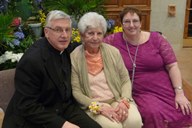
Often times when young people are impressed by a role model, it sticks with them for life. Father Stanley Skiba was one of three priests of Assumption Parish in the Black Rock section of Buffalo when a sixth grade student at the parish elementary school took notice. Young Robert Wozniak found Fr. Skiba, originally from Poland, to be very inspirational. He was impressed by the way this priest tended to the needs of the parish through the liturgical decorations of the church to his gardening around the parish; as well as responding most generously to the souls of his parishioners. The Felician sisters, who taught in the school, were also very influential and encouraging of Robert to consider the priesthood. Father Rob recalled, “I hid from God for a few years. Yet, God usually wins in the game of hide and seek.”
A grey picket fence surrounded the yard and home in which he grew up with his loving parents and older sister. He remarked, “We were the typical ‘All American Family.’” After graduating from Assumption Elementary School, Robert attended McKinley Vocational High School. Still “hiding from God,” he decided to test his vocation to see if it could survive outside of a catholic school setting as he went on to study biology for research at Buffalo State College. But he still felt something was missing. He decided to visit the college placement office to speak to an academic advisor about his future. She told him, “You’re not telling me what you really want to do.” After some soul searching she handed him a vocation booklet and encouraged him to look into the possibility of priesthood. He discovered ten years after his ordination that she was a Woman Religious and exclaimed, “The sisters’ powerful influence finally got me.”
After graduating from college, Robert worked for a year at K-Mart in a managerial position while still discerning his vocation. He then met with the vocation director at the time, Fr. Gene Ulrich, and decided he wanted something more. He recalled, “They were very good to me at the store, very supportive as I considered a church vocation.” He spent some time at the minor seminary in Ogdensburg to fulfill the Philosophy requirement before he could start at Christ the King Seminary in East Aurora. “It was the first time I was away from home. I had no car and looked at it as being ‘Exiled in Christ!’” The Diocese of Ogdensburg has more cows than people. He depended on his fellow classmates for support and was able to grow and mature in order to make that step.
Father Rob was Ordained to the Priesthood in 1988 becoming the 25th priest from Assumption Parish to do so. Assumption also boasts of 52 Women Religious responding to the call from the parish as well! His first assignment was to Infant of Prague Parish in Cheektowaga where he worked with Msgr. Angelo Caligiuri and Fr. Bart Lipiec. He exclaimed, “They were the first men I ministered with and they were wonderful mentors.” Father Rob spent five years there and then assumed an assignment to St. Leo the Great in Amherst. There he ministered with another wonderful mentor, Msgr. William McDonnell who remained in contact with Fr. Rob until his passing. Father Rob then was asked by the bishop to become the Vocation Director for the Diocese of Buffalo. He found that to be a tough assignment because he loved the aspects of the priesthood that his parish priest, Fr. Skiba, had originally inspired in him. He said it was “like being the recruiter for the Air Force but you’re not flying the jets.” He spent four years as Vocation Director and then returned to his love of parish life as pastor at St. James Major in Westfield and St. Thomas More in Ripley, NY. His next assignment was to St. Edmund Parish in Tonawanda, which included a parochial school and a parish preparing for a transition. He left there after the parish merged with St. Christopher Parish and went on sabbatical to Rome, Italy for a priestly program of refreshment and renewal. He spent three months there describing it as a “wonderful opportunity!” Upon his return he was assigned as pastor to three parishes; in Newfane, Wilson and Olcott on Lake Ontario area that merged into a new faith community of St. Brendan on the Lake in 2008.
After a time at St. Andrew Parish in Kenmore and St. Joseph’s Cathedral in downtown Buffalo, Fr. Rob was asked by Bishop Richard Malone to become the Director of Formation at Christ the King Seminary. The position of Director of Formation has the awesome responsibility of forming men into good and holy priests for our diocese. He currently holds that position as well as having been recently named Vice Rector of the seminary.
Father Rob loves life, takes time to walk and appreciate God’s goodness while enjoying the hobby of photography. His room is decorated with many photos he has taken. One photo taken at St. Joseph Cathedral from the choir loft is of an angel looking down with the main altar in the background. A couple preparing for marriage loved the photo so much they decided to use it as the cover for their wedding program at the Cathedral.
Being involved in people’s lives and accepted into their homes as a member of their families is one of Fr. Rob’s favorite parts of the priesthood. He also stated, in his love of the Eucharist, “It is still a profound mystery that those elements are changed in front of you and you don’t know how it’s done, but through you, God continues to work and is able to do those things that Christ did to build up His Church today.”
Accepting this new role at Christ the King Seminary has been challenging for Fr. Rob. Once again, he has been taken away from the things he loves best about the priesthood to become involved in a very specialized ministry. He has had to give up being involved in the lives of his parishioners and being active in a parish to become a role model for the men looking at priesthood and to help form them into what they should be. He is not doing baptisms, weddings, funerals, or any of those Sacramental things but instead forming Disciples of Christ so they can continue the work of priesthood. “It’s a major change, an awesome responsibility and I’m so blessed to have been given this great privilege to affect the future of our diocese”.
Father Rob recalled a retreat he made in Syracuse, NY, while he was at St. Leo’s, with Sister Briege McKenna. She has the gift of discernment of reading souls and that frightened Fr. Rob. She told him, “Robert, you’re going to do something that’s going to change the priesthood of your diocese.” That was 20 years ago. He recalled, “I thought when I was Vocation Director that I did it and it was done. Now I see that this new role is maybe fulfilling that ministry she was talking about 20 years ago.”
If you’re reading this and feel inclined towards priesthood, Fr. Rob believes that you should talk to someone. Reach out to someone; your parish priest or Fr. Rob or the current Vocation Director, Fr. Andrew Lauricella. Like himself, if you need to walk with somebody to see what it’s all about and where God is calling you give him a call. That’s the first step and often the most difficult, but a step that needs to be taken. The journey is different for everyone and that’s the tough part, but every journey begins with the first step.
It’s a wonderful life and Fr. Rob would be willing to take that first step of the walk with anyone and share his story with you as you begin to see the presence of God and where that voice is calling you on this journey.
MAY 2016 PRIEST OF THE MONTH - REV. DANIEL FIEBELKORN
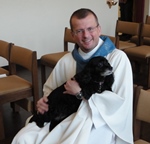
In his younger years, Fr. Dan lived in many places in the U.S. and in Canada. His father was in the Air Force and that meant moving frequently. Born in West Point, NY, he and his family lived for a short time in Newfoundland, Canada, his mother’s native land, as well as in Illinois, Michigan and Texas. In 1975 his father, mother, brother, sister and he packed up their wood sided station wagon and drove to Anchorage, Alaska where his father was stationed. Young Dan was educated in schools on the Air Force bases at the places they lived. They moved to Wasilla, AK (made famous by Sarah Palin) and he attended Iditarod Elementary School. They then moved to Soldotna, AK where he spent his junior high and high school years. He graduated from Soldotna High School in 1986. Dan worked several years at the local fish canneries. The schools were not in session from May to September because of the various fishing seasons occurring then. The fish needed to be cleaned and canned during that period. He worked the “slime line” and cleaned many different species of salmon and other fish. Never acquiring a taste for fish, he dislikes it to this day!
After high school, Dan spent one year at the University of Alaska at Fairbanks. He then transferred to Western State College in Colorado. He loved the mountains and outdoor activities that abounded there. It was during this time at college when he started becoming more active in his local parish. He remembers that the call to the priesthood happened gradually. His roommates wondered where he was going at 6:30 am. Not a usual hour for college students to be awake much less dressed and out the door. Dan was off to daily Mass. He recalled, “I had this hunger. I was just so fulfilled whenever I was doing anything for the church. I was a lector, Eucharistic Minister and involved with campus ministry. As the years went forward, I really felt the calling. When I looked back I could see the hand of God guiding me. While it was happening I was oblivious to it.”
Dan graduated in 1990 with a Bachelor’s Degree in History and a Minor in Geology . Still feeling a tug towards the priesthood, he decided to go to Conception Abbey in Missouri for a retreat. Raised in a Redemptorist church in Alaska, he considered joining that order of priests. He then decided he would spend a year working with the Franciscans serving the poor but at the last minute the program was closed. Dan felt lost and decided to come to Buffalo where he had family. He became very good friends with his cousin, Fr. Mark Wolski who was assigned at St. John the Evangelist in South Buffalo at the time. Dan moved into the rectory and started working there doing maintenance, serving at the Masses, etc. Living at the rectory he got to experience the “behind the scenes” of parish life. He felt a very strong calling to the priesthood and also felt called to serve in Buffalo. He said, “Fr. Mark was a big part of why I became a priest. I credit him with helping me to enter the priesthood and I credit him with being the role model that he is. I’ve learned so much from him. He is a wonderful mentor.”
He spent seven years studying at Christ the King Seminary in East Aurora. The summer before being ordained a Transitional Deacon he spent ten weeks at Our Lady of the Blessed Sacrament in Depew (Now St. Martha) and was assigned there after ordination to the Transitional Diaconate. After ordination to the Priesthood he spent his first year as a priest there as well. He fondly remembers, “I transitioned from a lay person to an ordained man at that parish. I loved the people there as well as all the things I was doing. It was such a thriving parish and the people were so active in their faith.”
Just one week before Fr. Dan’s ordination to the priesthood, his father passed away. Amid preparations for the funeral Fr. Dan’s mother told him something he had never known about his father. After his parents drove him to his first year of college in Fairbanks, said their tearful goodbyes and headed home, his mother recalled, “You know what your dad did? He looked at me and said, ‘He is going to be a priest.’” His parents never mentioned it again and they never said anything to Fr. Dan about it. Father Dan expressed, “It was a real affirmation. My first Mass was actually his funeral. It was extraordinarily difficult but I kept focusing on what he said and that at least I was able to preside at his funeral. It was a beautiful moment.”
After serving a year at Our Lady of the Blessed Sacrament, Fr. Dan was assigned to St. Stephen’s on Grand Island. He admitted he never knew anything about the island having only driven through it on his way to Niagara Falls. He found Grand Island and his new parish to be beautiful in so many ways. He loved the sense of nature being all around and the people were wonderful. Father Dan was there when they broke ground for their new church and he was there for the dedication upon its completion. He spent six happy years there and then decided to apply to be pastor at St. Joseph’s in Varysburg (Wyoming County.) He loved the wide open spaces that reminded him of growing up in Alaska. Here he met a large contingent of corrections officers who worked at Attica Correctional Facility. He became very aware of their lives and what it was like for them to work there. After four years the Journey in Faith and Grace Initiative merged that parish with Attica and it was time for him to move on.
Father Dan had been doing formation work at Christ the King Seminary. Conveniently, St. Joseph Parish was only about 15 miles away. He worked with the new seminarians in Pre-Theology and noticed, “When you’re working with guys who are discerning it brings you back in time. It brings you this sense of renewal because you’re kind of revisiting your own vocation story and you can relate to what they’re going through.” He was asked to do some graduate work after leaving St. Joseph so he spent a few years studying languages at the University of Buffalo. He lived once again with his cousin, Fr. Mark, this time at SS. Peter and Paul in Hamburg where Fr. Mark was pastor. Father Dan studied Biblical Greek, Biblical Hebrew, Aramaic, German and French. He really enjoyed his studies and helped out with Masses, etc. at SS. Peter and Paul as well. He could have gone on to teach at Christ the King Seminary but really felt called to parish ministry.
Entering once again into parish life he became pastor of Our Lady of Mount Carmel which has worship sites in Forestville and Silver Creek where he currently resides. When Fr. Dan first moved to the parish he couldn’t live in the rectory. The area had suffered a devastating flood and FEMA was working with people in the parish to rebuild their homes and their lives. The rectory needed much repair and it was a year before he could move in. Having completed his first six year term, Fr. Dan was just reassigned for another six years. He noted, “I’m in love with my priesthood and in love with the people of God in my parish. It is such a combination of rewarding and humbling ministry. I am invited into these sacred moments in people’s lives. I’m with them in joyful times like baptisms and weddings and also there at their death bed when they’re ready to enter into eternal life. I find great joy in what I do!”
Father Dan loves to read. He is a member of a book club and enjoys discussing the books with the group. Before he had a series of back surgeries he used to be an avid bicycle rider as well. He still enjoys being outside and taking walks whenever possible. He has been a pet owner and enjoys animals very much. He added, “They encourage me to do different things; walk on the beach and get out more.” Father Dan loves watching professional soccer and follows the Buffalo Sabres more than the Bills. On his day off, he enjoys going to the family cottage where Fr. Mark now lives in his retirement. He finds it very peaceful and very prayerful.
When asked about his favorite part of the priesthood, Fr. Dan gave the emphatic response, “The Eucharist! Presiding at the Eucharist! It was the Eucharist that brought me to the priesthood. I just love the Sacraments!” Father Dan noted that he really enjoys the weekend Masses where contact occurs with 90% of his parishioners. He also enjoys the week day Mass going parishioners, a group he calls a community within a community. He continued, “Ministry is very reciprocal. You do a lot of things not with the intention of receiving but it’s amazing the graces you get from doing different things.”
On the more difficult side, Fr. Dan finds that there are times when the sadness of life comes into play. People come to him with complicated situations; marriages that are in jeopardy, concerns about their children and hospital ministry. Sometimes he has to be with people who may be estranged from the Catholic Church and struggles to find the right words when trying to minister to them. Of course funerals can be difficult but they can also be consoling for family and friends. In some cases they can be an inspiration to those who have been away from the church to consider returning.
To those thinking about a vocation to priesthood, Fr. Dan recommends prayer and frequent use of the Sacraments, especially Reconciliation and the Eucharist. He advises, “You need to recognize that the priesthood is a commitment. Just like marriage, you’re not preparing for a day, you’re preparing for a way of life. There is a commitment level that has to be there.” He believes that if men really feel strongly about it, that’s God speaking to them. He then encourages them to speak to a vocation director or their parish priest. He added, “When you enter into seminary life it’s not a given that you’re going to be a priest. It’s just a setting where you can focus all your efforts to discern whether or not it’s for you. I would tell them about the joys of my priesthood and that it’s about fulfillment and inner peace.”
APRIL 2016 PRIEST OF THE MONTH - MSGR. DAVID GALLIVAN
“On September 15, 1966 about 2:30 PM I drove a tractor, mowing the lawn at St. John Vianney Seminary (Now Christ the King). I came upon a group of Latin American exchange students wandering through the campus. I got off the tractor and tried out my rudimentary Spanish with the teens. Their chaperone asked me when I would be ordained. I looked at my watch and answered: ‘…in about four hours.’ I wasn’t kidding. It was probably dumb luck, but I have always seen this chance meeting as a divine portent. You see, I was being ordained nine months early because I had offered to join the Buffalo mission team in Peru about a year later. The rest is history. Someone once told me your first assignment has the most influence on how you will unfold as a priest. In my case this has proven to be a correct observation.”
Monsignor David Gallivan began life as the sixth of his parents’ eight children. He grew up in the projects of Buffalo, sharing close quarters with his siblings. His Uncle, Msgr. David Herlihy, had a great influence on his earliest thoughts of becoming a priest himself. Uncle David was always there for his family. Father Gallivan recalled, “It was like having two fathers. I’m not sure what his salary was then but with eight of us living in the projects, he always made sure we had enough stuff. He would take a week of vacation and go with my brothers on trips to the mountains. I was too little! He also made sure everybody had some time in a Catholic school.” Father Arnie Schneider, who was a priest at his boyhood parish of St. James, was also very close to him as he grew up. Father Gallivan commented, “I remember there being a lot of priests in our lives.” Father Schneider was the first person he confided in when he decided he wanted to study for the priesthood.
After graduating from eighth grade, young David Gallivan decided to enter the Diocesan Preparatory High School. From there he went on to spend the next 12 years in preparation for the priesthood. While in the seminary, Bishop McNulty decided to extend the reach of the Buffalo Diocese to a parish in Lima, Peru. He asked the seminarians if anyone would be willing to minister at this new parish in Peru. David was one of two who volunteered. He said, “I was very close to the Latin American seminarians. There were eight there at the time and some would stay at my parents’ house because they couldn’t go home during school breaks. They helped me practice my Spanish.”
Father David was ordained in his home parish, the former St. John the Evangelist, in South Buffalo. He spent four months of each of two years at the Catholic University of Puerto Rico focusing on language and cultural studies and also at the Catholic University of Peru. His first assignment was from 1966 to 1975 in the Archdiocese of Lima, Peru. In 1975 Bishop Head decided to bring the U. S. priests back to Buffalo so Fr. David was transferred home. He was assigned as Parochial Vicar of Holy Cross Church in Buffalo from 1975 – 79 and then as pastor of St. Brigid’s Church and Director of the Diocesan Hispanic Apostolate from 1979 - 84. His Spanish speaking ability came in handy at these assignments.
In 1984 Fr. David was assigned Executive Director of the Secretariat for Latin America, USCCB. This position took him to Washington, DC until 1989. At first he didn’t think he would enjoy this assignment. He soon discovered that it would be much more exciting than he could have ever imagined. He explained, “I came to the job a week after fixing bingo tables and broken windows at St. Brigid’s and immediately went with a delegation of US bishops to negotiate delicate church and state issues with President Daniel Ortega of Nicaragua. In those years there were many experiences with a pope, dictators, and presidents as well as with war refugees, slum-dwellers, rebellious students and even shooting wars between opposing factions in Central America. It was in these years that I met young Bishop (now Cardinal) Oscar Rodriguez. We immediately became close friends (in age and interests). His blending of church doctrine, faith, spirituality, pastoral sensitivity, culture and political savvy made him a model for my own priesthood.”
On March 9, 1987, while he was assigned in Washington, DC, his uncle, Msgr. David Herlihy was murdered in the rectory of St. Matthew’s Church where he lived. Thirteen days earlier, another priest, Fr. Joseph Bissonette was also murdered in the neighboring rectory of St. Bartholomew’s Church where he lived. That same year Fr. Gallivan met Pope John Paul II. He has a picture of that meeting with the pope in which the pope is holding up two fingers. Father David recalled he was nervous about what to say to the pope when his turn came to meet him. He asked the pope for prayers for his family because his uncle who was a priest in the Buffalo area had just been murdered. The pope held up those two fingers just as the photographer took the shot and he said, “There were two priests killed in Buffalo just recently.” Father David was amazed that the pope had heard about the murders. He felt that his uncle had more of an effect on his priesthood after he died. Often people would tell stories about how his uncle had touched their lives. He continued, “Even now I often stop myself when I have a decision to make and ask, ‘Now what would Fr. Dave think?’”
After his time in Washington, Fr. David returned to the Buffalo area and Bishop Head suggested he minister in a suburban parish to round out his priestly experience. He was then assigned as pastor of SS. Peter and Paul in Williamsville. He feared this would be challenging because it would be the complete opposite of his previous assignments. What he found was a caring environment of people who were willing to assist him with whatever he needed recalling, “I thought the people in the parish would not be able to relate to my experiences with the poor and Hispanic culture but I found to my surprise they were interested in being involved and helping. I still have many friends among them.”
Father David was thrilled to return as pastor of Holy Cross Parish in 1999. “When I was needed at Holy Cross, I jumped at the chance. I would reconnect with the kind of ministry that especially appealed to me and I would reconnect with old friends with whom I was comfortable: a good way to conclude my years of active ministry (which aren’t over quite yet). But I have always considered priesthood a kind of ‘ministry of surprise’ and God wasn’t finished with me yet. Along came the Africans! Who would have thought…? They enriched the life of Holy Cross parish. Their faith and hope have been tested and tempered by the genocide, famine, distance and persecution in their lands of origin. They have passed the tests and their faith and family values inspire all of us.”
In 2014 Fr. David retired from active ministry. He now resides at his home in Angola and enjoys skiing, reading, playing the guitar and travel as well as helping his brother priests by presiding at Mass when requested. He does limited regular ministry among Hispanics in Lackawanna and recently traveled to Guatemala on a medical mission to assist dentists who were donating their time to care for patients there. He also went back for three weeks to visit families in Peru where he once ministered. He happily reported, “Sometimes you have doubts about the way you do things when you’re doing them but it was such a gift to be able to go back and visit those same people 42 years later and see that we did a lot of things right and they bore great fruit.”
He advises those considering priesthood to “follow that thought!” He went on to say, “Anything I’ve done or thought that might have been a challenge has led me to say, ‘Why not?’ Becoming a missionary never seemed to be a heroic choice to me. You just have to be open to trying new things. Don’t be afraid to say, ‘yes’ to those little itching’s you might not have expected in your life. Saying ‘yes’ to new things opens up a whole lot of opportunities we can never imagine. What a vocation I have been given! What a place to do ministry! For all of this and more, I can only say: ‘Yes, Lord’ and ‘Thank You!’
MARCH 2016 PRIEST OF THE MONTH - REV. JAMES BASTIAN
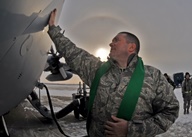
From Kenmore to Kentucky to Chicago and back to Buffalo, the road to the priesthood for Father James Bastian had many stops, twists and turns. The middle of five children in the Bastian family, Father Jim was born in Kenmore, NY and attended public schools. His father was a refinery operator for Ashland Oil and was transferred to Kentucky when Father Jim had finished his first year of high school.
“When we lived in Kenmore, I attended religious education classes at St. Paul’s as did the majority of my public school classmates,” Father Jim recalls. “In Kentucky, there were four of us who were Catholic in a school of 1,200 students – and one was my brother. It was quite a change.”
Upon graduating from high school, Father Jim studied electrical engineering at the University of Kentucky, noting that he had always had a knack for math. While in college, he became active in the university’s Newman Center at the nearby Holy Spirit parish, helping to establish a student parish council and serving on the finance committee.
“I was dating a woman at the time and I never really thought about the priesthood,” Father Jim says. “During the summers I worked at Ashland Oil, and worked part-time at the Eastern Kentucky Power Company. I really enjoyed the field of electrical engineering.”
As his involvement at the Newman Center grew, Father Jim became close friends with many of the staff at the parish including Father Dan Noll. “I began to see in Father Dan a tremendous man who was so life-giving to others,” Father Jim remembers. “I was very impressed by how he reacted in helping people in many different situations.”
The Newman Center had a “Called by Name” program in which members of the congregation were encouraged to submit the names of other members who they thought would make a good altar server, Eucharistic minister, deacon, or priest. After one such program, seven different people had submitted Father Jim’s name as someone who would make a great priest. “As I said before, I had never, ever considered the priesthood, but that experience made me begin to contemplate it,” Father Jim says.
A friend who was considering the priesthood invited Father Jim to join him on a trip to check out a seminary in Southern Indiana. “I had a horrific experience,” Father Jim notes. “There was just something about the school that made me very uncomfortable.”
The experience, however, did not discourage Father Jim from his consideration of the priesthood. He had graduated from the University of Kentucky in 1988 and started graduate school in electrical engineering. He had a job waiting for him when he completed his Master’s program and thought he would be married and start a family. Then he met a seminarian who was studying for the priesthood for the Diocese of Lexington, Kentucky. The seminarian suggested Father Jim consider a school in Chicago, Illinois – Mundelein Seminary.
After some soul-searching, Father Jim enrolled at Mundelein and right away found theological classes and philosophy studies very different from the math-oriented engineering classes he had taken.
“Being a numbers guy, I figured I had a 25% chance of becoming a priest if I entered the seminary,” Father Jim says. “But after I enrolled, I could sense my odds getting better and better. It was challenging, but I began to take to it.”
While doing ministry during the summers in the Appalachian Mountains of Kentucky, Father Jim began to feel like an outsider. “People always asked where I was from, because I didn’t speak the same way, being from Western New York,” Father Jim says. He knew that he would be serving in the Diocese of Lexington upon his ordination and began to think it might not be a good fit. With relatives still living in the Buffalo area, he decided to transfer to Christ the King Seminary in East Aurora and serve in the Diocese of Buffalo.
However, the summer before he transferred, Father Jim studied military chaplaincy in Germany. His father had been a Marine and Father Jim always had a great respect for the armed forces. He was eventually commissioned a Second Lieutenant in the U.S. Army, following a couple of more summers of basic training.
Father Jim received his Master’s in Divinity in 1994 from Christ the King Seminary and was ordained into the priesthood in 1995. His first assignment was at our Lady of Perpetual Help in Lakeview, NY where he served with the late Monsignor John Zeitler with whom Father Jim formed a great friendship. From there, assignments included St. Gregory the Great in Williamsville; Saints Peter and Paul in Hamburg; and Our Lady of the Sacred Heart in Orchard Park. He first served as pastor of a parish at the combined parishes of St. Bonaventure and St. William in West Seneca.
As if his assignments did not keep him busy enough, Father Jim taught religion at St. Joseph’s Collegiate High School; served as a chaplain at Roswell Park Cancer Institute; and was re-commissioned as a U.S. Air Force Chaplain serving with the 914th Airlift Wing in Niagara Falls, NY, attaining the rank of Major. He also serves as a chaplain at the VA Hospital in Buffalo.
Currently, Father Jim serves as pastor of Immaculate Conception Parish in Ransomville, NY in Niagara County, where he has been for almost three years. “I have truly loved the priesthood, especially bringing the sacraments to the faithful,” Father Jim says.
In his spare time, Father Jim plays the trumpet and still enjoys the challenge of solving math problems. Asked what advice he may have for a young man considering the priesthood, Father Jim concludes, “Give the seminary a try, even if there are some doubts. No one is ordained with everything he needs to be a priest. It is a wonderful learning process that is richly rewarding. Most of all, pray about it. God will offer His guidance.”
FEBRUARY 2016 PRIEST OF THE MONTH - REV. JUSTUS NDYAMUKAMA
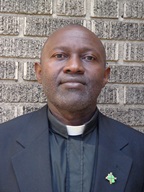
In 1968 Justus Emiliani Ndyamukama became the eighth of his parents’ ten children in Tanzania, East Africa. His oldest sister would grow up to become a nun and Justus, a priest. He was born into a strong Catholic family. Both his parents and grandparents were devoted to their faith. Father Justus recalls saying morning and evening prayers at home as well as praying the rosary together as a family. He also attended Mass almost every morning and began serving at the altar at age ten. Sometimes he would be late for school so his parish priest would tell the school, “If he is late, know that he’s at church.” He was very impressed by the priest at his parish. He liked the way he dressed and conducted Mass. He thought to himself, “One day I would like to be like him.”
After high school, Justus began his studies for the priesthood. In 1993 when he was 25 years old, he was required to enter the National Service for one year. The service took place in another region of Tanzania and there was no Catholic Church on the base. He never missed Mass before in his life and was not about to miss it now. He used to sneak off the base to attend Mass every Sunday and was surprised to find that the closest church was only visited by a priest every other week. The catechists would hold prayer services when the priest was not there. He decided to visit the diocese of the region to let them know he would like to resume his studies for the priesthood with them because of the lack of priests there. He was able to switch dioceses and was ordained in August 2001.
After ordination, Fr. Justus served as parochial vicar for nine months. He then served as pastor of St. Peter Apostle Church for five years. Father Justus then became vice rector of the seminary at which he was sent to teach. In this role, it became important for him to acquire a teaching degree. His bishop advised him to find a place of higher education that would offer him a scholarship. Father Justus knew a religious sister who was studying at D’Youville College in Buffalo so he contacted her. D’Youville offers scholarships to priests and religious sisters who want to further their studies. He applied and was accepted. Father Justus earned his Bachelor and Master degrees in December, 2014. He will continue on to earn his Doctorate as well.
Ultimately, Fr. Justus plans to return to Tanzania after his education to resume teaching at the seminary. While he is here, the Diocese of Buffalo will benefit much from his presence. While studying, he also assists at St. Rose of Lima and St. Anthony Parishes in Buffalo celebrating Mass in Latin. He also helps out when needed at Our Lady Help of Christians in Cheektowaga. Father Justus was recently named Director of the Diocesan Pontifical Mission Societies which is comprised of the Society for the Propagation of the Faith, the Society of St. Peter the Apostle and the Holy Childhood Association. As director, Fr. Justus will spread the word of the needs of the mission parishes throughout the Diocese of Buffalo. He is an avid volleyball player and used to enjoy competing with the seminarians back in Africa. He also likes to sing.
In Tanzania, there are high expectations for priests. Father Justus remarked, “The people believe a priest can do everything.” He went on to explain that whatever happens, sickness problems, etc. everyone goes to the priests for help. There is a lot of pressure on them to solve all these issues. He added, “The economic crisis makes it difficult for the priest to reach all the people wherever they are.” The parishioners are not in a position to be able to support the priests with enough gas money to get around to all the parishes they must visit. This makes it difficult to minister to their needs.
Father Justus doesn’t let the pressures of the priesthood get him down. He believes he has been called to a life of service and commented, “I feel happy when I offer service to other people.” If someone comes to him for help, he is pleased if they leave feeling “comfortable” with whatever help he can provide. Father Justus advises those interested in the priesthood to understand it is a life of service. He added, “We need to serve other people and we need to bring this light of the Gospel, the Good News, to other people.” He notes that priests are needed in the community to celebrate the Sacraments. Men who consider priesthood may have other ambitions but need to keep in mind that service to people should always come first.
Father Justus knows that by answering “yes” to the call to priesthood, he has not only enriched the lives of others but also his own. He exclaimed, “I am happy when I feel I am needed and when I fulfill my duties as a priest; saying Mass, assisting patients in the hospital, counseling, etc. If they can come out happy in the midst of whatever challenges they have been undergoing, that makes me happy.”
JANUARY 2016 PRIEST OF THE MONTH - REV. WALTER SZCZESNY
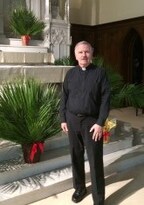
Whether talking with people about their delinquent tax returns as a field officer for the U.S. Treasury Office in Los Angeles, CA or guiding the faithful today as pastor of All Saints Roman Catholic Parish in Lockport, NY, Father Walter Szczesny has always brought compassion to his work.
Father Walter’s work on his path to the priesthood included a career with the federal government, a teaching position with a school for the blind in New York, and roles as counselor and tutor at a Catholic orphanage in California.
“Part of my job with the U.S. Treasury may have been an enforcement arm, but part of it was a compassionate arm,” he explains of his early career. “I listened, gained an understanding of the person’s situation and offered guidance – it was excellent preparation for the priesthood.”
One of six children, Father Walter grew up in Batavia, NY where he attended Catholic grammar and high school. He studied at Oswego State College before enrolling at Wadhams Hall Seminary College in Ogdensburg, NY. “When I started college, I wasn’t sure of my career goals,” Father Walter says. “After much prayer and reflection, I considered the priesthood and entered the seminary.”
He earned a Bachelor's Degree in Philosophy in Ogdensburg and then entered Christ the King Seminary in East Aurora for further study. Two years into the program at Christ the King, Father Walter took a summer job at a Catholic parish in Pomona, CA. He loved it so much that he obtained permission from the Bishop of Buffalo to delay returning to the seminary. Still discerning his vocation, he returned home to Batavia and took a job as a teacher at the New York State School for the Blind, where he learned sign language and taught children in a program for the deaf and blind.
After two years as a teacher, Father Walter went back to California and served as a counselor and tutor at Maryvale Catholic Orphanage in Rosemead. He spent about a year there before taking the position with the U.S. Treasury Office. Missing his Western New York roots, he transferred to the same job in Ithaca to be closer to family and friends and remained there for four years. Throughout this journey, the call of the priesthood was always in the back of Father Walter’s mind.
Nine years after leaving the seminary, Father Walter decided to return to Christ the King and resume his studies as a third year theologian. He was ordained a Transitional Deacon in 1989 and worked at Saint Amelia Parish in Tonawanda. He was ordained a priest on July 21, 1990 and was first assigned to Immaculate Conception Parish in East Aurora where he served for four years. He then served at Saints Peter & Paul Parish in Hamburg for the next five years.
Bishop Henry J. Mansell then asked Father Walter to return to Christ the King Seminary to be the Assistant Director of Formation and to teach in the Liturgy Department. After two more years, he was assigned the additional responsibility as pastor of Saint George Parish in West Falls. He served there until 2006 when he became the Director of Vocations for the Diocese of Buffalo.
“I was well-prepared for my work in the Vocations Office because I had been in the seminarians’ shoes, Father Walt recalls. “Like so many of these young men, I had worked in the world and understood that the path to the priesthood is not always direct and clear.”
In 2015, Father Walter was assigned as pastor of All Saints in Lockport returning to what he truly loves about the priesthood.
“I enjoyed my time as Director of Vocations and I am proud to have worked with many of the men who have been ordained to the priesthood during that time,” Father Walter concludes. “Now I look forward to what is every diocesan priest’s dream – leading a parish and helping people with compassion and understanding on their faith journey.”
NOVEMBER 2015 PRIEST OF THE MONTH - REV. MSGR. MICHAEL YUNK
Monsignor Michael J. Yunk’s path to becoming a priest was fairly typical for a young man in the 1940’s. With encouragement from a nun who taught eighth grade, he entered the Little Seminary in Buffalo upon graduating from Saints Peter & Paul Elementary School in Williamsville.
However, Monsignor Yunk’s priesthood has been anything but typical.
A retired colonel and chaplain in the U.S. Army, Monsignor Yunk has traveled the world – including motorcycle trips across Europe. He has earned a number of degrees in higher education, and in more recent years, he returned to the Diocese of Buffalo to help out wherever a parish needed support.
Today, Monsignor Yunk lives in the same house in the Village of Williamsville where he grew up. His family roots can be traced back to the 1850s in Swormville, where his great grandfather ran a farm off Stahley Road. Monsignor’s father was a plumbing inspector for the town of Amherst, and as a boy attending Saints Peter and Paul, the future priest worked as a pin setter at the school’s bowling alley. He notes that this was during the nation’s Great Depression when hard work and perseverance were the rule.
“I was actually well-formed by the Depression – we learned the value of money and the importance of moderation,” Monsignor Yunk explains. “I was part of what I call the Silent Generation – we benefitted greatly from the previous, Greatest Generation who fought in World War Two, as well as from the Baby Boomers who came after us, ushering in changes in education, civil rights, and new technologies.”
Not content to follow his father’s career in plumbing, Monsignor Yunk thought he might pursue the emerging field of electronics. But the results of some standardized testing his eighth grade class had taken pointed him in a different direction. One of the questions asked what the students were going to do with the rest of their lives.
“Where did I go wrong? Not one of you thought about being a priest or a nun,” Monsignor Yunk recalls the teacher saying after reading the test results. “I went to her later and said I think I might be interested in the priesthood.”
Monsignor says that he attended Mass every morning from the first day of the first grade when he was in school. An assistant pastor at the parish was a kind of role model for him and influenced his decision to consider the priesthood. “He was just an ordinary guy who you could easily relate to,” Monsignor remembers.
While classmates entered high school, he enrolled at the Minor Seminary, graduated from St. Bonaventure and also attended the Canisianum Jesuit Seminary of Innsbruck, Austria. He was ordained in 1957 in Innsbruck and would later earn a Master’s Degree in Education from Long Island University.
While at the seminary in Europe, Monsignor Yunk visited a cousin who was serving in the Army in Germany. The young seminarian stayed on the barracks and realized there was a shortage of priests in the Armed Services. “I asked my cousin if he ever saw a priest, and he said they had to be in three places at once – there just weren’t enough,” he says.
After his ordination and now back in Buffalo, Monsignor Yunk asked Bishop James McNulty if he could join the Army and serve as a chaplain. The bishop said he needed the young priest in the Diocese of Buffalo, so Monsignor became a member of the U.S. Army Reserves. “I drilled with the reserves and worked a job with other recruits, so I learned the ways of the Army,” Monsignor said. “I give the reserves a lot of credit.”
In 1966, Bishop McNulty granted his permission and Monsignor Yunk volunteered for the regular Army, becoming a chaplain. During his 27 years in the Army, he was stationed in South Korea, Okinawa, Vietnam and Germany. By the time he retired from the service in 1993 he had attained the rank of colonel.
Upon retirement from the Army, Monsignor Yunk returned to Buffalo and assisted at parishes across the Diocese of Buffalo including St. Mary’s in Lockport and St. Leo the Great in Amherst. Bishop Edward Head named him Monsignor in 1993. He retired from active service as a priest in 2000, but like so many dedicated priests he continues to help out where he can.
Monsignor Yunk is typical of so many retired priests in our diocese who serve the faithful with great generosity. Not so typical is the support he offers to his fellow priests, as well as soon-to-be priests at Christ the King Seminary, through the establishment of significant charitable gifts in the Diocese of Buffalo.
Monsignor Yunk looks back on his 58 years in the priesthood – paralleled with service to his country in the Army - with great satisfaction. “I am grateful for my priesthood and the opportunity to be of service to others,” he concludes. “Most importantly, I give gratitude to God the Father.”
OCTOBER 2015 PRIEST OF THE MONTH - REV. BRYAN ZIELENIESKI
Rev. Bryan Zielenieski grew up on a dairy farm in Arcade, NY, a farm founded by his grandparents in the 1940s. He lived and worked with his mother and father and two younger brothers on the farm, tending to the livestock and performing the many chores involved in running the dairy operation. He understood hard work at an early age.
While living on the farm in Wyoming County, he attended school in the Pioneer School District, including Arcade Elementary and Pioneer High School, from which he graduated in 1997. He was also actively involved in his parish, formerly known as SS. Peter and Paul in Arcade, and now named St. Mary's Roman Catholic Church. He received all his sacraments at the parish and volunteered as an altar server as a young boy. He recalls that his first inkling about the possibility of becoming a priest came when he was an altar server.
"I remember one Sunday watching our pastor, Monsignor Chester Melock, saying mass and I was thinking I could do that," Father Bryan explains. "But then the thought went out of my head and I did not consider it again until I was in college."
After graduating from high school, Father Bryan attended State University of New York at Cobleskill, located west of Albany, where he earned an Associate's Degree in Dairy Management and a Bachelor's Degree in Agricultural Business. He notes it was always his intention to take over the family farm, as his brothers had other plans outside the farming life. As it turns out, circumstances changed and his brothers stayed, while Father Bryan went on to teaching.
Upon earning his degree, Father Bryan started student teaching and earned his teaching certification through State University College at Buffalo. His first teaching job was at his alma mater, Pioneer High School, where he taught agriculture for three years. He worked on the family farm at the same time, on weekends, evenings, and during the summer, and he stayed active in his parish.
"When I was in college, thoughts of entering the priesthood had surfaced a little bit more," Father Bryan says. "A priest at the parish in Cobleskill that I attended during college – with whom I became very good friends – served as a gentle and quiet example of what I thought a priest should be. He made it more realistic to me."
It was during his time teaching high school that Father Bryan began thinking more seriously about the priesthood. He was also working as music director and high school coordinator for confirmation and involved in other volunteer activities at his parish in Arcade. To help out the pastor, who was responsible for two parishes in the area, Father Bryan took on the duties of pastoral associate. He notes that he absolutely loved it. And there was a moment during that time that he says really solidified his desire to become a priest.
"I was helping out, serving a communion service at the church," he recalls. "I was standing on the altar leading the Our Father when I was hit with the thought that there was no place I would rather be than right there, right then."
He prayed to God for guidance and before long Father Bryan contacted Father Walter Szczesny who was in his first year as Vocations Director for the Diocese of Buffalo. Father Bryan entered Christ the King Seminary in East Aurora and his parish assignments as a seminarian included Fourteen Holy Helpers in West Seneca, St. Vincent DePaul in Niagara Falls and Christ the King in Snyder. He also spent a summer at a seminary in Krakow, Poland where he experienced the Catholic faith in another culture, and he performed a hospital ministry at Mercy Hospital in Buffalo. He spent his diaconate year at Ss. Peter and Paul in Hamburg.
Father Bryan was ordained into the priesthood in 2014 at St. Joseph Cathedral in Buffalo and his first assignment was at St. Christopher's Parish in Tonawanda, where he serves as parochial vicar at this writing.
Father Bryan says there are parallels between being a priest and working on a farm. For one thing, the work is hard but very fulfilling. "On a farm, when you are raising livestock or planting crops, you put a lot of trust in God," he explains. "In a sense, the priesthood is the same – when you are tending to His flock, you put your trust in God. Ultimately, God is going to take care of things. We are simply his helpers in the field"
For the individual considering a vocation, Father Bryan advises that the man pray about it and ask God for guidance. Citing his own story, Father Bryan goes on to say it is okay to go on to college or pursue a career – trying other things is part of the discernment process.
"I love priesthood beyond a shadow of a doubt," Father Bryan concludes. "The best part for me is that everything falls away when I celebrate mass. Any stress and tension is put aside and it is all about bringing the sacraments to the faithful."
SEPTEMBER 2015 PRIEST OF THE MONTH - REV. THOMAS MAHONEY
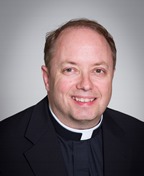
As one of the newest priests in the Diocese of Buffalo, Fr. Tom Mahoney couldn’t be happier with the path his life is on. The youngest of four children, Fr. Tom has always been a deeply religious person who feels very connected to his Catholic faith. His parents were raised in South Buffalo as devout Catholics. He and his two brothers and one sister grew up in Lancaster, attending Alys Drive Elementary School and Lancaster High School. He and his two brothers were altar servers together at their parish of Our Lady of the Blessed Sacrament, now called St. Martha’s Church. Faith was just a very natural part of their lives. Always a questioning person, his parents thought he would be a lawyer. But when it came to the big questions about the meaning of life and what he believes, Fr. Tom turned to reading and learning more about his faith. After earning his Bachelor’s Degree in accounting from Niagara University, Fr. Tom worked in public accounting. He moved on to become the comptroller of a small company in Amherst.
When did he begin to consider becoming a priest? “I think my first inclination was when my father passed away in 2002. I gave the eulogy, and I made the comment at the beginning of it that every funeral is a Catholic Mass, and every Mass is a celebration, and this is a celebration of my father’s life in Jesus Christ. Afterwards, Fr. Louie Dolinic, who was the pastor at OLBS at the time, came up to me and said, ‘You get this Catholic thing, have you ever thought about being a priest?’ He planted the seed and from there it grew. My father had been sick, he’d had a stroke and I was taking care of him, so that was a big part of my life for a couple of years. When he passed away there was a bit of a hole, and ultimately I was searching for where my life was going. I went to daily Mass and asked the Lord what He wanted me to do with my life. I feel like I’m drifting, and there’s Fr. Louie’s voice saying you should think about being a priest. My first response was, ‘No, let’s try that again!’ But it just kept nagging at me. I decided to give Fr. Louie a call, and I met with the vocations director (Fr. Walter Szczesny) and did a lot of soul searching. It still took a few years to take that leap of faith to sell my house and car and enter the Seminary. It took over seven years to work it all through. It’s like that Indiana Jones leap of faith. You have to place your trust in God and see how it all works out.”
Father Louie gave him the name of Msgr. John Madsen, who met with Fr. Tom once a month for spiritual direction, just to try to discern how God was moving his life. When he first entered the Seminary in 2007, he lasted about three weeks. It was hard, he had struggles and decided to leave. Having sold his house, he went to Syracuse where he met Fr. David Casey, a Jesuit priest. Father Casey helped him understand the Ignatian Discernment of Spirits, showing him that the negative feelings he had about how he really couldn’t succeed were not from God. He learned to trust God, and that made a big difference. When he felt frustrated with the formation process, writing papers or doing the work, he learned to trust God to get him through.
While earning his Masters in Divinity from Christ the King Seminary, Fr. Tom spent his pastoral year at St. Vincent de Paul Parish in Niagara Falls. “I remember towards the end of that year, I sat down to think about how I felt about this. I asked myself, can you do this, how do you feel about living in a rectory and living this life? All the struggles you have, it doesn’t outweigh the joy. When I looked back at the year, I had some days that weren’t great, but it was an awesome experience. The incredible people you meet on your journey to priesthood are amazing!”
Father Tom was ordained into the priesthood on June 6, 2015 at St. Joseph’s Cathedral. The date was special to him, as its D-Day in American history; and on the Church calendar it’s the feast day of St. Norbert. Father Tom’s father passed away on June 1st, so early June has been special to him. His first assignment was St. Gregory the Great in Williamsville. “I’m just starting my tenth week; Fr. Leon would like it if I gave it in weeks!” He’s had a wonderful experience so far. The transition has been smoother than he expected. “The priests I live with (Fr. Leon Biernat, pastor; Fr. Sebastian (Sibby) Pierro and Fr. Francis Lombardo) have been very helpful and there’s a real sense of community and brotherhood that was a good transition from Seminary. In Seminary, you live with a lot of guys in a community. While you don’t always have perfect relationships, it’s a very supportive community and helps you along in the program. Sometimes you come out into the priesthood and you’re on an island. You can feel lost. But Fr. Leon, Fr. Sibby and Fr. Francis have all been quite helpful.”
One big difference from Seminary is the rapid pace of life as a priest, especially at a large parish like St. Greg’s. Seminary offers a lot of time for reflection; but as a priest, Fr. Tom always finds himself going from one event to another. “One week, I had six funerals in seven days. And that was my third week here, so that was stressful. But it was a great learning experience to realize that I could be prayerful and be there for those people. I thought it was a great experience, after the fact. But getting through, writing a homily for each funeral and making sure that it was personalized and touched them, was stressful.”
The best part of priesthood for Fr. Tom is celebrating the Eucharist, he finds it truly amazing! “There are times when I start the Offertory on a week day when there’s no music, and I’m standing there going, ‘Ok, be in the moment’ and not get overwhelmed by the sacred moment that I’m in, how incredible it is. Make sure that you celebrate reverently in every moment.”
As anyone who attends Fr. Tom’s Masses knows, he is a huge New York Yankees fan. Before he entered the Seminary, he would go every year with a group of friends to New York to see a Yankees game. “Bishop Malone doesn’t know this, but on Ordination day I was wearing my Yankees championship t-shirt underneath. The Bishop is a Red Sox fan!” Father Tom also enjoys playing video games, even if he’s not very good at them. “Last Christmas I was able to get a PS4. Madden Football comes out today, I’m thinking about downloading it, I played it years ago. In Seminary, you don’t have money so I couldn’t buy it. It used to be that I would buy video games and my nephews would get them as hand-me-downs. When I entered Seminary, they were old enough to buy their video games and they would hand them down to me!” He also loves to read. “I try to do a lot of spiritual reading, although there’s not as much time to do that here at St. Greg’s as there was in the Seminary. I would eat up books there. But here, it’s been tough, sometimes you’re just exhausted, and the last thing you want to do is pick up the Pope’s new Encyclical…which I do have, and want to read! It’s just harder to get there.”
Father Tom’s advice to anyone considering the priesthood is to learn to trust God. “Having a spiritual director before you enter Seminary is key, having a priest or religious sister, anyone who has had experience in religious life really helps you to see how God is working in your life. I think the stories all have a similar bend to them. Even if you read scripture, how God calls the prophets. For my Ordination, the first reading was Jeremiah’s call, and I felt that very powerfully. Like God is calling and I’m saying, ‘No, I can’t do that! I can’t stand up in front of people and I can’t write these papers, I can’t!’ All this stuff I can’t do, and God was saying to Jeremiah, ‘Yeah, actually, I’ll give you what you need, just relax.’ Oh, that’s not an exact quote, but essentially that’s the feeling!”
AUGUST 2015 PRIEST OF THE MONTH - REV. ROBERT WARDENSKI
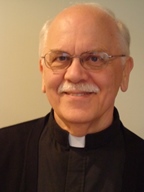
While in high school, young Bob Wardenski felt called to become a priest. Having been educated by Franciscans at Bishop Ryan High School but also influenced by priests he knew from his home parish, Holy Apostles SS. Peter and Paul in Buffalo, he needed to discern which group he would join as a priest. At first, he thought he considered becoming a Franciscan but he then thought, “I didn’t want to spend my entire life teaching. This was my perception of the Franciscans. It wasn’t true, but it was my perception so I decided to enter the Diocese of Buffalo to have a more diversified ministry.” The diversified ministry of diocesan priesthood suited him well. He even had some opportunities to teach and enjoyed them very much.
Father Bob is the third child in his family of four. He grew up with two sisters and one brother. His father passed away when he was three years old and his mother raised all four children on her own. The family owned a delicatessen on Clinton Street and she worked there from 7:00 AM to 11:00 PM. Besides the expense of raising four children, his mother also felt it was important that they have a Catholic education.
After graduating from Bishop Ryan High School, Bob spent two years at the Minor Seminary on Dodge Street. He then entered St. John Vianney Major Seminary (now Christ the King) in East Aurora. His mother passed away after his first year there. He was just 20 years old and the rest of his siblings still lived at home. He remarked that, “She died on September 9 just before I was to return to the seminary for my second year. I was delayed for a week but then returned. It was so nice to have the community of support from the priests and seminarians.” His mother was in favor of him becoming a priest. He recalled her advice to, “Make sure it’s what you want to do. You can come home right up until the day you’re ordained but once you’re ordained, you’ve made your choice and I expect you to be faithful to it.” She gave the same advice to his brother and sisters about marriage.
After ordination Fr. Bob was assigned for a short time to St. Adalbert Basilica. He then moved on to St. James Church in Buffalo where he spent five years. He really enjoyed that experience especially Religious Education and Liturgy. He said, “Those were two things I could really do.” There were many associates stationed at St. James with him and he found their company to be enjoyable. His next two assignments were to St. Francis Parish in Tonawanda and then to St. Rose of Lima in Buffalo. He then found himself back at St. James for five more years. He moved briefly to St. Paul’s in Kenmore where he spent a few months and was then given his first pastorate at St. Peter’s in LeRoy and St. Anthony’s in Lime Rock.
To go along with his changing role in leadership he also found himself in a rural area of the diocese with which he was not familiar. He remembered thinking at the time, “I’m a city kid and it’s strange to be a pastor 50 miles away from a city. I was used to getting in a car when I needed something but there I would put it on a list and shop once a week when I could get to a city.” His parishioners kindly referred to him as the “Big city priest.” Father Bob spent ten years as pastor there and then was named pastor of St. William Parish. After six years there in 2005 he was assigned to Immaculate Conception Parish in East Aurora where he will celebrate ten years as pastor this year (2015).
Father Bob loves to read and go to the movies as well as to the theater. He used to enjoy doing stained glass. He took a five session class when he was in Tonawanda at St. Francis Parish. There he had a room set up to use for this and purchased the materials he needed. He made windows, lamps, etc. He moved everything to LeRoy thinking he’d be able to do it there but it didn’t work out. When he left LeRoy he gave it all away. He recalls that it was a very peaceful and creative outlet.
As a priest, Fr. Bob has enjoyed teaching adults. He loves sharing the faith through RCIA, Baptism class and Sacramental programs such as First Reconciliation and First Eucharist. He feels most fulfilled when he has helped the adults in his parish. He exclaimed, “I can see I enlightened them somehow to understand the Faith better. They sit back and say, ‘Oh, I never thought of it that way.’ I love to be able to share the faith, not teaching in a classroom but more the group thing, adult education.” He also enjoys preaching very much.
Administration of the parish can be challenging but Fr. Bob finds it just as challenging as he puts it, “to see so many people who have left the Church and I don’t know how to get them back. Even in the ten years I’ve been here, I’ve noticed a lot of families have stopped practicing the Faith. I’ve actually sent letters to them asking if there is something we’ve done and they don’t respond. The Church has so much to offer them and yet, they don’t want it.” It’s also difficult to deal with families who have left the faith and come back for help when a crisis occurs. Father Bob finds himself thinking, “Where have you been for the last five years?”
To those considering a vocation, Fr. Bob advises, “Don’t come in to see it as a career, come in to see it as a vocation. You have to be willing to serve the people. You have to be willing to give yourself and your time to the people of the parish you’ve been assigned to. It’s not just a career you work 9 to 5 and the rest of the time is mine. Come in to be a priest who serves the people of God. People have asked me, ‘What was your plan when you were ordained?’ and I said, ‘I didn’t have a plan.’” Father Bob was happy to let God provide the plan and with an open mind and an open heart, have the courage to follow it. He has trusted God to direct him where he needs him to be.
JULY 2015 PRIEST OF THE MONTH - REV. ROBERT HUGHSON
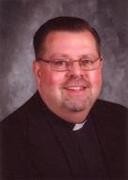
Growing up in Albion, NY Bob Hughson thought about the priesthood in high school. He was attracted to the ministry of his parish priest and was also invited by a different priest to visit Wadhams Hall Seminary with a group of other young men. Looking back, Fr. Bob recalls, “No matter what I was thinking about, I would always go back to that thought of the priesthood.”
The oldest of the three boys in his family, Bob graduated from the Albion Central School system and went on to earn an Associate of Arts Degree from Genesee Community College in Batavia. He thought about teaching but his father advised against it, thinking that there were not a lot of jobs in that field at the time. Still considering priesthood, Bob decided to enter Wadhams Hall Seminary-College in Ogdensburg, NY in 1973 and earned a Bachelor of Arts Degree in 1975. He then went on to study at Christ the King Seminary and graduated with a Master of Divinity Degree. Father Bob was ordained to the Priesthood at St. Joseph’s Cathedral in Buffalo on October 19, 1979 by The Most Reverend Edward D. Head, Bishop of Buffalo at the time.
His first assignment was as Associate Pastor of St. Anthony’s Church in Batavia. His mother’s family was from Batavia so he had grandparents, aunts and uncles there. That made for a nice beginning to his priestly ministry. In 1982, Fr. Bob was reassigned as Associate Pastor of St. William’s Church in West Seneca until 1984. Then he was named Administrator of Holy Spirit Church in North Collins for a year while the pastor was on sick leave. After that he spent a year as Associate Pastor of SS. Peter and Paul in Hamburg. In 1986 he was assigned as Parochial Vicar to Our Lady of Mt. Carmel Church in Niagara Falls, NY and he has been in that area ever since. From 1992 to 1998 he held the positions of teacher, Admissions Director, and Director of Campus Ministry at Niagara Catholic High School. He continued to live at Our Lady of Mt. Carmel and help out with Masses there on the weekends.
In 1998, Fr. Bob was named Pastor of St. Charles Borromeo Parish in Niagara Falls. He held that position until 2001 when he was then named Pastor of Prince of Peace Parish, also in Niagara Falls. This was a larger parish with a school. Prince of Peace Parish merged with St. Leo’s in 2008 to become St. Vincent de Paul and he was asked to stay on as pastor. In 2006, Fr. Bob was appointed Episcopal Vicar of Western Niagara County and in 2009 he was re-appointed Vicar Forane of Western Niagara County, a position he currently holds. Father Bob was named Canonical Administrator of Catholic Academy of Niagara Falls in 2013 and he currently holds that position as well.
Father Bob likes to read and watch movies. He enjoys traveling but has a difficult time getting away with his busy schedule.
He feels that the most enjoyable aspect of priesthood is, “Being able to touch the lives of people in so profound a way. You’re with them on the day of their wedding. You see joy in the couple as you’re witnessing this beautiful sacramental moment. You feel good that they’re getting married in the Church, not in the woods somewhere and good that they’re getting married at all. Later on, I may get a call to do the baptism for their first child. Here’s a new life that’s come from the love of these two people.” Father Bob went on to express how wonderful it is to then follow families on to be a part of their children’s First Communion, Confirmation, etc. He exclaimed, “It’s just a joy to be a part of that.” He went on to say, “When there’s an illness in the family I can help by anointing the sick person. Priests are there, not saying much, just being present to them. People just see you there and they feel good. Somehow that love of God is always there for them through the priest. I just feel good about touching lives in very profound ways, Sacramentally especially.”
On the more challenging side, Fr. Bob expressed that it is difficult to deal with people who can sometimes be unreasonable and have unrealistic expectations. From the parishioner in the pew to staff members who might not share his vision, he is always dealing with egos. He added, “Difficult times call for some difficult decisions. That’s not a fun part but it’s necessary. You try your best.” He mentioned that the merger of the two parishes he dealt with in Niagara Falls went well. They have two worship sites and a regional school and he works hard to ensure that everyone feels welcome and appreciated.
As he was inspired by priests when he was younger, he hopes himself to be able to inspire men to consider the priesthood. He advises those interested to, “Discern that possibility. Don’t be afraid to go after it because it probably is God calling you to something you might not want in the beginning or think you need or that you aren’t really worthy or holy enough for but God calls you in spite of your faults, failings and weaknesses. He wants you of all people to be a shepherd of His people.” He went on to advise that men should, “Talk about it to other priests as well as to those who are in formation. Ask the questions that you need to ask but don’t be afraid to make that commitment, to be a candidate for priesthood.”
Father Bob has supervised six seminarians through the years by welcoming them to his parish as part of their formation. Four have already been ordained and two, Fr. Tom Mahoney and Fr. Lukasz Kopala, were recently ordained in June 2015. He remarked, “We’re happy to be part of the formation process. I’ve enjoyed having seminarians with us. People (in the parish) have been very good and supportive of them and nurtured them along the way as well.”
JUNE 2015 PRIEST OF THE MONTH - REV. DENNIS MENDE
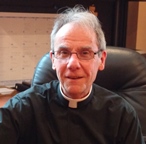
At a time in life when some people begin to lapse in their faith, Fr. Dennis was just getting started in his. His roots were in New Jersey but not in Catholicism. He recalls, “I wasn’t raised Catholic and therefore never had a thought in my mind about becoming a priest.” The old quote rings true for Fr. Dennis, “God doesn’t call the equipped, He equips the called.”
He spent the first nine years of his life in New Jersey until his father took a job transfer to Buffalo. His family moved to Eggertsville for two years and then Tonawanda. Dennis graduated from the Ken-Ton School District and the State University in Albany. His interest in faith matters began to develop in his college years. He graduated with a degree in Sociology and a minor in Latin American Studies. He intended to go on to grad school to get a degree in social work but decided to put it off for a while so he could earn the money he needed to proceed. While he was working he noticed, “the call began to show itself.” Influences in his life led him to the Episcopal Church where he was baptized and received as a member. Feeling called to serve God, he entered and tested a vocation in an Episcopalian religious order. He went through postulancy, novitiate and temporary vows with the Order of the Holy Cross but recounted that, “During that time I would say, in part, I read myself into the Catholic Church through the documents of the Second Vatican Council and the writings of John Henry Cardinal Newman. What God was calling me to was the fullness of Faith in the Catholic Tradition.” After contacting the Vocation Director for the Diocese of Buffalo, he left the religious order and was received into the Catholic Church at St. Leo the Great Parish. Dennis attended Wadhams Hall Seminary for a year to catch up on the Philosophy and Religious Studies he needed in order to enter Christ the King Major Seminary. He enjoyed the experience and commented that, “That proved to be an excellent decision.”
Father Dennis was ordained by Bishop Edward Head in 1983. At that time Bishop Head gave men the choice of being ordained at St. Joseph’s Cathedral or at their home parish or the parish where they served as a Transitional Deacon. Father Dennis chose to be ordained at St. Joseph’s Parish in Albion where he served as a Deacon. It was a good opportunity for people who had never experienced an ordination to do so.
His first assignment was to St. Mark’s in January of 1984. He was only there for a few months. The priest who was assigned to St. Elizabeth Ann Seton Parish in Dunkirk moved on to become the Director of Spanish Apostolate. Because he could speak Spanish, Fr. Dennis was reassigned to that parish as his replacement. It was a “hybrid” ministry because he was there as the parochial vicar for the Spanish speaking community and also the Catholic Chaplain at Brooks Memorial Hospital and the Chautauqua County Home. Father Dennis spent five years in this location and really enjoyed the experience. He was assigned to St. Amelia Parish in Tonawanda in November of 1989. In February, 1990, Bishop Grosz was made Auxiliary Bishop and someone was needed to replace him as Director of the Office of Worship. Because he was active with the Diocesan Liturgical Commission, Fr. Dennis was invited to apply and was appointed to the position. While serving as the Director of the Office of Worship from 1990 to 1993, he was in residence at St. Rose of Lima Parish in Buffalo and also served as Chaplain to the Carmelite Nuns at the Shrine of the Little Flower of Jesus on Carmel Road. In January of 1994, he returned to parish ministry as Parochial Vicar at St. Mary’s in Lancaster until October of 1995 when his Spanish speaking ability was once again needed. He then became pastor of Holy Cross Parish in Buffalo, where there is a sizeable Spanish speaking population, until 1999.
SS. Peter and Paul Parish in Jamestown needed a pastor in 1999. Father Dennis had really enjoyed Chautauqua County when serving his assignment in Dunkirk in the 1980’s, so he applied and was given the position. He loves to garden, hike and cross country ski. In 2008, as part of the restructuring of the diocese during the “Journey in Faith and Grace” SS. Peter and Paul Church merged with St. John Church and became Holy Apostles Parish. He is currently in his third term as pastor of Holy Apostles Parish.
Father Dennis finds celebrating Mass to be the most fulfilling part of priesthood. He enjoys Baptisms, Weddings and celebrating all the Sacraments. In his own words, he describes the most challenging aspect of the priesthood to be, “addressing the decline in religious fervor during this present time and knowing how to encourage people to become more active in their faith.”
In terms of advice he would give to someone discerning a vocation to the priesthood, Fr. Dennis said, “First of all I would ask the person, ‘Do you have a strong and vibrant relationship with Jesus?’ because that’s the heart of it all and, ‘Do you sense a call to serve in His name and in His image? Do you enjoy church?’ There has to be a sense of enjoyment in that. I enjoy praying, presiding at Liturgy and the diversity of ministries that are involved in a parish. I would also ask, ‘Do you have a sense of fulfillment within the Church and does this give meaning to your life?’”
Father Dennis described his own journey to the priesthood as a discernment process that had its ups and downs, doubts and challenges. Because he was open to learning about something new, he was given the graces and blessings needed to say, “Yes” when God called.
MAY 2015 PRIEST OF THE MONTH - REV. BART LIPIEC
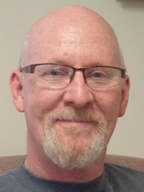
Father Bart Lipiec recalls two very powerful influences in his life that helped him recognize his calling to become a priest. The first was the strong Catholic upbringing his parents provided and the other was the inspiration of a very dedicated Catholic priest.
Bartholomew Lipiec was the oldest of the five children born to his Irish mother and his father of Polish heritage. He grew up in Depew, NY at St. James Parish. He attended St. James Elementary School and Lancaster High School. He credits his parents with being, “crucial in the formation of my faith and priesthood formation. Faith wasn’t something they did, it’s what they were.”
His earliest thoughts of the priesthood occurred in the second grade. Father Leo McCarthy came in to his classroom to recruit altar servers and made an impression on young Bart that he would never forget. He informed the boys, “I need men to be altar servers.” He then proceeded to do a hand stand on the teacher’s desk followed by some push-ups. Father Bart recalled, “It was Fr. McCarthy’s involvement in sports, boys choir and his own personal experience that he showed us what it was to be a Christian man. He held it out there as something you could aspire to and I thought this is the kind of guy I’d like to be.” Father McCarthy informed Bart when he was a junior in high school that he was taking a vanload of boys to see Wadhams Hall Seminary. He said they would get two days off from school and that was enough to inspire Bart to go. His impression was that, “The guys I met were all good solid guys, not what I imagined it would be. They were regular people.” By the second semester of his senior year, Bart felt drawn to explore more about the priesthood so he entered Wadhams Hall Seminary for college. He enjoyed the formation experience and the comradery with the other men who were there. After graduating from Wadhams Hall he decided to take some time off before continuing on to Christ the King for graduate studies. He commented, “When I decided to leave the seminary after college, my father was the first to say, ‘There’s no shame in that. You’re always welcome home. We love you because you’re you.’ That was a very powerful thing. Many years later he said how joyful he was that I stayed and added that if I was going to do it, I should do it because I wanted to do it, not to make my parents happy.”
After leaving Wadhams Hall he dated a little bit, worked in child care and spent some time in the Navy as an officer. He enjoyed the time at sea and seeing the world in a different way. He then felt, “This priesthood thing is still tugging at me and I just can’t let go of it.” So he re-applied and entered Christ the King Seminary to continue his path to the priesthood. On July 9, 1983, Fr. Bart was ordained by Bishop Edward Head. He recalled, “As I got further and further along I got more comfortable. If I had done anything else rather than priesthood it would have been like the square peg in the round hole, it just wouldn’t have fit. For me, it was a journey that took a little while to get there. Prayer, a sense of deliberation, always talking to older priests to see what their experience was, good guidance and the support of family helped me along.”
As a priest, Fr. Bart has served at Holy Trinity Parish in Dunkirk, Infant of Prague in Cheektowaga and St. Christopher’s in Tonawanda. Bishop Henry Mansell assigned him as Pastor of St. Michael Parish in Warsaw and then at Annunciation in Buffalo. He was then assigned pastor at Our Lady of the Blessed Sacrament and St. Barnabas in Depew. The two parishes were merged to form St. Martha Parish. He has thoroughly enjoyed every parish at which he has been assigned. He said, “I’ve had wonderful pastors who were more concerned to give great example of priesthood than anything else. Monsignor Fran Weldgen, Msgr. Dick Amico, Msgr. Ange Caligiuri, they were conscientious men, hard workers and good examples as I was being formed in my own priesthood.” In thinking back on the merger of the two parishes, Fr. Bart recalls, “I saw it as a defining moment of what church is and what it meant to be a pastor. It was a leadership question inviting people to look at what is church in a bigger way than just parochial. We have really good people involved and the merger went as smoothly as it could. It was a positive, sometimes painful experience. Spiritual growth comes out of challenge.” The name, St. Martha, came about because of her hospitality. Hers was the home Jesus went to before every critical moment. It appealed to people that their homes could be a refuge for Christ.
Father Bart likes to golf, play racquetball and lift weights and he used to ride a motorcycle. He really enjoys, “being connected to people by faith and being a part of their lives, hearing how they struggle with life and faith.” He added, “Seeing their depth of faith makes mine a little stronger and gives me a sense of satisfaction. Having a parish school and having the kids around brings great life to the parish. It brings struggles as well but I still feel we’re educating the next generation of Catholic leaders.”
He finds it challenging to keep pace with what goes on at the parish. He said, “I’m the only priest here so I get pulled in many different directions. I want to be fully present but unfortunately I can’t.” He describes the way he handles that dilemma as, “Ecclesial Triage.” He went on to explain, “I set what my priorities are going to be for that day or that week and tend to first things first. Unfortunately, there are always things you can’t get to and that leads people to feel slighted. I’ve been here for ten years so people know it isn’t for lack of desire. It’s not like I’m sitting here watching TV and eating chocolates.”
“Think about it,” advises Fr. Bart concerning men who may have a calling to the priesthood. “So many just let it pass through without giving it serious consideration. Even if you don’t feel inclined, think about it. You’ll be surprised how if you open your mind you can consider something you never thought you could see yourself doing. Once you do, you start seeing yourself in that role and you might be more comfortable than you thought. Pray over it.”
Father Bart was blessed to have a positive environment and people in his life who encouraged him to consider the vocation of priesthood. He is, no doubt, a positive influence on those he meets and serves every day.
APRIL 2015 PRIEST OF THE MONTH - REV. PETER J. DRILLING
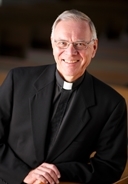
As a gift for his First Communion, Peter Drilling received from his grandmother a Daily Missal. It was a very special gift. It was written in English on one side and Latin on the other. This made it easier to follow along as Masses were celebrated in Latin in 1950. After celebrating his First Communion, young Peter accompanied his grandparents every day to morning Mass. Peter had an uncle who was a Josephite Order Priest who ministered in the south and an aunt who was a Williamsville Franciscan Religious Sister. His earliest thoughts of becoming a priest himself included the idea that someone from his generation should carry on the vocational tradition of his aunt and uncle.
Peter was the first child born to his parents in Astoria, NY close to New York City. Soon after his birth, his father was drafted into World War II and his mother moved with him to their original home town of Darien Center in Genesee County. They belonged to Our Lady of Good Counsel Church and he attended the parish school from grades one to eight. It was a small two room school house. Grades one through four were in one room and grades five through eight were in the other. Peter and his four classmates remained together throughout elementary school moving from one room to the other and then graduating. Most of the children who attended walked or rode their bikes to school. They went home for lunch unless they lived too far to walk.
After elementary school, he attended the Diocesan Preparatory High School for boys who had an interest in the priesthood. He went on to St. John Vianney Seminary in East Aurora (now Christ the King) and then to the Pontifical Gregorian University in Rome, Italy. He was ordained to the priesthood on December 21, 1967 at St. Peter’s Basilica in Rome. His family was able to join him for that special celebration.
After ordination, he returned to Buffalo to begin his priestly ministry. Due to the large number of priests in the diocese at the time, Bishop McNulty told Fr. Peter that he would have to wait until the fall for a position to open up. During that summer, he was assigned to Mercy Hospital as chaplain. This gave the regular chaplain a chance for some time off. Every day, Fr. Peter would say Mass for the large number of Sisters of Mercy who resided there as well as some hospital staff. He fondly remembers, “The sisters went out of their way to help me learn how to visit patients and deal with emergency calls in the middle of the night which happened on a regular basis. It was a wonderful experience.”
In September of 1968, Fr. Peter was assigned as Associate Pastor at Mother of Divine Grace Church in Cheektowaga. At this time the changes which came out of the Second Vatican Council were being implemented in all parishes throughout the world. Father Peter remembers it as a very exciting and also very challenging time. Speaking of himself and the pastor, Fr. James Harold Lucid, he recalled, “We had to take the time to explain why we were turning the altar around so the priest could face the people, as well as why lay people could now read the scriptures at Mass and why the Mass would be said in English rather than Latin.” He went on to explain that about 1970 the parishes had to prepare their congregations for some of the changes during Lent so that on Easter Sunday the changes could go into practice. Father Peter recalls that on Easter Sunday the people who hadn’t been to Mass since the Christmas before were unprepared and astonished at how much things had changed since the last time they were there. One of the changes was the introduction of the “Sign of Peace” which we all take for granted now. At the time, it was something new and Fr. Lucid, who was in his sixties, began his instruction by stating, “OK, I don’t like this any more than you do but if I can do it at my age, you can do it too.” Father Peter remarked, “That was the perfect thing to say as he was older than most of the congregation!”
After five years, Fr. Peter was reassigned to Our Lady of the Blessed Sacrament in Depew. He enjoyed his time there and while he was there he and his friend, Fr. Pat Keleher, went every week for three years to St. Michael’s College at the University of Toronto to study theology. Father Peter then lived in Toronto for two years in order to write his dissertation full time. He could have gone to school in Europe but decided on Toronto because it was the best place to study the famous Jesuit, Bernard Lonergan. His thesis was titled, A Study of the Development of Bernard Lonergan’s Thought on the Material Starting Point for Theology. He received his Th.D. in 1978. He has attended the Lonergan Workshop at Boston College, MA for many years and given several presentations and retreats featuring different aspects of Lonergan in the US, Canada and Europe.
Father Peter loves to learn and has studied languages in Germany and France as well as done further theological studies in Switzerland and the US, both during and after Seminary. His interest in learning blossomed into an interest in teaching when in 1980 he began teaching at Christ the King Seminary in East Aurora. At first he taught part time and was also the Associate Pastor at St. John the Evangelist Church in South Buffalo. He somehow found time to write a book, Trinity and Ministry which was published in 1991 and was then assigned as Administrator of St. George RC Church in West Falls from 1991 to 1995, while continuing to teach at the Seminary. In 1998 he was assigned Pastor of St. Anthony RC Church in Lackawanna until 2005. St. Anthony Church was a merged parish and had a very diverse congregation. The new parish included Hispanic, Italian and African American people. Father Peter celebrated one Mass in Spanish each week and, once in a while, he would celebrate a Mass in Italian as well. He felt he was able to unite the new congregation together because he did not belong to any of the ethnic groups represented yet he could speak both Spanish and Italian. The parish also hosted ecumenical services, some around the annual celebration of Martin Luther King highlighting African American Christian heritage.
Father Peter made it a point to become acquainted with the sizeable Muslim population in Lackawanna. Sometimes on Fridays in an inter-religious effort he would attend their worship services at the nearby mosque. On September 11, 2001 he was teaching at Christ the King when word was received about the events which occurred that day in New York City. He left as soon as he could to travel to Lackawanna. It was a Tuesday, not the usual Friday when he would join them, so he called one of the elders at the mosque and asked, “Do you mind if I come for your evening prayer?” He was welcomed and sat in the back for most of the prayer time until the elder asked him to say a few words. He did not expect this but responded, “This has been a very difficult day for all of us, but I want to assure you that we know that not all Muslims are terrorists any more than all Catholics are terrorists.” He referred to Timothy McVeigh, who was a Catholic and had recently caused the destruction of the Murragh Federal Building in Oklahoma City. They were aware of that incident and after the service most of the men came up and shook Fr. Peter’s hand.
In 2005 his pastorate ended at St. Anthony Church and he finished writing his second book, Premodern Faith in a Postmodern Culture: A Contemporary Theology of the Trinity. He continued at Christ the King Seminary as Professor of Systematic Theology and Pastoral Studies, and took on the added responsibility of Chairman of the Council of Priests from June 2006 to June 2008. At that time, Fr. Peter Drilling was named Rector President of Christ the King Seminary, a post he held from July 1, 2008 to May 31, 2014. In the fall of 2014 he returned for a few months of research and writing to Toronto, ON and was then named Rector of St. Joseph Cathedral, where he currently serves.
“I’ve had vast, exciting, lively experiences as a priest in my 47 years of ministry.” exclaimed Fr. Peter. He added, “That doesn’t mean there aren’t challenges and times I get frustrated but, overall, it’s been wonderful.” He has enjoyed “living with wonderful congregations of God’s people and mingling with them in all the different moments of their lives: Baptism, Marriage, being with them when their loved ones die, accompanying them and just knowing that you share people’s lives at some of the key moments. The context in which we share these moments is our Faith and our Hope and our Love.” Father Peter has facilitated retreats and delivered many papers and lectures on several aspects of Catholic theology and ministry throughout the US and Canada and he has published several articles for periodicals. He has also traveled extensively throughout Europe as well as visited his younger brother who works for the State Department. His brother has been stationed all over the world and Fr. Peter has had the opportunity to join him in Haiti, Nepal and Egypt. He believes without a doubt that, “It is so important to do some sort of physical exercise.” He enjoys walking, hiking, ice skating and cross country skiing. Since moving to the city of Buffalo he has gone skating at the new ice rink at Canal Side. On one occasion, another gentleman skated up beside him and pointed out that they both had the same kind of skates. The man mentioned that he bought his several decades ago and remembered paying $9.50 for them.
Father Peter has spent a lot of time helping men discern their vocation at Christ the King Seminary. He advises them to, “Make sure you pray every day and try to listen to how God is guiding you. If God is calling you to do this, God will give you the strength to go forward. Try to find a good advisor, someone you can talk to quite openly about your concerns, hopes, fears, desires, etc., someone who is well grounded and has wisdom.” If they are fortunate enough they may just find someone like Fr. Peter Drilling.
MARCH 2015 PRIEST OF THE MONTH - REV. JOHN W. ADAMS
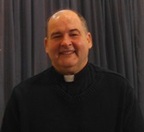
On the morning of April 8, 2005, John Adams awoke early so he could watch the 4:30 a.m. live televised funeral of Pope John Paul II from Rome. This pope had been a great inspiration to him and he had been sharing the struggles the pope faced due to his declining health and impending death with the students in his class, as well as with his own family. He wanted to see the funeral live so that he could record it to share his thoughts and feelings with them when they were once again together. What happened as he watched would change the course of his life forever.
John grew up south of Pittsburgh, PA in the city of Duquesne. His parents, Bill and Mary Adams, very devoted to their Catholic faith, raised John and his sister, Mary Ann and brothers, Bill and Mark to be people of service. John attended Holy Name School (The parish was renamed, Christ the Light of the World after a merger) until the 8th grade and then went to Duquesne Public High School. He played football and took part in a variety of activities while he was there. He went on to attend Penn State University where he majored in Special Education and Elementary Education with a focus on developmental disabilities, speech and language issues. He worked for a year in Pennsylvania with emotionally disturbed children and their families. His uncle, who lived in California, encouraged John to come out that way for graduate school. John then taught for another year in California working with socially and emotionally disturbed children before attending UCLA. He received first a Masters and then a Doctorate degree in Counseling Psychology. He also obtained certification as a school counselor and school psychologist. He took a course in sign language to fulfill a requirement and found it most enjoyable and stimulating, as it presented not only the basics of the language but also the psycho-social aspects of hearing loss and deafness and its effects on family life. Upon graduation from UCLA, he became an assistant professor and taught in the Counselor Education program for three years at California State University at San Bernardino.
Longing to return to the East Coast to be near his family again, John applied for a position which opened up at the Rochester Institute of Technology (RIT). For the next five years he worked as an Associate Professor in Psychology with undergraduate and graduate level students. He also trained School Psychology students to work with the deaf. He began working part-time at St. Mary’s School for the Deaf in Buffalo to gain practical experience he felt would be useful for teaching students at RIT. Eventually he left RIT altogether to work full time at St. Mary School as his love for working more directly with individuals with special needs and their families grew. While he was there he received training and his license as a psychologist so that he could help open a clinic to provide support services to the school and larger community.
At this point in his life he was living in Angola. He had a nice house on Lake Erie and attended St. Anthony Church in Farnham. The pastor, Fr. Gary Kibler, encouraged John to become more involved in the parish so he joined the Parish Council, became a Eucharistic Minister and Director of the Spiritual Life Committee and taught Religious Education. Things were going very well for him. He was dating a doctor who was also Catholic and he was very drawn towards starting a family. His psychology practice was thriving as quite a number of people needed the specialized services he offered. He found great inspiration in the way Pope John Paul II was able to reach so many people. He admired the pope’s ability to, as he put it, “get the Lord’s name out there and share our Catholic faith and connect with the youth.” He was very impressed by the courage Pope John Paul II had in facing the struggles associated with his declining health. He believed the example of how this pope lived and how he died could be inspirational to his students and family, so he got up early on the morning of the pope’s funeral to witness it live. When Cardinal Ratzinger (who would eventually succeed Pope John Paul II as Pope Benedict) gave the eulogy at the funeral, John experienced a profound realization. He recounted, “Whenever Cardinal Ratzinger said, ‘Follow me’ during several parts of the eulogy, an amazing feeling would come over me. The words spoken by him felt so powerful I thought, ‘I can’t ignore this!’”
So there he was, in his later forties, now faced with a life changing experience and no idea what to do next. Life seemed to be going so well he thought…”This must be a mistake, Lord.” A deacon friend of his advised him to get his prayer life in order. He told him to start praying the Liturgy of the Hours, a series of prayers throughout the day that clergy, consecrated religious and lay people alike pray using a Book of Christian Prayer or a IV Volume version. It just so happened that John had been given a book of Christian Prayer as a gift from a professor in California who told him, “I want you to have this. You might need it someday.” John kept it on a shelf for over 20 years but didn’t really know all that it involved and its primary purpose until his friend informed him. When John asked his friend, “What about the woman I’m dating?” His friend replied, “Date them both! Date her and date the Lord and you’ll know.”
John had to travel to Pittsburgh quite a bit because his mother was diagnosed with dementia and his father had to undergo open heart surgery. As the weeks and months passed by, his relationship with the woman slowly faded, possibly due to his needing to be away more often. He spoke more directly to his family about his thoughts of becoming a priest. The first person he told about the calling was his sister and she was very pleased. She revealed that for the last five years she had been praying that he would consider a vocation to religious life. At first he thought about entering a Benedictine monastery. He spent a year discerning with them in Pittsburgh on and off and upon deciding that this was not the path he wanted to pursue, he concluded that, “If it’s not where God wants you to be, you will find out as He lets you know in His time.” When he felt that he wanted to become a diocesan priest, his sister was thrilled and assumed he would become a priest for the Diocese of Pittsburgh so he would be close to his family. However, having lived in the Buffalo Diocese for so long, he decided that this was where he wanted to serve. The idea of studying at Christ the King Seminary in East Aurora with its acres and acres of woodlands was so appealing. This was attractive because of his enjoyment of the outdoors; hiking, cross country skiing, tennis and bike riding. In addition, he said, “It felt like a family atmosphere.” And, most importantly, he loved the fact that, “At the end of each hallway in the dorms is a chapel that houses the Blessed Sacrament.” When his sister and family came to visit the seminary, they understood. His sister exclaimed, “We now know that this is where you belong!”
People asked him how he could go back to school again after having already spent so much time in the past there. His answer was, “Where would I rather be than in such a beautiful location – God’s Country – studying about Him who I love the most?”
Father John Adams was ordained to the priesthood on June 7, 2014. He was assigned as parochial vicar to SS. Peter and Paul Parish in Hamburg. His first nine months of priesthood have only confirmed what he already knew; he loves working with people and serving God. He exclaimed, “Whatever you bring to people, they feed you just as much. You’re working at different roles within the Church like an orchestra moving in harmony and in the same direction together.”
Time is the most challenging aspect of priesthood so far. Father John stresses, “There are only so many hours in each day. I have to make sure I’m using the gifts God has given me in a timely way, according to His will. I have to discern what the Lord wants me to do with each ministry that is available to me and then not remain comfortable in a particular role but continue to challenge myself. Prayer, having a conversation with God about what He really wants me to do is key. The Spirit brings people to where they need to be but they have to be open to that direction.”
Father John advises those interested in the priesthood to, “Stay open to prayer and to the Lord’s presence in the Eucharist and in everyday living. The priesthood is the most awesome life you can ever imagine. Continue to see God in everything around you; your family, friends, creation, all people and experiences. That’s where God is revealed. Be open to learning through all experiences, the good and the not so good. God works through many different sources to show His will. It’s a joyful time of learning. I always have the image of God’s hand being on my shoulder – guiding and supporting me.”
The life of being a priest has just begun for Fr. John and he believes that, “It has brought great joy already into my life. I’m on a path of continued growth like any relationship. It is exciting! I’m enjoying the priesthood ministry so much, now, I can’t imagine how much more awaits me as time goes on.”
JANUARY 2015 PRIEST OF THE MONTH - REV. THOMAS J. QUINLIVAN
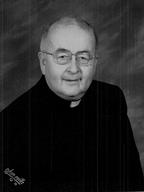
Father Tom Quinlivan’s home parish was St. John the Evangelist on Seneca Street in South Buffalo. His assignment for the last seventeen years has been and continues to be Pastor of Queen of Heaven Church on Seneca Street in West Seneca.
One of Father Tom’s fellow priests was a close neighbor when they were growing up and as fate would have it, he was also pastor at a neighboring parish for a number of years. The two apparently could not resist engaging in a bit of ongoing, good natured repartee from their respective pulpits. The parishioners of both churches enjoyed the touch of wit but since most of them went only to their own parish, they never got to hear both sides of these rejoinders.
On one such occasion, Msgr. Bill Gallagher remarked in passing that since Father Tom Quinlivan started at St. John the Evangelist and is now at Queen of Heaven, the prima facie defining factor in Fr. Tom’s life is a three and a half mile stretch of Seneca Street.
Pure malarkey! Naturally, nothing could be further from the truth.
By the time he was in the upper grades in grammar school, Tom Qunilivan knew that his vocation was the priesthood. His early aspirations began at home where they were nurtured not only by his parents but also by his two sisters. The Sisters of Mercy ran St. John the Evangelist School and many other Catholic grammar schools in South Buffalo. He remained steadfast in his intention to enter the priesthood throughout his years with the Franciscans at Bishop Timon High School. But kept these intentions to himself until he was ready to graduate high school and enter the Diocesan Preparatory Seminary.
After completing two years of study at the Diocesan Preparatory Seminary and then six years of study at St. John Vianney Seminary, Tom Quinlivan received a B.A. in Philosophy and an M.A. in Theology. Then he was ordained a deacon and for the next year, the Rev. Mr. Thomas Quinlivan served at The St. Jude’s Center which has been described as a haven in the middle of the hospital complexes, including Roswell Park Cancer Institute and Buffalo General Medical Center. During this, his diaconal year he also served at St. Mary’s School for the Deaf.
Father Tom was ordained to the priesthood in May of 1972 at St. John the Evangelist. He was the only candidate to be ordained on that day. Since he graduated from the Seminary in 1971, he still considers himself to be part of the class of 1971. The newly ordained Father Thomas J. Quinlivan served for about a year at a parish in Batavia.
Near the end of that year, the Bishop asked Father Tom to resume and enlarge his work with deaf and hearing impaired children and adults in the area. This was also to involve lengthy advanced training that would be needed in order to be effective in this specialized ministry. This was no easy or simple task. Father Tom responded willingly and enthusiastically.
He studied for and received a second master’s degree, an M.S. in Deaf Education from Canisius College. During these years, he also engaged in all the necessary training and practice to become fluent in sign language. He pursued further graduate studies at Gallaudet University, a federally chartered private university for the education of the Deaf and hard of hearing located in Washington,D.C.And he completed additional graduate training at the National Technical Institute for the Deaf, a college of the Rochester Institute of Technology in Rochester,NY. He holds New York State Education Department Permanent Teacher Certification in the areas of Nursery, Kindergarten, Grades 1 – 6 and Deaf and Hearing Impaired. The Council on Education of the Deaf also conferred a Professional Certificate for teaching the hearing impaired at the elementary and secondary school levels.
He served for eight years as Chaplain at St. Mary’s School for the Deaf in Buffalo.
After completing his priestly assignment at St. Mary’s, Father Tom served in Bolivia,South America in the Maryknoll Associate Program. In order to serve effectively here, Father completed yet more studies at the Cochabamba Language Program.
Father Tom did not become a parish priest in earnest until late 1990 when he was assigned as Pastor of St. Mary of the Angels Church in Olean, NY. He served there for about six years and then completed a sabbatical at the Center for Theological Foundation in Rome.
After returning to Buffalo in 1997, he was appointed as Pastor of Queen of Heaven Church and as noted above, he continues in this assignment today.
G.K. Chesterton began one of his books by writing that “there are two ways to get home and one is to stay there”. Father Tom Qunilivan obviously chose the long way, the demanding way and the rewarding way to make his way home. Along the way, he certainly adopted the viewpoint expressed most succinctly by Maryknoll Father James Keller: “Be world minded, not local minded”.
Especially since he returned to his native area, Father Tom has had the opportunity to develop and pursue his interest in certain aspects of local history. He is also able to spend some time reading fiction and non-fiction.
Father’s advice to anyone considering the priesthood is to let others know so the candidate can begin a reality based discernment process. The Diocesan Vocations Office can connect potential candidates with various groups composed of men considering the priesthood.
Father Tom is certain that under the wholesome leadership of Pope Francis, both the duties and the day to day life of future priests will be noticeably different from the past and present day.
At the same time, certain priestly attributes are timeless. Among these are what St. Paul refers to as the fruit of the Spirit. Clearly, Father Tom Qunilivan lives by the spirit and his life bears the fullness of the fruit of the Spirit. His reputation precedes him in this regard. Among the first qualities people readily observe in Father Tom are his kindness and his gentleness.
DECEMBER 2014 PRIEST OF THE MONTH - REV. MSGR. PAUL A. LITWIN
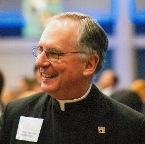
“My life stands on a three legged stool. The first is priesthood, the second is music and the third is golf.” Monsignor Litwin believes that, “every person should do three things; find a vocation in life that you really love, learn to play a musical instrument and become at least reasonably good at a sport.” He has come to see life as a balancing act where different entities help each other out. It’s not good to do any one of them all the time but rather to incorporate them all in an appropriate time and place so that nothing suffers and everything supports everything else.
Paul Litwin, the youngest of three boys in his family, grew up close to Our Lady of Victory National Shrine in Lackawanna. He was an altar boy who greatly admired the priests assigned there and enjoyed being involved in the parish. Upon graduation from Our Lady of Victory Grammar School he had three choices for High School. They included Baker Victory, Lackawanna public and the Diocesan Preparatory Seminary. Of the three, he thought the best choice would be the Diocesan Preparatory Seminary. It was a smaller school with a very skilled faculty. The boys who attended were usually considering the priesthood. Some went on to become priests and some did not. It was a place of early discernment that included a wonderful college preparatory atmosphere. Paul spent four years there and then spent another four years at Wadhams Hall Seminary College where he graduated in 1975 with a BA in Philosophy. Four years later he graduated from Christ the King Seminary with a MA in Theology.
Playing the organ and singing were two things he really enjoyed. He began learning to play the organ in eighth grade and took voice lessons as well. He held the position of organist at Wadhams Hall Seminary College from 1971 to 1975. He took organ lessons from Max Elsberry for the first year until Max passed away. After that, he took voice lessons from Max’s wife, Arlene, during the rest of his undergraduate years. When he got to Christ the King Seminary, he became the Director of Music and principal organist for the four years he attended.
Father Paul was ordained to the Priesthood on October 19, 1979 by the Most Rev. Edward D. Head. His first assignment was as a parochial vicar at Blessed Sacrament in Kenmore for six years. In order to satisfy his musical appetite, he joined the Buffalo Philharmonic Chorus in 1980 and remained a member until 2012. His excellent musical qualifications led him to become a member of the Diocesan Music Commission from November of 1979 to September of 1986. He was then assigned once again as a parochial vicar at Nativity of Our Lord in Orchard Park from 1985 to 1988. At that time, he was asked to continue his education in Washington D. C. at the Catholic University of America. He attended from 1988 to 1990 and earned a License in Canon Law. While he was in Washington, not wanting to be without a musical connection, he joined the choir of the National Shrine of the Immaculate Conception.
Upon returning to the Buffalo area, Fr. Paul was assigned Judge and Adjutant Judicial Vicar at the Diocesan Tribunal. He served in that position from 1988 to 1996. He took on the added responsibility of lecturing on Canon Law at Christ the King Seminary in 1994 and then from 2000 to the present. From 1996 to 2006, Fr. Paul was Vice-Chancellor and he became Chancellor in 2006 which is the position he currently holds. In 2008, he was honored with the title, Monsignor. He helps out by saying Mass at St. Joseph Cathedral as well as the Carmelite Monastery, Villa Maria Convent and wherever his brother priests need him to fill in when they are unavailable.
Monsignor Litwin holds memberships in the Canon Law Society of America and the National Association of Pastoral Musicians as well as the Church Musicians’ Guild of Buffalo. He is also a member of several boards including the Foundation of the Diocese of Buffalo, Catholic Charities of Western NY, OLV Homes of Charity, Baker Victory Services, the Cantalician Center for Learning and numerous Regional Catholic Schools and Housing Corporations. He became a member of the Buffalo Master Chorale in 2012 and retains that membership to the present.
Monsignor Litwin’s musical background has largely been in Sacred Music which has helped him in the liturgical aspect of his priesthood. His interest in golf has provided many an analogy for life in his sermons. He has advised the congregation to, “Stay in the middle of the fairway. Don’t let your grip be too tight or too loose, etc.” He has been running the Clergy Golf Tournament since the early 1990’s and believes that, “Golf forces you to dismiss all other troubles from your mind. The shot and the moment take up all your concentration and help you to forget about whatever else is bothering you. There will be time for dealing with the other issues in life but it’s good to get away from it for a while. It’s good to have something to relieve stress.”
Of course, Msgr. Litwin feels that, “Priesthood has a lot of joys. It’s not all stress.” He considers his favorite part of priesthood to be whatever he is working on at the moment. He likened it to asking a musician, “What’s your favorite piece of music?” He said, “The correct answer is, the one I’m working on right now.” He added, “I’ve enjoyed everything while I was doing it. I’ve enjoyed preparing couples for marriage, parish ministry, studying Canon Law, etc.” Probably the most challenging aspect of his priesthood so far has been working in the Tribunal because it involves working with a lot of people’s raw emotions. People who have gone through a divorce are usually not in a very happy state of mind. Monsignor Litwin describes it as, “not an easy thing to do.” He added, “You find yourself hopefully being a healing presence to the people but you have to make decisions and judgments about their stories.” He realized though, that the experience created growth within himself. He very much enjoys being involved in diocesan activities. He commented, “You meet a lot of talented people who are there to help. You get a good idea of what’s going on in a broader sense.”
Timon, Bishop Malone’s newly adopted black Labrador retriever, has brought much joy to the household on Oakland Place where Msgr. Litwin also lives. Monsignor Litwin grew up with dogs as pets and he exclaimed, “I had forgotten how much fun it is to have a dog in the house. They are pure unbridled enthusiasm! When you come home you have this happy little creature to greet you.” He also feels it is very healthy to get out and walk the neighborhood. He added, “I’ve met more neighbors since getting the dog than in all the time I’ve lived here.”
In advising those considering a vocation to the priesthood, Msgr. Litwin believes a person needs to “Be patient.” He goes on to say, “Open yourself up to thinking deeply about all kinds of ultimate questions, the deeper questions of life. Also be willing to help others to search and seek and pray and discern what God’s plan is in your life. Try to answer questions like: why am I here and where am I going? Not only ‘I’ but ‘we,’ where are we going?” He also feels that, “Questions are not a sign of a lack of faith; questions are a sign of a deep and vibrant faith.” He considers his position as a priest to be a privilege. He enters the lives of people who are unfamiliar at first to preside at their weddings, baptize their babies and bury their loved ones. Monsignor Litwin believes that finding what you’re good at and what makes you happy and balancing them together is the key to a happy, Holy life.
NOVEMBER 2014 PRIEST OF THE MONTH - REV. THOMAS D. DOYLE
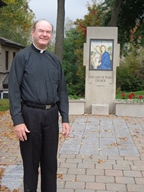 Looking back on his earliest thoughts of priesthood, Fr. Tom Doyle recalled his St. Thomas Aquinas Elementary School years saying, “It was a time when girls were encouraged to enter the convent and boys were encouraged to become priests.” Just before graduating from Bishop Timon High School he was approached by his Spanish teacher, Fr. Venard Carr, OFM, who asked him if he ever thought about becoming a priest. Young Tom replied, “I don’t think so.” Father Venard then told Tom, “If God wants you; He’s going to haunt you. You’ll be in college and you’ll think, ‘I wonder if I’m supposed to be a priest.’ You’ll be on a date and you’ll think, ‘I wonder if I’m supposed to be a priest.’ You’ll be working and you’ll think, ‘I wonder…’” Father Tom recalls that he told Fr. Venard, “That’ll never happen to me!” But that is exactly what happened.
After attending Erie Community College for two years, Tom went to Buffalo State College. He left Buffalo State to work at Sears where he was employed for several years. The thought kept coming back to him to look into the priesthood so he called Fr. Ted Krause, the Vocation Director at the time. Father Ted took him to Chef’s Restaurant and from there plans were made for Tom to enter Wadhams Hall Seminary College in Ogdensburg, NY. He started in January and there he finished his undergraduate degree in Philosophy. He recalled that, “After a week I knew that was where I should be. I never looked back because I felt a sense of direction, peace and contentment that I hadn’t experienced before.” He spent two years there and then went on to Christ the King Seminary in East Aurora.
After his ordination in 1982, Fr. Tom was assigned to St. Joseph’s in Batavia. He spent two years there and then went to Immaculate Conception Parish in East Aurora for five years. He was then assigned as Assistant Vocation Director and lived in the Pope John Paul II residence working with Msgr. Paul Burkhard for the next six years. Father Tom then became pastor of St. Cecilia Church in Oakfield (now St. Padre Pio). He spent six years there and while he was there, took on the added responsibility of prison ministry at the Orleans Correctional Facility. After being reassigned to Our Lady of Peace Church in Clarence, Fr. Tom resigned from prison ministry. Then Msgr. Robert Cunningham, on his last day as Administrator of the Diocese, just before he left to serve as Bishop of Ogdensburg, NY, asked Fr. Tom to take the Catholic Chaplain position at the Wende Correctional Facility. He has been ministering to prisoners ever since.
Father Tom has spent the last 12 years as pastor of Our Lady of Peace Parish in Clarence where he currently resides. Throughout his priesthood he has very much enjoyed celebrating the Sacraments and working with people. He is very grateful for the help he receives from lay people in running the parish. The nuts and bolts administrative work is probably his least favorite aspect of priesthood.
Family is very important to Fr. Tom. He has three sisters and three brothers, five of whom live in the Buffalo area. His mother passed away two years ago at the age of 94 and his father died before he was ordained. For the last five years of his mother’s life, she was unable to stay alone in her house. Father Tom and his four local siblings took turns staying with her so she was never alone. He recalled, “She was with one of us every single day.” Two weeks after she passed away he and his siblings realized they had not been in contact with one another and they missed that connection. Ever since then, they have made a conscious effort to get together on a monthly basis. Once a month they do something fun together that they don’t usually do like go bowling, etc. When he was stationed in Oakfield, he had his entire family over for Thanksgiving at the rectory. He still carries on this tradition at Our Lady of Peace. Over the summer, the family was together for the Fourth of July. It was a gathering of some 60 people.
When Fr. Tom gets some time to relax, he enjoys playing a little golf. He also likes to cook and has recently dabbled in baking artisan breads.
Father Tom advises those considering a vocation to, "Follow your heart and begin by making the decision that you are going to try it." He went on to say, "I can only describe it as like jumping off a cliff. If you're in the right place, God will catch you. Even if you're in the wrong thing you'll be able to live your live at least knowing you tried it." Father Tom made a pact with himself saying, "I'll try it for a year, if I don't like it, I'll walk away from it and won't be haunted by it. At least I'll know." And now he does, that after 32 years of priesthood he can confidently say, "I can't think of anything else I'd rather do!"
OCTOBER 2014 PRIEST OF THE MONTH - REV. JOHN E. STANTON
 It had become a tradition for John Stanton to pray at Our Lady of Victory Basilica in anticipation of big challenges in his life. He prayed there before taking the New York State CPA exam, and he passed. He prayed there before taking the New York State Bar exam, and he passed. He prayed there before entering Christ the King Seminary to become a priest, and he was ordained. He commented that, “Before big tests, you go to big places to pray and the National Shrine of Our Lady of Victory Basilica was the largest shrine I knew and still remains the largest in the Buffalo area.” Little did he know when he was taking the bar exam, prayer cards from Our Lady of Victory and Father Baker on the desk in front of him, with the intention of becoming a lawyer, that he would someday end up living at that very shrine and ministering to the parishioners as a priest for the Diocese of Buffalo.
John was born and raised in West Seneca. A lifelong parishioner of Queen of Heaven Parish, his mother still lives in the same home in which he grew up. He is the youngest of John and Mary Stanton’s six children and the only boy. He recalls that his father mentioned early in his life that he should be open to the possibility of a call from God to enter the priesthood. John commented, “My family has always been active in our parish. My father was the president of the parish council and I was on the Queen of Heaven Carnival Operating Committee, taught religious education, was a lector, member of the Mission Team and participated in scripture study. My father’s brother, the late Msgr. Bill Stanton, was a Diocesan priest who was a witness to the joys of priesthood. He absolutely loved it.” John and his family spent many a Christmas Eve at the St. Ambrose Rectory with his Uncle Bill. Throughout his life, he found himself surrounded by a host of religious sisters and priests who made a great impact on him. John’s clear that “I don’t know life without that Catholic influence. My joy comes from it. I can’t imagine life without my Catholic Faith.”
After graduating from West Seneca West High School, John entered the University at Buffalo and graduated from the School of Management with a concentration in accounting. He went directly on to law school and, during the summers in between, trained to be a Certified Public Accountant. Shortly after his graduation from U. B.’s Law School, John was admitted to the bar, and obtained his CPA license. He worked for two different law firms in Buffalo (associated with Saperston & Day, P.C., and a partner at Brown & Kelly, LLP), and also remained active in volunteering at Queen of Heaven Parish.
When he was in his early thirties, John participated in a priesthood discernment program called the “Response Program.” As he describes it, “The program consisted of just regular guys from regular parishes throughout the Diocese of Buffalo who were taking a good look at where God was calling them.” The seed his mother, father, uncle and many others had planted continued to grow and John felt it was important for him to take a closer look at the possibility of priesthood. He recalled that, “After I graduated from law school my father told me it wasn’t too late to go into the seminary.” John then enrolled in Philosophy and Religious Studies classes at Canisius College, all while continuing to volunteer at the Parish and practice law. He realized, “I found through all the prayer and reflection that you’ve only got one life to live and that God comes first.” He knew that he could not devote his life to the practice of law and spend as many hours as he did volunteering at the parish. “I had to choose,” he decided. “I placed God first in my life and entered Christ the King Seminary.”
On October 19, 2012, the Memorial of the North American Martyrs, he was Ordained as a Transitional Deacon and on June 1, 2013 he became the first and only priest in the Buffalo Diocese that year to be Ordained by the newly appointed, Bishop Richard Malone in St. Joseph Cathedral. His Ordination was filled with inspirational moments but he vividly recalls, “Of the nearly 1,000 people who attended my ordination, only about 100 were my family. The rest were made up of the sheer size of the Church and they showed me a different way of looking at family. I’m one of six children and I have cousins and fifteen nieces and nephews. The Church is so much bigger than that. By joining the priesthood I not only had my own family but another global family about one billion Catholics strong -- much larger than I ever envisioned.”
Much to Fr. John’s delight, his first and current assignment was to the National Shrine of Our Lady of Victory Basilica in Lackawanna. The place he had always gone to pray when it really mattered had become the place he would now call home.
So far, the best part of being a priest for Fr. John has been celebrating the Sacraments. He remembers that when he taught fifth grade religion at Queen of Heaven he was so impressed by the openness his students had to discovering whatever it was God was calling them to become. When he discussed the Sacrament of Holy Orders with them, their openness led him to accept that everyone needs to be as considerate as these children when they discern their life’s path. Now, as a priest, he is honored to, “be with people in some of the most precious times of their lives whether it be at the bedside of someone dying, a funeral Mass of a loved one, Baptism, Reconciliation, or someone’s Sacrament of Marriage. It’s a sacred time when you’re invited in places very few people are able to be welcomed. You represent the Lord, who is really the one welcomed.”
Father John is trying to do his best and at times he finds that challenging. He said, “God accepts me for who I am and I really want to show God’s love and His hope to His people. I’m not perfect. I’m experiencing a brand new pathway in my life that I know the Lord is gracing me with and He’s inviting me to exciting opportunities.”
When Fr. John gets some free time he enjoys visiting his mother and taking care of the family home by mowing the grass or doing whatever else needs to be done. He also has a membership at the YMCA and likes to work out to relieve stress. He likes to see movies, read books, travel and go on retreats. He is always appreciative of some quiet “down time” to regroup, recharge and refresh his spirit.
In advising those discerning the call to priesthood he commented that, “Somehow the Holy Spirit is working through you and is encouraging you to give priesthood a try. I’ve always looked at the seminary as like going on a first date. Unless you give it a try, you’re always going to wonder if that date was for you. There’s a reason why you would consider it and God’s likely inviting you to at least grow deeper and see where He’s calling you. If you have hesitation, that’s normal. The seminary is a program of many years. Give it a try -- you will grow!”
Father John recalls, “I wanted to be a priest because I wanted to be a bridge to bring people closer to God. I also wanted to live the life that God designed for me and that’s where I would find that true happiness. As St. Augustine said, ‘Our hearts are restless until they rest in you, Oh Lord.’”
SEPTEMBER 2014 PRIEST OF THE MONTH - REV. MSGR. KEVIN T. O'NEILL
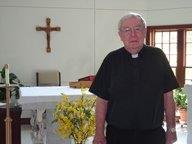
When Msgr. Kevin O’Neill was a boy growing up at Holy Family Parish in South Buffalo he had thoughts of becoming a priest but then so did most of the young Catholic boys his age. As he neared the end of his high school days at Timon, he thought he was headed for the Navy but the Korean War ended and that stopped everything. Unsure of his next move, he heard a voice over the loud speaker at school calling him down to the office. When he arrived, a Franciscan Priest who was the Dean of Discipline, sat him down and explained that his name had come up at a faculty meeting. The faculty thought young Kevin may have a vocation to the priesthood. His response was a firm and positive, “Are you kidding me?” Followed by, “Father, thank you very much but I think you may be mistaken.” Looking back, Fr. Kevin now admits, “That was the seed.” He couldn’t stop thinking about what was said to him that day so he finally went to discuss it with his parish priest. He hadn’t been there very long when the priest got up and left the room. Upon returning he informed Kevin that he arranged for him to take an exam the next morning at the seminary. Once again Kevin’s response was surprise and bewilderment. He only wanted to discuss the possibility with the priest, not begin the process of entering the seminary. His parish priest’s reply was, “Kev, you can always try and if you don’t like it you can leave.” Fifty-three years later, Fr. Kevin reports, “I have learned one thing; listen to other people. God often works through others.”
Father Kevin remembers his ordination very well. It took place in Erie, PA and his mother was upset because his family was always late. He told her to stay over the night before so she would be right there for the ordination the next day. The next morning, Fr. Kevin overslept and missed his ride to St. Peter’s Cathedral. The other seminarians in the car noticed he was missing, turned around and went back for him. He made it just in time for the procession to begin. As they neared the Cathedral, the procession stopped to wait for a family as they crossed the road and scurried into the church. The family was his! He remembers that the Ordination lasted for four hours. At that time they combined the Ordination with other celebrations such as Altar Server of the Year, etc.
Originally Fr. Kevin studied for the diocese of Erie, PA. His first assignment was in Clearfield, PA near Pittsburgh. He was then assigned to Erie, PA to be closer to his family. He then returned to the Buffalo area and was assigned to Batavia for five years. After that he spent nine years in the inner city at St. Vincent’s, and at Blessed Trinity with Msgr. Paul Juenker. He has fond memories of ministering with Msgr. Juenker recalling that he was a wonderful teacher and boss. He was assigned as Pastor to Sacred Heart Parish in Friendship and Angelica and then as Pastor for four years in Arcade. He spent the next 23 years as Pastor at Immaculate Conception Parish in East Aurora. He enjoyed coaching basketball and attended 40 years of trips with eighth grade classes throughout his priesthood. He retired from Immaculate Conception nine years ago.
To retire from the active priesthood is really just to move into another kind of ministry which is fine for Msgr. O’Neill. He exclaimed, “I like to keep going!” And keep going he did. He is currently the Canonical Administer for Mary Queen of Angels Regional Catholic School in Cheektowaga. The July 2014 issue of the Western New York Catholic featured an article on the front page about a program he led in the school where the students prayed for and raised money for the current seminarians at Christ the King Seminary. The money will go towards covering expenses while the seminarians attend the March for Life in Washington, DC this upcoming January. Father Kevin also helps out in South Buffalo at St. Thomas Aquinas Parish and at the Mercy Center Convent, both on Abbott Road, as well as at Fourteen Holy Helpers Parish in West Seneca. When the Pastor of St. John the XXIII Parish became ill, Fr. Kevin filled in. It happened to be Holy Week and lasted through the recent Canonizations of St. John the XXIII and St. John Paul II so there was a lot to do in terms of celebrations. Family also keeps him busy as he has one brother who had eight children. He now has 47 great nieces and nephews, many of whom attended the celebration of his 50th year of Priesthood three years ago.
The Gospel story of the Washing of the Feet, usually read during Lent, is one of Msgr. O’Neill’s favorites. He believes it sums up the best part of priesthood which, for him, is service. He exclaimed, “I enjoy being able to be of service to the people.” He also loves to preach. Although he was very good at the administration aspect of being a pastor he never really enjoyed it. Father Kevin has a painting depicting the Gospel story of The Road to Emmaus. It shows the two men walking along and talking with Jesus although they don’t realize it is Him. He mentioned that it is important to, “Find another friend that you can share your frustrations and doubts with.”
Father Kevin revealed that, “The most fun thing I ever did was coach basketball.” While he was in Batavia the parish needed a basketball coach. They asked Fr. Kevin to watch the team for a while until they could find a replacement. After two weeks he enjoyed it so much that he agreed to become the coach. This opportunity made him realize that he’d be doing things he never would have expected. He summed it up by saying, “In the Priesthood a lot of doors are opened to find your talents.”
Pray and listen! These are two wonderful ways Fr. Kevin believes men who are considering the Priesthood can hear God’s call. He knows well from experience that God often works through others when He has a message to deliver. While he was in the seminary there was a point when he decided he wanted to leave. He packed his bags but before he could make his intentions known, he was offered an important and very coveted position within the seminary. The Prefect who was in charge informed him that the faculty had voted him into the position because they felt he definitely had a calling to the priesthood. Once again, he decided to listen to the voice of God speaking through others. He unpacked his bags, took the position and never looked back. Fifty-three years later, he feels so blessed to have been called to the Priesthood and without a doubt knows he made the right decision.
AUGUST 2014 PRIEST OF THE MONTH - REV. MSGR. THOMAS F. MALONEY
 “Young parents are not going to hire a sitter so they can go to Church on Sunday. If we want them, we need to take care of their young kids while they are at Mass. And we are in a great position to do that. We have excellent pre-school facilities that no one is using on Sunday mornings.” Monsignor Tom Maloney, pastor of St. Amelia Church in Tonawanda is talking about evangelization. “We want to make the weekend church experience not only attractive, but irresistible for parents with young children.”
Father Tom explains that he grew up in a parish, Holy Family in South Buffalo that was a magnet for young families. “I attended the parish school, but a whole lot of after-school activity was parish-centered. I was an altar server, and a Boy Scout. Serving put me in contact with happy priests, and from an early age, I decided I wanted to join their ranks. Scouting was decisive for me. I joined Troop 120, reluctantly as an eleven-year-old, and ended up staying on for ten years! The parish has three bowling alleys, and from age 11 I was a ‘pin-sticker’ in the days before automation.”
Young Tom’s sister Sally became a Sister of Mercy, and she had a formative influence on his life. So also did his older brother Mike, who studied for the priesthood, and later opted for a career in law enforcement. Father Tom quips, “He figured he would prefer not to pray for sinners, but instead arrest them. As we say in the family, Uncle Mike is still concerned about sinners, but from a slightly different angle.” Mike served as the elected Sheriff of Schulyer County, in the Watkins Glen region, for 32 years. Sister Sally retired recently after serving as a Vice President of the Catholic Health System.
From Holy Family School, Tom went on to the Diocesan Preparatory Seminary, for six years, then to St. John Vianney Seminary in East Aurora for two years. His final years of preparation were spent at the University of Louvain in Belgium.
“That was some heavy lifting in theology,” Father Tom recalls, “but we had some great opportunities for meaningful service. I was a nurse’s aide in the local hospital, and volunteered a lot at the local Flemish orphanage. In fact, I was ordained a priest in the hospital chapel, and my first Mass was at the orphanage.”
As a young priest he served at parishes in Niagara Falls, Tonawanda, Dunkirk, and Lancaster. Then in 1978, he became co-pastor of St. Joseph’s Parish in University Heights, in an experimental “team ministry”. Six years later, Bishop Head asked him to direct the diocesan RENEW program. During his four years with RENEW, he lived at St. Mark’s parish, where he taught French in the parochial school. In 1989, he became pastor of Annunciation Church in Elma. He says now “Annunciation is every priest’s dream of an ideal parish – great enthusiastic people, an outstanding school, good youth programs, a rural setting just 15 minutes from downtown. Bishop Head once told me that if he were not a bishop, he would love to be pastor of a church like Annunciation. We built a new rectory and a new social hall, and I would have been content to stay there forever.”
Then, in July 1995, he got a phone call. Bishop Mansell asked him to go back to Tonawanda, to St. Amelia’s, where he had served five years as a young priest. “I had been on retreat the month before, out in Denver, and in prayer; I got the sense that God was going to ask something of me. When I got the phone call, I saw it as a call from God. Much as I hated to leave Annunciation, I said yes to the bishop’s request. That was 19 years ago. I never regretted it. I thank God every night that I am pastor of this parish.”
St. Amelia’s is a large parish, with close to 9,000 members, and a school that enrolls over 650 children. The school is an effective instrument of evangelization, Father Tom believes. “Parents enroll their kids in our pre-school program for three-year-olds. They do that because it makes good economic sense, plus they trust the St. Amelia brand name. We are a National School of Excellence. The kids like it, and so do the parents, and so 75% of those pre-school kids sign up for kindergarten; 95% of the kindergarten graduates go on to first grade. And as the kids gradually mature as followers of Christ, the parents deepen their own discipleship.”
At age 71, Father Tom is eligible to retire, but he has no plans to do so. He says, “I love what I am doing. There is no greater thrill than to know that God is using you as an instrument in bringing someone into a right relationship with Him, or in helping someone come back to Christ and his Church.”
July 2014 Priest of the Month - REV. SEAN PAUL FLEMING Today it is not at all unusual for a young, unmarried person to live in a nice apartment in the city. Don't be surprised if you hear Father Sean Paul say "been there, done that" and again, don't be surprised if he tells you that he doesn't remember anything about it.
Early Years:
You see, Sean Paul Fleming was a newborn infant when he lived (with his parents, of course) in an apartment in South Buffalo. He was baptized at St. Michael's Church on Washington Street in the Theatre District. Sean Paul has had a lifetime connection with St. Michael's, especially with a Jesuit priest, Father Ronald Sams, who is now Pastor Emeritus. From time to time Father Sams would check up on Sean Paul and others baptized at the church to see how well they were coming along in their development.
Sean Paul's father was employed by Niagara Mohawk Power Corporation (now part of National Grid). Because of his father's job, Sean Paul and his family moved from Buffalo to Youngstown in Niagara County and then to Fredonia in Chautauqua County. While there, Sean Paul and his family were members of Holy Trinity Church in Dunkirk, NY when he made his First Reconciliation and First Holy Communion at this parish.
Sean Paul's mother grew up in Eden, NY and the family ultimately moved there and has remained there ever since. So he fittingly regards Eden as his hometown and Immaculate Conception Church as his home parish. He attended Immaculate Conception School until 6th grade and finished 7th and 8th grades at SS. Peter & Paul School which is located "up the road" in Hamburg, NY. He then spent four meaningful and memorable years at St. Francis High School in Athol Springs (also in the Township of Hamburg).
College and Career:
Following graduation from high school, Sean Paul Fleming traveled about 300 miles from home in order to study at Rensselaer Polytechnic Institute (RPI) in Troy, NY, near Albany. His major was Computer Science and Engineering.
After completing his college program, he began his professional career as a computer engineer and manager of information technology. This involved programming and coordinating a lot of the computer support for hardware and software development. He worked in this capacity for a company in Lockport, NY for about 3 1/2 years and while there, he assisted in the establishment of a branch in Dublin, Ireland.
Free Time and Hobbies:
Sean Paul is a man of many interests. He plays an occasional round of golf. He has a developing interest in photography and video production. He is also curious about the world of aviation, although he states he has not taken any flying lessons - yet.
And then there is the interest in food that he shares with the Pastor of St. Bernadette's, Father Paul Seil. Father Sean Paul has appeared three times as a guest on Father Seil's TV show, "Our Daily Bread," on Daybreak Productions.
But Father Sean Paul's real avocation is music. People who know him regard him as both a connoisseur and a talented performer who sings and plays the piano. He enjoys all genres of music including Maroon 5 and Coldplay to opera. He has found the easiest way to go to the opera is to view screenings at the local Regal Cinema. He says it's like being at the Met (Metropolitan Opera in New York City). He's been known to tell people that Rene Fleming is "his cousin" even though she is really not.
It's probably true that Sean Paul Fleming never encountered a musical instrument that he didn't like. Since the parish church organ is sometimes available, he has been teaching himself how to master the art of making his hands and feet do four different things simultaneously.
The Calling:
Priests and sisters were part of Sean Paul's life from the beginning. Some were friends of the family and Sean Paul was able to see that these were vibrant, devoted, happy people. He thus believes "a seed was planted" because of his early observations and experiences.
This seed in the back of Sean Paul's mind began to germinate and then to flourish when he was a student of the Conventual Franciscan Friars at St. Francis High School. During his junior year, one of the Friars, Father Joe Benicewicz, asked Sean Paul if he had ever thought of becoming a priest. Sean Paul recalls this as a bright and beautiful day that started him thinking. His reply was an unequivocal "yes" but further discernment would be needed in order to determine if he would be a Franciscan Friar or a diocesan priest.
By the time he was ready to graduate from high school, Sean Paul was resolute in his decision to enter the seminary and become a priest. There was only one slight problem: his parents were insisting that he gain more life experience and grow in maturity before making such a lifelong commitment. They said he should go to college, major in something unrelated to theology and then graduate. They also advised him to work for a couple of years after college and then if he were still interested in the priesthood, they would support him 110%. Sean Paul reacted to all this with typical adolescent bewilderment.
But as chronicled earlier, Sean Paul Fleming ultimately complied with his parents' wishes both in word and in spirit. He chose a major in computer engineering, which naturally included a great deal of science and mathematics and matriculated at RPI. Following graduation, he pursued a professional career in a highly competitive field and he did this for almost twice the length of the suggested "couple of years."
Later, when Sean Paul was well into his seminary studies, he began to more fully understand and more deeply appreciate the wisdom of his parents. In retrospect, he realizes that he received the best advice they could have given. And true to their word, his parents did support him 110% and continue to do so today. Some refer to Sean Paul's vocation as a "delayed" one. Sean Paul replies that the path God led him on is the path he is supposed to be on.
Father Sean Paul Fleming was ordained a priest at St. Joseph's Cathedral on June 2, 2012. At the conclusion of the ordination ceremony, Bishop Edward Kmiec said in jest - but only partly - that it was time for Father Sean Paul (and two other priests ordained with him that day) to go to work. But for Father Sean Paul, who is well familiar with the world of work, this was more a resumption of work. He now pursues a different career (vocation) that is fully congruent with his life purpose and his mission here on earth.
The Best Part and the Most Challenging Part of the Priesthood:
Father Sean Paul smiles when he says that it's great not having to be in the office all the time. But when giving more thoughtful consideration to this, he finds it hard to define one specific thing that he loves most about the priesthood for there are many. He does think it's amazing to wake up in the morning and say, "Okay, God, I'm yours" not knowing where the day will take him and where it's going to end. He does have his itinerary for the day but that is merely a point of departure for he never knows in advance who or what will command his most urgent attention. He simply must be ready to be Christ's messenger for the people.
In the mind of Father Sean Paul, the greatest challenge in the life of a priest is the attitude that the status quo must be preserved. "This is the way we have always done things around here." This approach excludes people and stifles creativity and new ideas. He thinks this may well be a universal trait of human nature and certainly not an attitude that is peculiar to any particular age group, geographic locale or gender. Father Sean Paul thus recognizes the need to keep reminding himself that the church is a living, breathing organism made up of people that continues to grow and develop.
The Present and Future Ministry of Father Sean Paul Fleming:
Father Sean Paul Fleming is a young man and a new priest, having been ordained for two years ago. His priestly vocation has been strong since its inception at the time he was a young boy. His priestly vocation has also been tested in the fire of a fiercely competitive world.
He approaches his day-to-day life as a priest with considerable vigor and works especially hard to preach the Gospel so it can be understood by his congregation, which is usually composed of members with widely different backgrounds, ages, education, and life experiences.
As the Parochial Vicar of St. Bernadette's Parish, he is also Moderator of one of ten parish schools that will close at the end of June. The prospect of impending closure and the event of closing itself can only be accompanied by much grieving - by graduates of the school, students, and the teachers who have dedicated a huge part of their lives. While reflecting upon this, Father Sean Paul is reminded how the people we serve are tested and yet for every struggle and challenge faced in life, prove their reliance upon God.
June 2014 Priest of the Month - REV. RICHARD REINA Father Rick Reina will retire from Christ the King Seminary this year. He has spent the last five years there as the Director of Spiritual Formation which included doing spiritual direction with the seminarians as well as teaching a course in spirituality. Father Rick advised seminarians to, "Develop an intimacy with God. In developing an intimacy with God, they will learn more about what God is asking of them." He knows well that developing this intimacy is an ongoing process and that it is not always easy to figure out God's plan. While not easy, it's always worth the effort.
Richard Reina grew up in Buffalo with his parents, brother, and sister. His elementary school years were spent at Mt. St. Joseph's Grammar School. His father and uncle not only graduated from there themselves but boarded there as well back when it was a boarding school. Starting in about the fifth grade, Rick's father would bring him to morning Mass in the chapel before school started. The Sisters of St. Joseph would attend as well as the Jesuit priests from Canisius College across the street. He remembers the sisters filling the chapel in full habit and recalls, "There was something there, the mystery of it all, and those wonderful priests from Canisius. I always admired them. I think that was the beginning of it (his thoughts on becoming a priest himself), the awesomeness of the Eucharist and the witness of really nice priests."
When he was in the third grade, he recalled, "I wrote down that I was going to be one of three things: priest, doctor, or dancer. I don't have too much rhythm, so dancer got knocked out. I can't stand blood, so doctor got knocked out. The only one left was priest!" After graduating from elementary school, young Rick wanted to go right into the Diocesan Preparatory High School but his father was not in favor of that. Thinking he was too young to start down that path, his father advised that he finish high school before considering the priesthood. With that advice in mind, Rick attended Canisius High School. He dated, socialized, and enjoyed his high school years and went on to Canisius College graduating with a double major in Philosophy and Sociology. He wanted to study Psychology but the school didn't offer it at the time. After college, he entered St. John Vianney Seminary (now Christ the King Seminary) and was ordained in 1970 by Bishop McNulty.
The year he was ordained, the Diocese of Buffalo discontinued their Missionary Apostolate Program. They instituted a new program that only lasted a year. The newly ordained priests moved somewhere new every three months. Most of the men did not like the experience but Father Rick didn't mind it. He first started out as a chaplain at St. Francis Hospital on Main St. in Buffalo. Three months later he moved to Rushford where he spent a very difficult winter at a parish. After that he was assigned as chaplain to four girls high schools. He spent time at a different school each day and weekends at St. John the Baptist in Black Rock. After that he was assigned to St. Columba, an inner-city parish, with Monsignor Caligiuri. He then went to Holy Cross parish with Monsignor Lorenzetti for three years.
Father Rick was then asked to become the Assistant Vocation Director with Monsignor Nugent. He really enjoyed his time with all the priests who were pastors of the various parishes at which he helped. Father Kraus became Vocation Director and was then assigned as Director of the Diaconate Program. Father Rick was then asked to become the Vocation Director for the Diocese of Buffalo. He enjoyed that very much and always felt his job was to help people to discern what they were called to do in life. He added, "It wasn't that I was looking for priests or religious but I was looking to help people and if this was the way it should go, I was happy to help lead them in this direction." His main objective was to help direct people in their lives as Christians.
After that, Father Lanahan, Rector of Christ the King Seminary, wanted to initiate a new program called Human Growth and Formation. Father Rick was asked to head up this new curriculum and spent the next eight years implementing it. While he was at the seminary, he earned a Master's in Spirituality at Creighton University.
He then went on to a position as parochial vicar with Monsignor Caligiuri at St. Peter's in Lewiston. He enjoyed being with Monsignor Caligiuri as well as the people he encountered at the parish. After nine months there he decided to leave the Diocese of Buffalo to join the Franciscans in religious life. He had long considered doing this as St. Francis had always been special to him. He has a cousin who was a year ahead of him in school who joined the Franciscans and he also recalled that, "I had lived with the Franciscans at Christ the King Seminary in the Friary and got used to that life."
Father Rick spent the next five years discerning a call to the Franciscan life. He moved to Boston, MA and lived in Brookline where he spent his first year of Novitiate. From there he moved to Washington, DC where he received a Master's Degree in Clinical Social Work from Catholic University. He then moved to New York City and spent two years doing clinical work with the Franciscans specializing in alcoholism and drug addiction. They opened three residences for mentally ill street people. Father Rick worked with formerly homeless people specializing in schizophrenia and bi-polar disorders as well as substance abuse cases. The Franciscans then asked him to be part of a team setting up the Urban Ministry in Wilmington. He was still in Simple Vows, not yet having professed his Final Vows, and experienced doubts about committing to the Franciscans. On the night before they were printing up the invitations to the Final Vows Ceremony, Father Rick informed them to "Hold the presses!" They ended up leaving his name off the invitations because as he put it, "I decided to come back home."
When Father Rick returned to Buffalo, Bishop Head was very welcoming. He assigned Father Rick to St. Lawrence Parish as Administrator while the current pastor recovered from heart surgery. When the pastor decided to retire, Father Rick was granted the position. He loved it there and really enjoyed the people. After eight years his home parish, St. John the Baptist in Kenmore, became available. He applied and was accepted for the position as pastor. He spent twelve years there with many people he greatly admired.
It was then that Father Peter Drilling, Rector of Christ the King Seminary, asked him if he would come back to help form seminarians once again. Father Rick considered his background and decided that with his degrees in clinical work and spirituality as well as his experience as a pastor, he could effectively prepare seminarians for priesthood. Upon retiring, he plans to continue as a weekend assistant at Christ the King Parish in Snyder, work part-time at Christ the King Seminary in East Aurora and make himself available to help other priests who need him. Because of his substance abuse counseling background, Father Rick is interested in getting involved with places like St. Luke's Mission of Mercy or Friends of the Night People.
Father Rick was an avid runner and tennis player but now enjoys music, visiting art galleries, and reading. He'd like to join a book club and is also interested in learning to play the piano.
Of all the things there are to love about the priesthood, Father Rick exclaimed that one of his favorites is "the people!" He went on to say, "To be so welcomed in peoples' lives and to be so trusted, to be with people in tragic, sad moments and happy, wonderful moments, to be a part of that experience with them is worth all the money in the world." He added, "I love being able to celebrate the Eucharist. To me it's always the family meal. To preside and be able to bring people around the table is a great privilege." He is also very fond of celebrating the Sacrament of Reconciliation. He commented, "The healing it brings to people is very rewarding."
He found the most challenging aspect of priesthood occurred occasionally while he was pastor of a parish. Issues with the running and merging of schools as well as personnel matters, keeping enrollment up and raising money involved a degree of unwelcome stress.
When men express a desire to become priests, Father Rick believed, "That's a wonderful thing and they should listen to that because that's obviously a sign of something happening. If that's what God wants, they'll see priesthood as a response to an invitation as opposed to something they might be initiating." He also advised, "Try to imagine yourself doing what the priest does. How does that feel to you? Celebrating the sacraments, baptisms, hospital visitation, counseling and so forth, is that attractive to you? Can you imagine yourself in that position? Try to make use of your imagination."
Although he has experienced some struggles and uncertainty along the way, Father Rick exclaims about his life as a priest, "At the end of the line, I can't imagine doing anything else." When he approached Bishop Malone about retiring he told him, "Bishop, this has been a blast!" He looks forward to retirement as this will bring new opportunities to use all he has learned to continue growing personally as well as helping others. Father Rick relates to his training as he states, "In Developmental Psychology there are 'tasks' you have to complete throughout your life. The last one is integrity where, in your senior years, you look back and you say, 'It's all been meaningful.' And that's where I am. I am very content."
April 2014 Priest of the Month - MSGR. J. PATRICK KELEHER "I am quite overwhelmed with gratitude for the journey of the priesthood."
A common and persistent misperception is that the life of a priest is more or less isolated, uneventful and, therefore, rather boring. The real life stories of Buffalo Diocesan priests presented here during the past six years clearly demonstrate that nothing could be further from the truth. And the life story of Msgr. J. Patrick Keleher is, to say the least, a case in point.
Thirty-Three Years of Ministry in Public University Education:
This year Father Pat will celebrate his forty-sixth anniversary of ordination to the priesthood. He has devoted thirty-three years to Catholic campus ministry including the last twenty-six years as Director of the Newman Center, University at Buffalo North Campus.
He has become one of the most familiar faces at UB and his presence extends from the Newman Center throughout the entire campus including the Medical School, various academic departments, the Student Union, sports events, and lectures. His vibrant presence is a hallmark of his ministry which encompasses not only students but also faculty, staff, and area families. During his twenty-six years at the University, Father Pat has served thousands of people who are grateful to God and to Him.
Father Pat's approach to ministry is empathetically inclusive. The following notice is featured prominently on the front of the Newman Center bulletin every Sunday:
ALL ARE WELCOME HERE!
No matter what your present status in the Catholic Church is...
No matter what your current marital or family situation is...
No matter what your current year, major or research topic is...
No matter what your personal history, age, race or orientation is...
No matter what your own self-image is...
You are invited, welcomed, accepted, loved, and respected here at the Newman Center at UB.
For Father Pat, campus ministry is more like missionary work. The University at Buffalo has thirty thousand students who come from eighty-five countries around the world. In addition, more than six thousand faculty and staff work at the University. Some of these people believe there is no God. Of those who do believe there is a God, some hate Him, others love Him and still others are more or less indifferent. In addition, adherents to nearly every kind of religion from fundamentalist sects to Unitarians can be found on campus. In this regard, Father may seem at times to be following in the footsteps of St. Patrick, his Patron Saint, who ministered for years among so many Druids and kings of every sort.
The Newman Center at UB had been in existence for more than fifty years when Father Pat became director. At that time the Center was basically a small chapel housed in one of the buildings on UB North Campus. During Father Pat's tenure and under his inspiring leadership, the Newman Center at UB has become a pioneering Newman Center Community. This Center has a new home of its own, a "state of the art" multi-purpose campus ministry center. After two years in the making, the first Mass was celebrated there on Christmas in 2009.
Today, the Newman Center at UB is a full fledged Catholic Faith Community. There is a regular schedule of Sunday and weekday Masses. The Sacraments are celebrated regularly although many candidates for Confirmation are adults for some reason. Each Wednesday evening during the fall and spring semesters, UB students, Catholic and non-Catholic alike, are invited to enjoy without charge a full home cooked dinner, prepared and served by Newman Center volunteers. Normally about two hundred students show up.
Newman Centers as Models for Parishes of the Future:
Newman Center Communities could very well provide a glimpse at what a viable, sustainable Catholic parish in the United States might look like in the future. And accordingly, this could also offer a preview of what the life of a future parish priest might be like. Since Father Pat is so well accustomed to the language of academia, he naturally thinks of the Newman Center model in terms of a course that he would call "The Parish of the Future 101."
Consider the following: Newman Centers have traditionally served people who will graduate and leave after a few short years. Today in America, however, society at large is forever on the move. For example, employed people change jobs every three years on average and when they do, they frequently relocate out of the parish and for that matter, out of the archdiocese. If this trend continues, then lifelong parishioners are likely to become nearly extinct.
Newman Centers have a great deal of experience in the fine art of making new people feel they are not only most welcome but also an integral part of their new faith community. This ongoing warm reception of new people will be the lifeblood of the parish of the future.
Father Patrick Keleher's Background: Family, School, and Home Parish - A Vocation in the Chrysalis:
Patrick Keleher was born and grew up in Lockport, NY. His father worked as a foreman at Harrison Radiator. He died after Pat's first year in the seminary. His mother was a housewife and when her children were of school age, she returned to work as a registered nurse at the Lockport Hospital. At the time of her death in 1996, she was the oldest living alum of the Millard Fillmore School of Nursing.
Patrick is the second of three children in his family - "the bologna in the sandwich" so to speak. His brother was in the seminary for a few years and then went on to a career in the US Navy that spanned thirty years. His sister was in the convent for about six years and then had a long career as a public elementary school teacher in Lockport and then in Florida. His home parish is St. John the Baptist in Lockport.
Father Pat doesn't remember any specific time when he first consciously thought about becoming a priest. He says that "it just happened" and he "took his brother's place in the seminary." But Father Pat vividly recalls the positive and wholesome influence of his parents as well as the good school and parish priests at St. John the Baptist. In particular two young assistant pastors, Father Kolb and Father Ash, were a great inspiration to him.
The Seminary Years and Additional Studies:
For Father Pat, the seminary was in some ways a real challenge. On the one hand, he loved the scriptures and the theology and the prayer. He also loved the community. On the other hand, he thought there was too much discipline. He didn't like the rules and thought many of them were silly. One gets the impression that his superiors sometimes found the young Patrick Keleher to be a source of consternation - perhaps not unlike the young Peter Schickele during his years of graduate study at The Julliard School of Music. But in retrospect, Father Pat believes the rigors of seminary life did him no harm. He also observes that present day seminary life is more agreeable in terms of rules.
Father Pat pursued additional study at Maryknoll School of Theology, Ossining, NY. He also engaged in graduate work at Toronto School of Theology and Catholic University in Washington, DC.
Ordination and Early Assignments:
At the time of his ordination, Patrick Keleher had spent half his life in formal preparation for that day. However, he never did view ordination day as a culmination but rather a continuation of his journey. As he puts it, "I became a priest about ten years after I was ordained."
Father Pat was one of twenty-five men ordained to the priesthood on May 25, 1968 at St. Joseph's New Cathedral, a building which was subsequently torn down. The church building of his home parish was condemned and slated for demolition two months before his ordination so he celebrated his first Mass at neighboring St. Patrick's Church in Lockport. So according to Father Pat, his life as a priest started out from ruins.
Following ordination, he was sent to the Missionary Apostolate and enjoyed his first year as a priest serving at a parish in Canaseraga, NY, a hamlet in the northeast corner of the Allegany County not too far from Dansville. Then in the summer of 1969 he was the hospital chaplain for a month at Millard Fillmore and a month at E.J. Meyer Memorial Hospital (now ECMC). His first regular assignment was at Our Lady of Victory in Lackawanna, NY that lasted "five wonderful years." While there, he was also appointed chaplain at OLV Infant Home, an agency serving unwed mothers and their newborn children. He had various other parish assignments from 1974-1981. So he was involved in parish ministry for a total of about 13 years.
Ministry in Public University Education:
Then there was an opening for Campus Minister at SUNY Fredonia and he went there form 1981-1988. And as reported and described above, in August of 1988 he was assigned as Director of the Newman Center at the University at Buffalo North Campus and he plans to continue in this assignment for the foreseeable future. He loved Fredonia and he loves UB North.
The Joys and Challenges of the Priesthood:
In Father Pat's own words, these are the Joys of the Priesthood: I am quite overwhelmed with gratitude for the journey of the priesthood. It continues to be a very great ride: every day a new day, every day new scenery, new view, new vision - most every one of them unpredictable surprises...
Very few people have the daily, constant grace to share the sacred panoply of privileged moments of grace. That is the GIFT - birth and death, dispatch, arrival, health, harm, tears of joy, tears of loss, "companions on the journey."
Free Time:
Father states, or rather he quips, that he seldom takes a day off. Yet he is known to maintain an ongoing interest in 20th Century Literature, especially the writings of James Joyce. He enjoys poetry from many cultures and works on an occasional composition himself - which may wind up in a UB Newman Center publication under the title of "Thoughts from Father Pat." He also loves to travel around the world, especially to Ireland and France.
Father Pat's Reflections on His Life and His Vocation:
Without being the least bit facetious, Father Patrick Keleher says, "I am the happiest person I have ever met."
Father Patrick Keleher's priestly vocation is fully congruent with the man he is and the life he lives. In short, it would be difficult to imagine Patrick Keleher as anyone other than Father Pat. He is a well loved priest and friend to all.
March 2014 Priest of the Month - REV. PAUL VARUVEL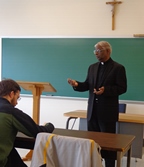 Father Paul Varuvel's Catholic roots go back five generations on his father's side and four generations on his mother's. Those deep roots allowed him to grow and blossom to spread his Catholic faith far and wide.
Born and raised in the State of Tamil Nadu in South India, Paul first felt a calling to the priesthood when he was nine years old. His mother attended daily Mass and his father worked in agriculture. Paul's father produced many different products such as rice, mangos, and coconuts. Paul and his two brothers and three sisters grew up in a very faith filled family. The parish church was two miles from their home and they would walk to Mass every day. One morning at the 6:30 a.m. Mass, the altar server was absent and the priest asked young Paul to fill in for him. In those days the Mass was in Latin. Paul felt confident that he knew the responses and duties involved in being an altar server so he gladly obliged his pastor's request. From that day on he served happily at the altar. He has fond memories of that priest recalling that, "He was a great man, very much into serving the people and a very devout person himself. He gave me an example of what a priest might be like. Those were the initial stirrings in my heart responding to God's call."
At the end of his middle school education when Paul was 13 years old, the local Vocation Director visited his parish. He asked young Paul if he would consider entering the minor seminary. Paul gladly accepted the offer and enjoyed this first experience of being surrounded by other boys who felt the same way he did about the priesthood. He lived at the seminary and walked every day to the high school which was run by the Jesuits. He was very interested in his studies and open to learning all he could. The headmaster of his high school always encouraged him and his classmates to do their very best. When Paul graduated, he was not only at the top of his class but of the school, the district, and the state.
After completing a two-year Latin course in the minor seminary, Paul went on to study Philosophy at St. Paul Seminary, Trichy, which was about 250 miles away. After one year in that seminary, he was asked by his bishop to continue his studies in Rome, Italy at the Pontifical College of the Propagation of the Faith. This college specialized in educating those who would work in mission churches. He ended up spending over eleven years in Rome and exclaimed, "That was one of the best parts of my life because there I was so close to the Pope in the Eternal City, the center of Catholicism." He enjoyed very much being surrounded by students from all over the world. It was a shock at first because he had never been to Europe and it took a while to get used to a different culture. Besides the culture of Rome, there were people from Asia, Africa, Australia, Latin America, the U.S., Ireland, Poland, England, as he put it, "A real mix of humanity." While in Rome Paul earned a licentiate in Philosophy and Theology from the Pontifical Urbaniana University. He was ordained in 1972, seven years after he arrived in Rome, by the Cardinal Prefect of the Congregation for the Evangelization of Peoples, Agnelo Rossi. After ordination he chose to specialize in Moral Theology and in 1977 earned a Doctorate in that field from the Alphonsian Academy of the Pontifical Lateran University.
Father Paul then returned to India. It was the first time he had been back since leaving for Rome over eleven years earlier. He said his first Mass in his home parish which was established in 1930. He was the first man to enter the priesthood from that parish and the second was his younger brother. His brother was inspired by Paul's vocation and was ordained to the priesthood for the Diocese of Meerut while Paul was in Rome. His brother is also considered a missionary priest because he serves in a diocese in Northern India in a different cultural and linguistic context.
The bishop of Father Paul's home Diocese of Kottar assigned him to a parish as an associate pastor. He served there for a year and then was reassigned to St. Paul's Seminary, where he had studied before, to teach Moral Theology. He stayed there for twelve years teaching Indian Philosophy as well. In 1989 he was asked by the new bishop to return to his home diocese to serve as his Vicar General. He remained in that position for the next six years. After that, Father Paul returned to teach once again at the seminary for another three years.
In 1998 he was granted a sabbatical in New York City. He spent a year in the Diocese of Brooklyn and a year in the Archdiocese of New York City. During that time he took a course at Fordham University and earned a Master's in Religion and Religious Studies. At that time he came in contact with Father Charlie Amico. (Father Amico's story was featured on this website for the month of November 2010.) Father Amico was an alumnus of the same university in Rome where Father Paul studied. They met in New Jersey at an alumni meeting. It was through Father Charlie Amico that Father Paul came to know about Christ the King Seminary in East Aurora and its need for a professor of Moral Theology. He interviewed at Christ the King Seminary and was hired by Bishop Mansell. He joined the faculty in August 2000.
With every new experience comes a period of adjustment. This was Father Paul's first time teaching in an American seminary. He once again had to get used to a new culture and a new educational context. It was also the first time he experienced teaching in a seminary where lay people were educated with seminarians. After five years of teaching at CKS, Father Paul was incardinated into the Diocese of Buffalo by Bishop Kmiec. Previously he was a priest of the Diocese of Kottar, India. In addition to his ministry of teaching, Father Paul has the responsibility of formation of the seminarians as a member of the Formation Team. He also serves on the Board of Governors of the Network of Religious Communities as a representative of the Diocese of Buffalo.
During the summer months, Father Paul exercises the missionary aspect of his priesthood by traveling to different parishes and dioceses in the U.S. and Canada to give mission appeals. He speaks on the needs of the diocese of his origin in India and asks for prayers and financial support for that area. He visits parishes from New York to California and admits, "I still consider myself a missionary. I am from a mission country and if I can be of some help in promoting missionary work in the diocese where I grew up, I will certainly do it." His youngest sister was living in the New Jersey area a couple of years before he came to New York. He enjoyed spending time with her when he could. She and her family have since moved to Dallas, Texas and he hopes to reunite with them again soon.
In 2004, Father Paul made his first visit back to India since he began working at Christ the King Seminary. He arrived on December 13th and witnessed first-hand the devastation brought about by the Asian Tsunami that hit Indonesia and other parts of Asia on December 26. It was a Sunday. He had just finished saying two Masses when about 100 people arrived in pick up trucks announcing that the tsunami had hit their village which was in his diocese. Nine hundred people were lost in that area during that tragic event, almost all of them Catholics, descendants of converts of St. Francis Xavier, the great Jesuit missionary who evangelized the area of Kottar diocese in the 16th century. Father Paul remembers, "The destruction was terrible. Homes were washed away and several people lost family members and all their possessions." The following year he returned again. He noticed in one village a common grave where about 300 people were buried because there was no time for individual burials right after the tsunami occurred. He concelebrated the one year anniversary Mass with the bishop in that village and was impressed with the hope that people expressed. They said, "We will rise from our disaster." And they did.
In his many years of priesthood, Father Paul believes that educating youth is among his favorite aspects. He feels that his own youth was enhanced greatly by the educational opportunities he experienced and he enjoys being able to pass those meaningful experiences on to others. He feels much fulfilled in his role of educating and forming seminarians. He also finds great joy in performing the Sacraments. He is happy to be a spiritual support for people in their time of need through the Sacrament of Penance as well as at times of death and grief.
Father Paul is challenged not only by adapting to a new culture, but also in knowing and understanding the seminarians of today. In his role of forming them into priests for others, Father Paul strives to include the four dimensions emphasized by Pope John Paul II and the U.S. Bishops: Human, Spiritual, Intellectual, and Pastoral dimensions. He added, "I try to incorporate all of these aspects into my teaching." Because he teaches Moral Theology, Father Paul concentrates a little more on Human Formation. He wants to "give them a sense of what it is to become a better human being by instilling the values we need to make a part of ourselves." He brings those values into the teaching of Moral Theology. He also teaches Catholic Social Teaching. In this he said, "I try to bring together spirituality and social concerns. I help them to understand that living a spiritual life means that the love of God must flow into the love of neighbor." He added, "These things are my constant concerns as I engage in teaching."
Reading is one of Father Paul's favorite hobbies. He would like to do more reading for pleasure but finds most of his spare time is devoted to reading on the subjects he teaches. He has written a few books in his own native language of Tamil. He has published books on the "Life and Mission of Jesus" and on "interpreting the Scriptures" which have been very well received back in India. In describing his motives he said, "I can contribute something for the formation of seminarians back in India. Those I would have taught, I like to keep them in mind."
Father Paul advised those who are considering priesthood to draw from the Catholic faith they have. His family experience was an important part of his decision making process. He also suggests that if the calling that a man receives is from God, he should keep searching even when things are not clear. Pray for God's help to see where he is leading. Spend time in prayer and reflection. Get into yourself to see what God is telling you at this point in your life. If the calling is to a life of service and ministry, even if vague in the beginning, give it some attention. He adds, "When you have a stirring within you, go talk to someone who is a trusted person such as your own pastor or another priest."
Reflecting on his decision to become a priest, Father Paul exclaimed, "I'm really happy especially looking back, I can see how God has led me through a diversity of experiences in India, Rome, Europe, and the United States. Through all this I see God's loving and gracious hand directing me. There is a clear direction and I need to continue to say 'Yes' to this guidance from God. This is very fulfilling to see that in your life God is present and you are an instrument in His hand to bring His message to other people in a very special way in the training of priests. That gives me great joy and is something that I cherish."
February 2014 Priest of the Month - REV. MATTHEW ZIRNHELD When we hear a reference to "The Diocese of Buffalo," most of us naturally think of the City of Buffalo or perhaps the Buffalo Metropolitan Area. But as Father Matthew Zirnheld has learned from firsthand experience as a pastor, there is more to the Diocese of Buffalo and, for that matter, much more to his day-to-day life as a parish priest than might initially meet the eye.
Father Matt Zirnheld is a native of Kenmore, a village that hugs the North Buffalo City line. Kenmore itself occupies an area of less than 1 1/2 square miles and is home to over 15,000 people and four Catholic parishes including St. Andrew Parish, Father Matt's home parish.
Education and Work Experience:
Father Matt graduated from St. Andrew Country Day School in 1976 and from St. Joseph Collegiate Institute in 1980. He then majored in psychology and also completed a minor in religious studies at Canisius College, where he received his baccalaureate degree in 1985.
While a student, Father Matt also gained some work experience first delivering newspapers and then working as a clerk for a couple of summers at the neighborhood public library. While in college he held a part-time job at a fast food restaurant. During the first three years after college, he worked full-time at BJ's Club as a sales associate.
Father Matt dated in high school and in college during the time when he was thinking about the priesthood but was not yet ready to make any commitments. There were one or two girls he was really quite serious with. As his college years progressed, he began to think more seriously about becoming a priest. During these times it seemed that a lot of people around him knew that he was thinking about this, but no one mentioned it! Well, almost no one. One of his girlfriends had actually asked if he had ever thought about being a priest because she thought he was such a nice guy - always other centered and the type of guy a lady would want to marry.
Formation:
It was in 1988 that Father Matt participated in a diocesan program of discernment known as "John Paul II: Called by Name." This program included a return to Canisius College for coursework to meet academic admission requirements at the seminary. Father Matt went on and entered Christ the King Seminary later that year. In December 1992 he was ordained a deacon and graduated from Christ the King Seminary the following spring after more than five years of post-baccalaureate study. Bishop Edward Head ordained Father Matthew Zirnheld on July 31, 1993. Father Matt took particular delight in being ordained at St. Andrew Parish, his home parish. He was the only one to be ordained that year.
It was in January 2005 that Father Matt received his first assignment as a pastor. This was also the time he began to experience firsthand the richness of life in communities within the Diocese of Buffalo that are outside of the Buffalo Metropolitan area. He became pastor of two linked parishes - St. Cecilia in Sheldon, NY and St. Mary in Strykersville, NY, about ten miles southeast of the Village of East Aurora. Then in 2008 these two parishes, along with St. Patrick in Java Center and St. Nicholas in North Java, were merged into one new parish - St. John Neumann Catholic Community. Bishop Edward Kmiec named Father Matt as the first pastor of this newly formed parish with two worship sites - one at St. Cecilia and the other at St. Mary. In addition, the parish has an Oratory at St. Patrick and St. Nicholas Catholic Cemetery. Father Matt's earthly pastoral responsibilities include the management of thirteen buildings as well as five cemeteries. Today Father Matt continues as pastor of St. John Neumann. He more recently received an additional assignment, Vicar of Genesee-Wyoming.
Family:
Father Matt's parents moved from Buffalo to Kenmore in 1960. His dad, Ronald Zirnheld, was employed as a laboratory technician at DuPont and later as a mental health aide at Buffalo Psychiatric Center. He passed away in 1977. His mother, Anne, was a registered nurse at Kenmore Mercy Hospital and is now retired and continues to live in Kenmore.
Father Matt has a brother, Mark, who is Executive Director of the St. Vincent de Paul Society of Buffalo. Mark and his wife, Laura, have a daughter, Julie, who is a recent graduate of Canisius College and a son, Edward, who is now a student at Canisius. Father Matt also has two younger sisters. Michelle is married to David Tyran and they have two daughters, Amanda and Alyssa. Michelle was a secretary at St. Joseph Cathedral but now works as a secretary/receptionist at a chiropractor's office. His other sister, Mary, lives with their mom and has worked many years at Children's Place in Buffalo.
Free Time, Friends and Family:
When he has time to himself, Father Matt enjoys reading or seeing a movie. He is also a fan of virtually all sports but is especially interested in football. When the opportunity presents itself, he visits with his friends back in the old neighborhood.
Of course, he stays in contact with his mother and his family. Most every summer the Zirnheld family gets together for a reunion in Kennebunkport, Maine. No one in the family has ever seen any presidential parachuting and, for that matter, no one has ever attempted any jumps of their own. There is also no credible evidence that the Zirnheld family visits in Maine had anything to do with Bishop Malone coming to Buffalo.
The Joys and Challenges of the Priesthood:
Father Matt is happy being a priest. For the past nine years he has been fully engaged in his present assignment. He is happy being pastor and even happier now since the completion of "Journey in Faith and Grace" (the process of merging four parishes into one new parish). The journey was not a bad thing but it did involve much diversion of attention and a long three or four year period of uncertainty. No one knew exactly what was going to come out of this whole process and what the effects might be. This made for some stressful times.
Parish mergers have become more or less commonplace and are necessitated by demographic changes that are in rather profound contrast to the way parishes were fifty years ago. Nevertheless, the merger here has been an especially bitter pill to swallow for Catholics living in these Wyoming County Townships of Sheldon and Java. These good people can best be described as strong in the faith and strong in their affiliation to their parish. Each of these four parishes was over 150 years old when it was merged six years ago. Nearly all the members of each of these parishes had been lifelong parishioners. Notably, their parents, grandparents and great grandparents have also been lifelong parishioners who were buried or will be buried in the parish cemetery at the end of their life here on earth.
One of Father Matt's greatest challenges as a pastor has been to inspire and encourage these faithful people to make this new parish their parish. This has taken not only time, but also understanding and patience. He is delighted with progress so far and credits his parishioners for all they have been doing to make this happen.
For Father Matt, the best part of being a priest includes celebrating the Sacraments, being present with his people, getting to know families and ministering to them, especially in some of the biggest moments of their lives. These are the joys of day-to-day parish life.
One of Father Matt's most challenging part of being a priest is trying to be as present and as available as he can given the human limitations of time and energy. In a merged parish there is the additional ever present necessity to travel from place to place. Father has had to learn how to be a "portable pastor" because St. John Neumann Parish covers almost one hundred square miles - very different from the 1 1/2 square miles of Kenmore.
Another related, equally challenging part of being a priest is accepting the reality that you must establish some boundaries and priorities. You have to learn to say "no" even though your natural inclination is to say yes and do what so many different individuals are legitimately asking of you.
Father Matt's Advice to Someone Who May Be thinking of Becoming a Priest:
If you're thinking about becoming a priest, you should go and at least check it out. God calls us in many different ways and sometimes the toughest decision is to move ahead and at least take a look. When you move ahead and take a look, you don't have to have all the answers because it's not like you're going to be ordained the next day. It is also important to continue to pray about it.
Sometimes family and friends can be very encouraging. However, in today's society a man may be thinking about a vocation when he is older and might not be comfortable talking about it with someone he relates with regularly. The Diocese has discussion groups and discernment groups and it's important to participate because you then realize that you are not alone. These groups continuously encourage you in your vocational aspirations in ways your family and friends may not know how to. The priests involved in these groups are most accommodating in helping a potential candidate discover where he is in the process leading to a decision.
January 2014 Priest of the Month - REV. RAY CORBIN After earning an undergrad in Business and an MBA, Raymond Corbin found himself in his thirties running an Army/Navy surplus and co-owner of a Century 21 office. He owned a home and found success in the business world yet somehow thought, “This is just not it.” He decided to go back to school, get a degree in Social Work, and look for employment at a non-profit. Father Ray concludes that, “That kind of fits what I’m doing now plus a whole lot more!”
Father Ray was from what he called a “nominal” Catholic home. He explained, “We received sacraments and went to Church on holidays, weddings, and funerals.” When he was in his twenties, young Ray stopped going to Mass entirely. His mother ran a local business and one of her customers was the Director of Religious Education at the parish. She told Mrs. Corbin that she needed an eighth grade religion teacher. Mrs. Corbin replied, “My son will do it!” As it turned out, Ray ended up learning more about his Catholic faith because he had to teach it. He taught eighth grade for seven years. He then started getting more involved in his parish helping out in many ways and even becoming a member of the parish council. He feels that it was then that the seeds of his vocation to priesthood were probably planted. The pastor of the parish, Father Frank Cybulski, mentioned that Ray should consider going to the seminary. Ray thought, “I could probably do that.” He recalled that he had never even considered it before because, as he put it, “No one ever asked me, and it definitely wasn’t the plan I had for my life.”
Ray attended a “look and see” weekend at Maryknoll and began their vocational discernment program in Ossining, NY for the Missionary order. He considered that path for about a year but decided against joining because he didn’t want to do missionary work full time away from his home and family. He met with Bishop Mansell in June of 1998 to discuss the possibility of entering Christ the King Seminary. Two months later he stepped back into the classroom again, this time as a seminarian. He sold his house and his business, moving from a twelve room home to one room at the seminary where he shared the bathroom with fifteen other guys. At first he thought he had made a mistake. After two weeks he called his father and said, “I’m leaving and coming home!” His father reminded him that he sold his home and encouraged him to give it more time. He didn’t unpack for almost a year and every month he said, “I’ll give it another month.” One month turned into a year, which turned into five and before he knew it he was being ordained a Transitional Deacon. “All of a sudden,” he recalled, “this comfort level came in.” He found that being ordained a Deacon was a very moving experience because it was the first time he professed vows. Priesthood, he felt, was a re-affirming of those vows along with the addition of added responsibilities. While lying prostrate on the cold marble floor, Father Ray recalled that because of his height, his feet hung over the edge of the sanctuary area. Stretching beyond the boundaries was not new for him. During his first summer as a seminarian he requested to be placed in an inner-city parish. He exclaimed, “I’m a big social justice person. No seminarian had ever asked that so they didn’t know what to do with me.” The request was unusual for a first year seminarian but nevertheless granted. He spent that summer ministering in three Buffalo City parishes, St. Valentine, Our Lady of Perpetual Help, and Columba-Brigid, working with people of many different cultural backgrounds. This fit in very well with his first inclination to do missionary work. “I like a broad experience of church,” he added.
Father Ray spent his Transitional Deacon year, along with the first year of his priesthood, at St. Philip the Apostle in Cheektowaga. He went on to spend six years as a parochial vicar at St. Mary’s on the Hill in Lancaster. He loved that experience. He was then named pastor of Infant of Prague Parish in Cheektowaga where he currently resides. In looking back over almost ten years of priesthood, Father Ray recalls, “In the first five years I tried to be the all for everyone. I am still learning, still growing into my own priesthood and realizing you can’t be everything to everyone. Everyone is not going to like you. I knew that in the business world but I thought it would be different in the Church. You have the collar on, you’re the one who does the Consecration, therefore, everyone’s going to love you. That’s so not true. The Church is a big tent, room for all and we all just have to get along.”
“What I really love about the priesthood,” continues Father Ray, “is that every day is different. I don’t punch a clock or do the same thing day in and day out. I never know who is going to walk through the door, who is going to call on the phone or what I’m going to be thrown in the middle of. Opportunities to minister in any way, shape or form may be a part of each day, always remembering that they are Christ.”
In the midst of what he really loves, Father Ray also finds difficulty in dealing with so many different personalities and the different directions in which he’s pulled. Even though variety is something he likes, he finds it difficult to have patience with administrative issues and then move into areas of spiritual direction which require a whole different mindset. He sums it up by saying, “Switching those gears is sometimes challenging.” He also finds that, “Some people can be really spiritually draining on the priest. Emotionally, physically, they will take until there’s nothing left to give.”
Father Ray has a cottage on the lake and believes, “My best praying is by the water!” He enjoys working out, reading new up-and-coming theology, woodworking, and even continues to dabble in real estate. He is also considering going back to school through an online course at Catholic University of America to get a Doctorate in Social Work. He is a Chaplain at Roswell Cancer Institute two or three days a week and is on call every night. He would like more in-depth information on how to counsel people on changing and complicated end of life issues. He has been at Roswell for six years and would be able to use that time as clinical experience towards his degree. As far as how he plans to fit all this into an already busy schedule, he responded, “It all comes down to time management and not wasting time.” He enjoys traveling and will be taking a tour of Italy this year. Visiting Ireland is usually an annual event.
He advises those discerning a vocation to the priesthood not to rush into it and adds that if they are offered any kind of helpful experience, they should take advantage of it. He adds, “This is not something to be taken lightly because it is not an easy life. Everyone thinks that priests coast and that they’re pampered. It’s not that easy but if it’s for you, you’ll get through it.” Recalling his own experience he said, “When you’re newly ordained you think you can do it all, but you have to pace yourself. Keep yourself emotionally and physically charged because it will drain your priesthood if you don’t. Take days off, retreats, and vacations. Protect that day off like it was holy because people will take it from you. You have to be firm and say, ‘This is my time to recharge so I can be with you the rest of the week.’” He also feels that every day priests have to wake up and re-commit to their vows just like married people should in their vocation as well. He commented, “Some days it feels like ‘Maybe’ but the majority has been really fulfilling in more ways than I ever thought.”
Father Ray concluded, “I’m extremely content in the vocation that chose me. People say, ‘You chose it.’ No, no, no, I was happy with my life. This (God) chose me!” He felt something was missing and had the courage to keep searching until he found it.
December 2013 Priest of the Month - REV. ANDREW LAURICELLA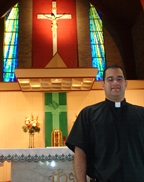 For some people a life of service to others is a very attractive prospect. Combine that with examples of people who joyfully live out that life and a little pressure from those who see the possibility of that calling in another person and you have the basis for Father Andrew Lauricella's decision to become a priest.
Andrew Lauricella grew up in North Buffalo as the oldest of four children. He attended his parish school, St. Margaret, from kindergarten through eighth grade. When he was in the sixth grade, the Vocation Director at the time for the Diocese of Buffalo, Father Rob Wozniak, paid his class a visit to talk about the vocation of priesthood. Father Rob said that he felt called to become a priest when he was in the sixth grade. He pushed it down at first but it kept coming back to him. He also shared some of the things he found joy in doing as a priest, such as celebrating the Sacraments of Baptism, Marriage, anointing people who were dying, etc. Father Andrew recalled, "Seeing the joy he had attracted me to the priesthood. I wasn't ready at that point to say that was exactly what I wanted to do, but it did appeal to me." Shortly after that, young Andrew dressed as a priest for career day at school.
After graduating from eighth grade, Andrew began high school at Cardinal O'Hara. It just so happened that Father Leon Biernat, that next Vocation Director for the Diocese of Buffalo, was the chaplain for the school. As Father Andrew now puts it, "Father Leon was one of the major influences in finding my vocation." Father Leon saw the spark of a vocation to the priesthood alive in young Andrew and he didn't miss a chance to let him know. But the end of his senior year of high school, Andrew couldn't decide what to choose as a major in college. He thought he would go to a two year college so he could explore his options while earning college credits. As he put it, "I knew I wanted to do something where I'd be helping people to be their best." He thought of being a teacher, counseling psychologist, etc., but couldn't find the one thing that, as he put it, "fit like a glove." Father Leon encouraged him to live in the John Paul II Residence, which was a place where young men could be with others who were discerning a call to the priesthood while attending college. Before graduating from high school, Andrew finally thought seriously about becoming a priest and realized, "Priesthood, could that be it?" He felt a strong draw to that and decided to begin heading in that direction. He also felt, "I can always change course if it's not for me." He remembers telling Father Leon about his decision and asking him where he thought he should attend college and what classes he should take. Father Leon's response was, "Andrew, for four years I've been praying that we'd have this conversation. Now, when I've given up, you take me up on my offer! Had I known that, I would have given up sooner!!"
D'Youville College seemed to be the best choice for Andrew. They were very supportive of young men who showed an interest in continuing on towards the vocation of priesthood. Andrew studied philosophy and lived at the John Paul II Residence while attending college. He found his experience at D'Youville to be tremendously fulfilling and enlightening. As he explains, the legacy of Marguerite D'Youville is one of service and charity. She founded the Grey Nuns of the Sacred Heart and her desire to make a positive impact in her community was shared by all those associated with D'Youville. He was impressed with the many programs at the college that were geared toward service, especially in the fields of education and healthcare. He exclaimed, "I really did delight in being in the company of people who were interested in serving and building the Kingdom of God." He graduated in the spring of 2007 and entered Christ the King Seminary that September.
Father Andrew was ordained to the priesthood on June 2, 2012. He recalls that on his ordination day he felt a very deep sense of prayer and support from the people who attended. He said, "Every person who was at my ordination was responsible for, in some way, and shared in my coming to ordination. Everyone there deserved applause." He added, "At ordination I felt the coming of what's meant to be my whole life." He thought back to his diaconate ordination about six months before and noted that, "That seemed like a bigger step because it brought me into Holy Orders. Ordination to the priesthood was a deepening of my vocation to Holy Orders. After diaconate ordination I felt more like myself. After priesthood ordination I felt even more like myself." He thought that on the day of his priesthood ordination he would feel no hesitation whatsoever in taking that step forward. He asked God, "Show me the green light that means all is clear." He wanted to feel completely comfortable in making this commitment but he felt God answering, "I want you to step forward in faith. If you really do believe I'm calling you, then come. I'll take care of everything."
Father Andrew's first and current assignment is to St. Vincent de Paul Church in Niagara Falls. He feels the people he ministers to are such a blessing because there is so much of an exchange that happens. He noted, "In all the different ministries I'm involved with, the people remind me what it's all about." He believes it is a privilege to be "in persona Christi" in service to others. He stated, "I'm called to minister the Sacraments to people but ultimately they are calling on Christ to come and touch them. It's not me, but Christ working through me when I minister to them. Whenever people reach out to a priest, they are reaching out to Christ. I have the privilege of being Christ's instrument in this capacity."
Although he enjoys variety, he admits that it can sometimes be difficult and exhausting to adjust throughout the day to all the different ways he is called to be Christ for others. In a single day he may go from saying daily Mass, to celebrating a funeral ,to participating in a rally at the school with lots of enthusiasm and positive energy, to taking a phone call from someone in distress who needs guidance, to a meeting where he needs to switch to serious thinking and planning mode. This is typical for a priest and requires a lot of energy. Father Andrew relies on his intuition when reacting to different situations depending on the people who are experiencing them. Upon the death of a family member or friend, different people need different levels of support. Some want to hold on to the priest and spend time grieving with him while others want to say some prayers and then need time alone to process their grief. Knowing how to read people and what they want and need can be difficult but it's all part of the life of service.
When Father Andrew gets some time to himself, he enjoys biking and swimming. As an alumnus of D'Youville, he still makes visits to their swimming pool. Another hobby he has enjoyed for some time is detailing cars. He profited financially from this when he was younger but now he seldom has time to work on cars other than his own He recalled, "I always loved taking a dull, dirty car and bringing out its best appearance. That may have been a precursor to my wanting to help people become the best they can be."
Many men find themselves asking if priesthood is for them. Father Andrew believes, "The world is filled with many different voices. Sometimes family members, priests, etc., will tell you what they feel is important and how you should handle questions you have in your life. Make God's voice the one you're going to listen to and be yourself." He feels that prayer is essential to voicing concerns and vital to hearing God's response. The devil is always trying to distract and derail people who want to listen to the voice of God, so Father Andrew recommends being aware of his presence and his attempts to distract. Another tactic of the devil is that he tries to convince us that the success we achieve is due entirely to our own efforts. This instills a sense of pride in us that does not leave room for acknowledgment of God's help. Humility is a very important quality to foster. Father Andrew gives the example of Mary who rejoiced in the privilege of being the Mother of God and considered herself a lowly servant and handmaid of God. He said, "My joy is like that of Mary. The amazing thing about Mary is that as she rejoiced in the privilege that God entrusted to her, it never went to her head. I don't want to let my work or accomplishments go to my head either." He also relates well to how Pope John Paul II, whenever he was applauded, raised his hands to lift the applause to God, who is primarily responsible for any success.
Father Andrew believes that, "Priesthood is beautiful. Are there challenges? Yes, but in spite of all that, priesthood is a beautiful and fulfilling privilege!"
November 2013 Priest of the Month - REV. JOHN GAGLIONE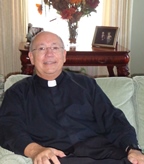 To say Father John Gaglione is a man of service would be an understatement. He not only serves as a Priest in the Diocese of Buffalo but also served the United States of America as a member of the Air Force Reserve for twenty- five years. Currently, he is serving as pastor of Christ the King Parish in Snyder, returning to the place where it all began.
John R. Gaglione, along with his brother and sister, grew up at Christ the King Parish in Snyder. Father John received all his sacraments at that parish from Baptism to Priesthood Ordination. He attended the parish elementary school and attributes his early thoughts of becoming a priest to his involvement in the parish as a student. He recalled, “I was always hanging around the church. We used to help the sisters in grade school take care of the Sanctuary area. I was an altar server and always had a leaning towards priesthood.” He then went on to graduate from Bishop Neumann High School and earned a BA in Philosophy from St. Mary’s College in Kentucky. In 1976 he earned a Masters of Divinity from Christ the King Seminary and was ordained to the Priesthood on June 12, 1976.
Father John’s first assignment as a priest was to Holy Name of Jesus Parish in Buffalo. He spent two and a half years there and was then reassigned to St. John the Baptist Parish in Kenmore as a parochial vicar with the added duty of Secretary to the Most Rev. Bernard J. McLaughlin, DD, Auxiliary Bishop of Buffalo. He held this position from 1978 until 1986 and it was during this time period when he began serving our country as well. He was commissioned First Lieutenant, Chaplain in the Air Force Reserve on April 16, 1983. He moved on to become parochial vicar at St. Lawrence Parish in Buffalo from 1986 to 1988 and was promoted to Captain in the Air Force Reserve on October 16, 1985. In June of 1988 Father John became the Coordinator of the Priests’ Personnel Board for the Diocese of Buffalo. He held that position until June of 1994 and spent that summer as pastor of Holy Name of Mary Parish in Ellicottville. He was also promoted once again on April 16, 1994 to Major in the Air Force Reserve. Father John was then reassigned as Senior Parochial Vicar at St. Paul Parish in Kenmore from September, 1994 to December, 1995 when he was made Pastor once again at Our Lady of the Rosary in Niagara Falls. He held that position until September, 2000. Promoted to Wing Chaplain at the Niagara Falls Air Reserve Station on October 1, 1996, he held that position until 2008. During that time he was promoted once again to Lt. Col. On April 16, 2001. He was activated for Base Support at Niagara Air Reserve Station from August, 2005 to February, 2007. On January 30, 2008, Fr. John retired after twenty-five years of Military Service. He is a Veteran of Desert Shield and Desert Storm as well as Iraqi Freedom and has received numerous military decorations. Appointed Pastor of Christ the King Parish in Snyder in May of 2007, Father John remarked, “It’s quite an honor to be back here.”
Over the years, Father John has been active in many organizations. He has been a member of volunteer fire companies and rescue squads as well as emergency medical services, chaplain of the Council #247 Knights of Columbus, member of the Diocese of Buffalo Finance Council, and chairperson for Niagara Falls Catholic School Network. He currently serves on the Board of Directors for Mercy Flight and is a member of the Scientific Staff of the Buffalo Police Department. He is Chaplain for the Snyder Fire Department, Amherst Fire Council and Erie County Emergency Services and also currently serves as Defender of the Bond for the Court of Second Instance on the Diocesan Marriage Tribunal.
Even with his involvement in so many areas, Father John finds free time here and there. He likes to relax at the beach as well as pursue the hobby of amateur radio operation. He has a base unit in the car and in the house and had to study to get a license to operate. There are different levels that can be obtained which offer different frequencies and privileges associated with each level. Through this radio operation, Father John is able to contact people all around the world.
Father John remarked that he really enjoys “being a part of people’s lives, being able to share your faith and their faith.” He added, “I’m always inspired by people’s lives. The greatest homilies aren’t preached from the pulpit but lived in the pews.” He feels that as a priest he gets more encouragement from the people he interacts with daily than they get from him. The people he deals with would probably say it is the other way around! Father John also feels that without a business manager, things would be much more difficult. He believes that things pertaining to administration are very complicated these days and he is grateful for help in that area.
Concerning the priesthood, Father John advises those who are discerning to “really make sure that it’s what you should be doing.” He adds that, “Like any commitment in life, be it marriage or anything else, you never really know what it’s like until you’re involved in it. Always keep your eyes focused on the local ministry, the people that you’re sent to serve. If you start looking up (aspiring to receive greater promotions and recognition) it can be very frustrating. Do what you’re asked to do and what you’re sent to do.”
Father John is a humble man who has accomplished much while believing nothing has been more important in his life than serving. He sums it up by stating, “I’m happy ministering to people and doing those things I’m called to do.”
September 2013 Priest of the Month - MSGR. ROBERT ZAPFEL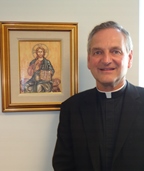 Monsignor Zapfel remembers it as if it was yesterday. He heard a talk given by a seminarian encouraging the students in his eighth grade class to be open to the idea of a religious vocation. Following his mother up the stairs of their Amherst home near his elementary school, Christ the King, he brought up the issue of where he would attend high school. He recalls, “She had a big load of laundry in a basket and I told her I was sort of thinking about the Diocesan Preparatory Seminary High School.” Without much discussion, she informed him that he would attend Bishop Neumann High School and that they could discuss it again in a few years. While he very much enjoyed his time at Bishop Neumann and dated in high school, the thought of becoming a priest stayed with him. Towards the end of high school he spoke with his guidance counselor, an Oblate of Mary Immaculate priest, about his desire to become a priest. He wasn’t really sure of the difference between a priest like his counselor, who was a member of an order, and his parish priest, Father James J. Browne, who was a diocesan priest. His guidance counselor told him if he felt more inclined to be a priest like Father Browne, he would need to talk to the diocesan vocations director, so he did. He recalls, “Studies show that by 6th or 7th grade kids have pretty good ideas of what they want to do with their lives. That was true for me, too. I knew that I wanted to explore the possibility of being a priest.”
He entered Wadhams Hall Seminary College in Ogdensburg, NY where he spent two years. He then transferred to The Catholic University of America in Washington where he earned a Bachelor of Arts degree in Philosophy. After that, he earned a Bachelor of Sacred Theology degree from the Pontifical Gregorian University in Rome, Italy.
In 1981, Monsignor Zapfel was ordained to the priesthood in his home parish, Christ the King in Snyder. Bishop Head preferred to ordain men in their home parishes. The bishop thought that ordaining men in their home parishes was a good way to encourage others to consider priesthood.
After he was first ordained, Monsignor Zapfel spent two weeks as a chaplain in Orchard Park at the motherhouse for the Mercy Sisters. He then spent two months at St. Benedict Parish and then returned to Rome where he earned a Licentiate degree in Moral Theology. He was an Associate Pastor at St. Peter Church in Lewiston NY, served as Vice Chancellor of the Diocese of Buffalo, and returned to school to earn a Doctorate degree in Moral Theology. He served in the Vatican Congregation for Catholic Education for several years. He is currently the pastor at St. Leo the Great Church in Amherst and the Bishop’s representative for health care.
Of all the places he’s been and things he’s done, Monsignor Zapfel exclaimed, “I’ve got the best position right now. I love being a pastor!” He feels that being a pastor is by far the biggest blessing he’s ever had. He enjoys the diversity that every day brings as a priest: morning Mass, baptisms, weddings, funerals, meetings, involvement with the parish school, youth groups, senior parishioners, and families. He also loves preaching and celebrating the Eucharist. He said “The Church tells priests that the most important thing we do is to proclaim the Gospel – to preach. I take it very seriously and it is a real joy and blessing.”
Challenges are not a problem for Monsignor Zapfel. In fact, he actually likes them and believes that they can lead to positive outcomes. He notes that, “There is always tension between doing things you have to do, doing things you should do, and doing things you want to do.” This is not unique to the priesthood. Everyone faces these choices to some extent and we must sort out and prioritize important things while leaving room for fun and relaxation as well. Shortly after starting as pastor at St. Leo the Great Parish, the other two priests who ministered there were reassigned. The parish went from three priests to one, but Monsignor Zapfel credits the many parishioners who stepped forward to become more involved in the life of the parish and the wonderful staff he has with easing the transition. He observed that, “The volunteers and the parish staff see their roles here as ministry in service to the Lord and the Church. People really feel involved here. It’s a parish family. I’m so lucky to be here. It’s a great parish with wonderful traditions and lots of hope for the future.”
The oldest of seven children in his family, Monsignor Zapfel visits his mother every day in a nursing home. His father has passed away. Several of his siblings live in town and they regularly get together.
It can take five to seven years beyond college to become a priest and Monsignor Zapfel has noticed that many people are surprised by that. He said that it is a long road to the priesthood, but worth every mile. When he was younger, someone gave him a pamphlet about discerning a vocation to the priesthood. He learned that one of the signs that a man might be called to the priesthood is if the thought of becoming a priest makes him happy. He remembers that being true for him. The long years of preparation were happy times because the goal of priesthood made him happy. He said, “I can’t believe I’ve been ordained over 30 years already. The time just goes so fast.” He believes that because there is so much diversity in the life of a priest, someone considering this vocation should be open to change and see the changes in the Church as gifts of the Holy Spirit. He added, “The Lord will lead us where He needs us to be for the people and the Church.” He observed that, “Society today tells us we should be in control of everything. We should get what we want, how we want it and when we want it. Everything is instant this and quick that, but life isn’t like that. When you give your life over to the priesthood, the priesthood becomes your life. Everything you do is for the Lord and for His people. We have our own personal lives too, but that is small in comparison to our lives as priests.”
He tells young people thinking about the priesthood, “The words of the Gospel are really true, ‘…whoever loses his life for my sake will find it.’ (Mt. 10:39) You have the best life in the world if you’re willing to make the sacrifices needed to be a priest.”
August 2013 Priest of the Month - REV. JOHN MACK “I’d say my heart is in education,” remarked Father John Mack, faculty member at Christ the King Seminary. He added, “My first love is the classroom but I enjoy the parish work as well. It’s what we’re all about at the seminary, Ministerial Formation first and foremost. The people we minister to here at Christ the King Seminary will eventually be the people who will work with and in service to the people in the pews.” In trying to prepare seminarians for the specific purpose of becoming priests, he notes that everyone has different gifts and talents and therefore no two experiences of the seminary will ever be the same. Once ordained, guided and inspired by those gifts and talents, their experience of priesthood and what they bring to the people of Christ when they serve will be unique as well.
The experience of Father John’s priesthood is rich and varied. He was born and raised in Rochester, NY, the only child of his parents who are both now deceased. He attended public school and graduated from high school in 1971. He received a Bachelor’s Degree in Communications from Kent State in Ohio with the intention of working primarily in radio broadcasting. He worked in radio at Seneca Falls and then in Olean. While working in Olean, he first felt a calling to the priesthood. He enjoyed being involved in the Newman Center at Kent State and participating in their Liturgies and while in Olean became more involved in church life and felt called to ordained ministry. He was surprised by this as was everyone around him.
In 1980 he entered Christ the King Seminary and graduated in 1984. Father John was ordained on June 1, 1985 and his first assignment was as a parochial vicar at Fourteen Holy Helpers in West Seneca. He was there for three years and really enjoyed the experience. For the next five years, he directed the Newman Center at SUNY Fredonia. This experience led him to discover that he really wanted to become more involved in teaching and so he was reassigned to St. Mary’s High School in Lancaster where he taught English and religion for six years. He participated in Campus Ministry and retreat work there as well.
Father John was granted permission to take a sabbatical in 1999 in order to work towards a certificate as a School Administrator at SUNY Brockport. After a year and a half he received his permanent certification and then went on to become Assistant Principal as well as teach Theology at Notre Dame High School in Batavia. While teaching, he always lived at a parish and helped out on the weekends saying Masses.
Father John was named pastor of St. Cecilia Church in Oakfield, NY from June 2003 to May 2006. During this time he went back to teaching at Notre Dame High School from September 2005 to May 2006. He was then assigned as pastor of St. Andrew Church in Kenmore from May 2006 to August 2008 when the opportunity arose again to become involved in academics. This time it was to do priestly formation at Christ the King Seminary and also work towards a Doctorate in Systematic Theology at the University of Toronto in Ontario, Canada. He first earned a Master of Theology in November 2012 as well as a Licentiate in Sacred Theology (required to teach at the seminary level) also in November 2012 from Regis College – University of Toronto.
In looking back on all he has accomplished, he said, “I took away something from each one of those experiences. The people, the learning, became a part of what the next situation was.” While at Christ the King, Father John and all the priests who reside there, either as faculty or in retirement, help out with one or more parishes throughout the diocese. He noted that, “It’s important that we keep in contact with the people in the pews.”
There are three aspects of the priesthood that Father John finds most appealing. First is the Sunday communities he serves. He enjoys the relationship he has with the “folks in the pews” who come to daily or weekly Mass and enjoys getting to know them through the various ministries of parish life as well. Second are the many great friendships he has formed with his brother priests. He mentioned that Bishop Head used to tell the newly ordained priests that, “Priesthood is the greatest Fraternity in the world.” Father John has come to understand that to be true. And third is the great variety and diversity of the everyday life of a priest. He feels that there are always new challenges and opportunities to be dealt with and many good and supportive people to give you a hand when you need it. Of course, even those things that are blessings can be challenging at times but that’s what keeps life interesting.
During the summer, Father John likes to garden. He also enjoys cooking but doesn’t get to do very much of that living at the seminary. Reading is required for his educational pursuits but he wishes he had more time to read for pleasure. He finds that spending time with friends is a relaxing way to unwind.
Working at the seminary, Father John has had the opportunity to advise many seminarians. He tries to help them understand the process involved in becoming a priest. In today’s world where everything is virtually instantaneous, he cautions those in priestly formation to “be open to the grace of God and the gift of the Holy Spirit within the process of formation.” He notes that there is a growth process where each seminarian moves from being someone who was in the pew to being an ordained priest. This takes time and preparation. He also advises seminarians to be themselves. He directs them to “be authentic and be genuine.” He warns them not to try to live up to some image they have of what they think the priesthood is about but rather to be open to exploring who it is God is calling them to be in their unique priesthood. Patience is key to achieving success in any endeavor and the process of becoming a priest is no different. The main job of a seminarian is to find out who he is and who God is calling him to be.
Father John exclaims, “I love my ministry. I don’t like it all the time but then, who likes everything? However, if you love something, you find a way to get through the parts you find challenging. I can’t think of anything more rewarding than to be able to preside at the Eucharist, minister at the Sacrament of Reconciliation, etc. The more I do it, the more I’m in awe of it. I am aware more and more of the incredible gift that is given and the challenges that go along with it and the unworthiness that I feel from it. It can be overwhelming but not in a bad way, just in the realization of it all.”
July 2013 Priest of the Month - REV. TED ROG
 When he was in eighth grade, Ted Rog was known to tell a joke or two in class. His eighth grade teacher was in attendance at his ordination somewhat out of curiosity. She had been convinced all those years ago that it was the student who sat behind him who would become a priest, not necessarily Ted. His easy going personality and good sense of humor have served him well throughout his fifty years of priesthood. The right attitude in life can make the tough times easier and the good times greater.
His hometown was in North Tonawanda where he and his four younger brothers and sister lived on "The Avenues" which was a nichname for their neighborhood. He attended Our Lady of Czestochowa Elementary School in his home parish and went right into the Diocesan Minor Seminary High School. He was an altar server and eventually took charge of the group. Admiring his pastor and other priests he encountered, he felt that the priesthood would suit him just fine. He graduated from high school in June of 1956 and went on to earn a BA from Our Lady of Angels at Niagara University in June of 1960. Father Rog graduated from St. John Vianney Seminary and was ordained to the priesthooed on February 22, 1964. In May of 1977 he received an MS Ed. degree from Canisius College and in September 1982 earned a Permanent Counseling Certification from State University of NY at Buffalo.
Bishop James McNulty ordained Father Ted and his classmates at St. Joseph's New Cathedral during the "Ember Days" of Lent. Due to the solemn nature of the season, the celebrations were kept to a minimum. He said his first Mass the next day at his home parish. His first year as a priest was spent at Holy Family Church in Machias, NY as Administrator during his Missionary Apostolate from June 1964 to September 1965. At that time he also served as Chaplain at the Cattaraugus County Infirmary in Lime Lake, NY. From there he moved to St. Ambrose Church in Buffalo as Associate Pastor from September 1965 to June 1967. He was then assigned for a short time as Associate Pastor to Holy Cross Church in Salamanca and then spent the next seven years as Associate Pastor of St. Joseph Church in Gowanda. At the same time, he was also assigned as Chaplain to the J.N. Adam Developmental Center in Perrysburg.
In August 1974 Father Ted's ministry moved from parish life to education where he was able to put his counseling degree to full time use. He was assigned to Cardinal Mindszenty High School in Dunkirk where he was named Director of Guidance and he also taught religion. In 1979 he was assigned as Associate Director of Guidance at Bishop Turner High School in Buffalo where he also taught and worked as a counselor. He remained there and also took on the duties of Administrator of Our Lady of Victory Church in Frewsburg until 1981 when he was then assigned as a counselor and Director of Testing at Niagara Catholic High School in Niagara Falls. While he was there he also served as Weekend Associate at Our Lady of Peace Church where he lived in Clarence.
In June 1983 Father Ted was assigned for a short time as Administrator of Nativity of the Blessed Virgin Mary in Harris Hill and then moved on to become pastor of Nativity of the Blessed Virgin Mary in Buffalo from September 1983 to July 1989. He was then assigned pastor of St. John Vianney Church in Orchard Park from July 1989 to November 1997 and pastor of St. Rose of Lima Church in Buffalo from November 1997 to July 1998. He served as a member of the Diocesan Board of Catholic Education from February 1993 to May 1999. Father Ted then served as pastor of St. Josaphat Church in Cheektowaga from August 1998 to December 31, 2009.
On January 1, 2010, Father Ted Rog retired. He now lives at the Bishop Head Residence in Lackawanna. Even in retirement he continues to keep very busy. He is part-time Chaplain at South Buffalo Mercy Hospital and he helps at Our Lady of Victory Skilled Nursing Facility, Mercy Center, and the parishes of St. Martin, St Teresa, St. Bernadette, and Our Lady of the Sacred Heart.
Throughout his priestly ministry, Father Ted has always felt a special connection to Venerable Monsignor Nelson Baker. When Father Ted moved into St. Mary of the Angels at Niagara University, the Vincentian priest in charge told him that he was staying in the same room once occupied by Father Baker. Then, while preparing for the 100th Anniversary Celebration of St. Josaphat Parish, he discovered that Father Baker signed the papers for the incorporation of the parish. Now living at the Bishop Head Residence, he is only two blocks from Our Lady of Victory Parish in Lackawanna where Father Baker served. He exclaimed, "It's an amazing connection!"
Throughout his years of priesthood, Father Ted has been involved in both church and civic organizations. He is a 4th Degree Knight of Columbus, Knight of St. John, and a member of the Holy Name Society. He was president of the NYS School Counselor Association in 1976 and president of the NYS & Western NY Personnel & Guidance Association in 1977 and 1978. He served on the Board of Trustees of the WNYPGA from 1978 to 1981. Father Ted was the Zone Administrator of the Key Clubs in WNY for NY State from 1977 to 1979 and was honored by them with awards. He also received the Diocesan Holy Name Award in October 2008. He was Chairman of the Committee which introduced and implemented the concept of Regionalization of Parish Elementary Schools in the Diocese of Buffalo in 1987.
Father Ted finds retirement to be very enjoyable. He gets to celebrate Mass and minister to those in need without all the administrative worries associated with being pastor of a parish. "I'm doing the thing that I was ordained to do, especially along the lines of hospital ministry," he said. He feels that it is an honor to be with people when they die. He said, "I tell the loved ones - this is sacred ground." He noted that it can be a great shock when someone you love dies, but it is a privilege to be there in that moment. Father Ted helps families to get through the grief by pointing out that, "When we're born we come into the world crying and everybody's happy. When we die, we're happy and everyone else is crying." This is comforting to those who have faith.
Reacting to pressures from within himself as well as from the outside world can be difficult for Father Ted. He feels that when situations occur it is very important to react in a way that will favor the best outcome possible. Different reactions can lead to different outcomes. Patience and thoughtfulness do not come easy but are worth the effort.
When he was younger, Father Ted enjoyed wrestling and fencing among other sports. He loves to travel and has been throughout Europe to Spain, Portugal, Fatima, Germany, Austria, Poland as well as the Holy Land of Israel. Someday he'd like to travel through the Panama Canal. He also enjoys reading and spends a lot of his time now helping people through the various ministries in which he participates. People who he baptizes approach him to now baptize their children. It is a great gift to touch the lives of so many in such a positive way.
The advice that Father Ted would give to someone considering a vocation to the priesthood would be to consider where their talents lie and to use them in God's service. He feels that, "You don't have to be everything to everyone. Let your interests guide you to where God is calling you." Father Ted often ends his Masses with a funny little story. The good sense of humor he displayed in the eighth grade has led to a useful tool in ministering to others. He adds, "I like telling people stories because it brings them together."
June 2013 Priest of the Month - REV. ROBERT ORLOWSKI
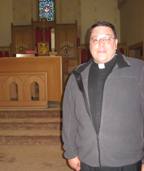 When Father Rob Orlowski was in his junior year of college at the University at Buffalo, he felt that something was missing from his life. He was working towards a degree in History yet he really wasn't sure how he would make use of it. Looking back on his journey to the priesthood, he feels that the most difficult thing about it was getting started. He recalled that, "The hardest part was admitting to myself that I may have a vocation to the priesthood and then letting other people know it because I didn't know what their reaction would be."
Rob grew up in Lackawanna with his parents and two older brothers attending Our Lady of the Sacred Heart Parish in Orchard Park. He graduated from St. Francis High School and went on to earn an Associate's Degree from Hilbert College. He then attended the University at Buffalo where he earned a Bachelor's Degree in History. After deciding he wanted to look into the possibility of becoming a priest, he moved into the John Paul II Residence while he took a few classes he needed in order to enter Christ the King Seminary. He lived there for a year and enjoyed the experience very much.
After graduating from Christ the King, Father Rob was ordained on May 17, 1997. He didn't feel nervous at his ordination; rather, he was happy to be there with his classmates. "We had each other and we had been together for a long time," he remarked. He also remembered feeling something special at certain parts of the ceremony such as the Litany of the Saints and the Laying on of Hands. It was something that just could not be described.
Father Rob's first assignment was to St. John the Baptist Parish in Lockport. He spent time there after being ordained as a transitional Deacon and then spent his first year of priesthood there as well. He was then assigned as administrator to St. Anthony Parish in Lockport for one month. After that he moved to Holy Spirit Parish in North Buffalo where he was a parochial vicar for four years. He then took on the role of administrator at St. Mary Parish in Lancaster for about ten months and spent another ten months as a parochial vicar at St. Gregory the Great Parish in Williamsville. Once again, he was asked to take on the role of administrator, this time at St. Teresa of Avila Parish in Akron for another eight months. He then became pastor of the current St. Maximilian Kolbe Parish in Corfu which was a result of the merger in 2009 of St. Francis of Assisi Church in Corfu and Holy Name of Mary Church in East Pembroke. In September of 2012 he became the pastor of Our Mother of Good Counsel Parish in Blasdell where he currently resides. He is happy that during all those moves his classmates had been assigned to parishes that were somewhat close to his which enabled them to stay in touch.
Father Rob enjoys very much celebrating daily Mass. He said, "I like getting to know the people. It's like having your own little church family." Father Ed Czarnecki lives at Our Mother of Good Counsel with Father Rob. Father Ed has been a great help to Father Rob because he knows everyone and is still very active and dedicated to the parish. This has made Father Rob's transition into a new church family a lot easier.
One of the most difficult things Father Rob finds about being a priest is saying the funerals of young people. He feels that, "Everything else, you can deal with if you break it down and work it out. Financial problems, couples who want to get re-married from divorce situations, even the merger of Corfu and East Pembroke, etc., you can work with these things. But when you're facing that kind of loss, words just don't cut it."
When he has some free time, Father Rob enjoys movies, reading, watching a little TV, and traveling. He always wanted to travel when he was growing up and now he helps to lead group tours to various wonderful locations just about every other year. He once visited China and would like to return to the Far East sometime to experience more of that area of the world. This fall, he and Father Art Mattulke are leading a trip through Alpine Europe. He also enjoys spending time with his family, friends, and his two dogs.
He exclaimed, "I've been happy at all my assignments. Moving to Our Mother of Good Counsel has been a good opportunity to experience ministry in a different way. There are always challenges to face. Change can be difficult because of the unknown but it can be fun as well." He sums it up by stating that, "Every day is an adventure!" And that keeps life interesting.
May 2013 Priest of the Month - REV. STEVE JEKIELEK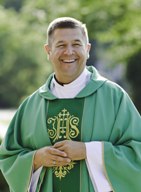 Father Steve traces his earliest thoughts of the priesthood to his preparation for First Communion. The sister who gave them instruction asked him and a few others to help her put some things away after class one day. He recalled, "It was the first time I had gone into the sacristy and I thought, 'This is pretty cool!'" After that he thought about it off and on in high school and beyond but didn't do anything about pursuing it. Originally he thought he would study to become a dentist but then changed his mind. He began to spend more time at his parish, St. Peter in Lewiston, helping out as a Lector and Extraordinary Minister of the Eucharist as well as teaching Religious Education. He would also serve Mass in the morning before going to work. Sister Donald, a Franciscan Sister of St. Joseph who was principal of the school, took notice of his involvement and told him one day that she thought he should pursue a certain young lady in the parish. She thought they would make a great couple. The next week when she saw Steve, she told him, "Forget the girl, I think you should become a priest!"
Father Steve has always called Lewiston, New York his home. He was raised there with his two sisters, and his parents still live there. He attended Lewiston-Porter schools for elementary and high school and earned a Bachelor's Degree in Biological Sciences from the University at Buffalo. After graduating from UB, Steve spent 19 years working for a company on Grand Island that makes products for medical research. The company paid for him to go back to school and earn an MBA. He bought a house in Lewiston which he still owns and enjoys on his days off.
As time went on, Steve would think more seriously about the priesthood but it seemed that every time he began to reconsider it he would get a promotion at work. He would then think, "Ah, see, it isn't meant to be." That became his excuse for not pursuing it any further. Finally, it got to the point where he felt it was getting too late to put it off any longer. He thought he should at least look into it because he was getting older and felt that it was now or never.
When he entered Chris the King Seminary he sent a letter to Sister Donald, whose age by that time had confined her to the infirmary at the convent, just to let her know he had decided to act on her advice. He spent the first two summer assignments at St. John the Baptist Parish in Kenmore and St. Mary of the Assumption Parish in Lancaster. He spent his pastoral year at Blessed Sacrament Parish on Delaware Avenue in Buffalo. His third summer assignment and Diaconate parish was St. Bernadette in Orchard Park. He remembers everything about his Ordination as a transitional Deacon on November 5, 2010 and his Ordination to the Priesthood, June 4, 2011. Both days he wasn't nervous at all. He recalls, "I thought I'd be a little nervous but by that point you've committed yourself to doing this." His ordination to the Diaconate was a regular day like every other in that he had classes and went to dinner. It seemed strange that after dinner such a monumental event would take place.
While driving to St. Joseph Cathedral on June 4th, he couldn't believe that the day was finally here. As he entered the near empty cathedral, he heard the cantor rehearsing a song, "Benedictus," that he had specially requested, which was from a CD put out by "The Priests." The music had to be sent all the way from Ireland. It seemed as if it was purposely set up that way just to welcome him as he arrived. There were moments during his Ordination to the Priesthood that were extremely special. It was a very powerful experience to lie prostrate on the floor as the Litany of the Saints was sung. Also special was the Laying on of Hands when his brother priests welcomed him into the fold. Father Steve recalls that it meant so much to him to have two priests who were so special in his life help him on with his vestments. After he was dressed he thought, "Now I not only feel like a priest, I look like one too." Then it became real. His first and current assignment is as a Parochial Vicar at St. Christopher Parish in Tonawanda.
So far as a priest, Father Steve has had many positive experiences. He is happy to be someone people can come to when they need the kind of assistance only a priest can give. The ultimate joy of his priesthood is presiding at Mass and a close second is hearing confessions. It is very gratifying to him to hear the confession of someone who has been away from that sacrament for years. The part of priesthood he never thought would be so great is funerals. He has found that, "You get to meet with these families who are in such pain and sorrow and it's just amazing to see how many of them have such great faith." He noticed that as soon as they see "Father" they feel everything is going to be alright. He says it's not him but rather the collar, the idea of a priest representing Christ to those who are in need. The same is true when a loved one is very ill. Just the presence of the priest in the home or hospital makes them feel better.
Father Steve hasn't found very much of the priesthood to be negative or challenging. He feels that things like dealing with difficult people or different personalities is a part of life and would be encountered anywhere. There are always going to be those people who don't like what you're doing or the way you're doing it. That's life.
When he gets some free time, Father Steve likes to go to the theatre. He has tickets to Shea's and enjoys those performances. He also enjoys sporting events, movies, reading, and cooking when he gets the chance. He likes to travel but it's not easy to get away from such a busy parish. He has an aquarium that he keeps at the rectory and appreciates the serenity it brings. He also enjoys spending time with friends.
To vocation candidates, Father Steve advises, "Do it! Give priesthood a try." The seminary prepares you but you have no idea what really awaits you after Ordination. He adds, "When you start experiencing the things you're called to do as a priest, you'll be amazed!" He further explains that it's exciting and he is never bored. There is always something to keep you busy. He also feels, "If you're looking for something challenging and exciting, this is the lifestyle." He loves business and looks forward to using his business degree when he becomes a pastor. He likens that position to becoming the CEO of a "company." He adds that no matter where your talents lie, there is always a way to make your interests a part of your priesthood. Father Steve really feels that priests need to encourage men who are considering the priesthood. Even those who haven't started thinking about it yet but show signs of being involved in church life can benefit from an encouraging word or a suggestion to consider the priesthood. As Sister Donald did for him, everyone should tap on the shoulders of young men who show signs of having a vocation to the priesthood. He feels that anyone who may be interested should, "Jump in and try it! You won't regret it!"
April 2013 Priest of the Month - MSGR. DAVID SLUBECKY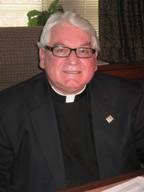 When a man considers becoming a priest, he usually has an idea of what he thinks the experience of the vocation will be. Sometimes he is correct. More often than not, it turns out to be full of twists and turns he never expected. Having grown up in Alden, NY, Monsignor David Slubecky thought that parish life would dominate his priesthood, but God had different plans.
Young David attended St. John the Baptist Parish School in Alden. After the eighth grade he wanted to enter the Diocesan Preparatory High School and start on the path towards priesthood. His parents thought it would be better if he attended a regular high school but he insisted on the Diocesan Preparatory. They were very supportive but also made it clear that they would support him if he decided he no longer wished to pursue the priesthood. He went on to St. John Vianney Seminary (now called Christ the King) in East Aurora where he graduated in 1969 with a BA in Philosophy. He continued his studies in Rome at the Pontifical Gregorian University and graduated in 1972 with a BA in Theology and began work on a Licentiate in Theology at the University of St. Thomas Aquinas in Rome.
Monsignor Slubecky was ordained in his home parish of St. John the Baptist in Alden on July 21, 1973 by Bishop Edward Head. He recalled that it was a very hot day made even hotter by the fact that he wore a suit under his vestments made of wool. While he was a deacon in Scotland the pastor of the parish in Edinburgh gave him a bolt of wool and he had it made into a suit. It was so special to him that he was willing to wear it even on that very hot day.
His first assignment was to St. Mary Parish in Batavia as a parochial vicar. In October of 1973, he was sent back to Rome to complete the Licentiate in Theology at the Angelicum University. He returned to St. Mary's and in 1975 was assigned to the St. Ignatius Renewal Center as associate director. He worked with the first class of permanent deacons. In 1978 he was named Director of the Renewal Center and Director of Formation for the Permanent Diaconate. He once again returned to Rome for further studies in 1983 and, in 1985, earned a Licentiate Degree in Canon Law at the Gregorian University. In June of 1985, Monsignor Slubecky was named Vice Officialis for the Diocesan Marriage Tribunal with residency at St. Lawrence Parish in Buffalo and, in 1986, was named Officialis with residency as chaplain of the Sisters of Mercy Motherhouse in South Buffalo.
Unable to recall when he first thought about becoming a priest, Monsignor Slubecky said, "I am told that I actually said it in the second grade." He had a great uncle on his father's side who was a priest in Canada. His great uncle would sometimes visit and that was a positive influence on Monsignor Slubecky as was the wonderful example of the priests he encountered in his parish while growing up. His idea of priesthood was very much centered around parish life and so far he hadn't seen much of that. As Bishop Head neared retirement, Monsignor Slubecky mentioned that he would like to be assigned to a parish seeing as "that's what I thought I'd be doing as a priest." He was assigned in 1994 as pastor of Fourteen Holy Helpers in West Seneca where he spent eleven years ministering as the parish priest he had always envisioned himself to be.
In 2005, Bishop Kmiec asked Monsignor Slubecky to become the Vicar General and Moderator of the Curia for the Diocese of Buffalo. He holds that position presently and, in looking back on all that he has done so far in his life, he said, "It has been a rich experience with all sorts of opportunities, none of which I chose or asked for except for going into the parish (Fourteen Holy Helpers). But in every instance, after the fact, I was happy I'd done it. I kind of sensed - maybe that's what I was supposed to do. That was God's plan." When Bishop Kmiec asked him to get involved again in administration and leave parish life, he recalled feeling that "in the past it's worked. I guess it's what I'm supposed to do."
For Monsignor Slubecky, the celebration of the Eucharist is the highlight of his priesthood. He added, "Touching people at levels sometimes painful with crisis, often times joyful such as when they are getting married or celebrating the sacraments with their children, is also one of the best aspects of the priesthood. Sharing in people's sacramental lives and their lives as a Christian community makes our lives as priests so unique."
Even though administration is where most of his priesthood has been centered, Monsignor Slubecky sometimes finds it to be challenging. When he reflected on the time he spent on the Marriage Tribunal he noted that on one level he wished he could grant annulments to everyone who asked for them. In reality, he said that for every case he had to begin with the assumption that the marriage was valid until proven otherwise. If there was not enough evidence to declare the marriage null, an annulment could not be granted. He found these and other administrative issues to be difficult to deal with at times.
Monsignor Slubecky enjoys eating out at restaurants, going to the theatre, listening to classical music, and traveling. When he was pastor of Fourteen Holy Helpers, he went to Rome four times with groups from the parish. Although he has been all around the world to places like China, Russia, Germany, Switzerland, Scotland, France, Egypt, and Israel, his favorite place to visit is Rome. This is where he studied and spent a lot of quality time getting to know the ins and outs of the area. While he was studying in Rome, he was able to easily travel to many of the surrounding countries. Back then he had the opportunity and the time to do so. Life is busier now and he finds it difficult to get away as much as he would like.
"The Church is constantly undergoing change," commented Monsignor Slubecky. It's not the same as when he started 40 years ago. Back then most priests were ordained almost 22 years before becoming pastors. Now it's three to five years. It can be scary to consider what the future holds but he feels it is important to "trust that the Lord will provide as long as we don't stand as obstacles to Him." He advises that those who are considering a vocation to the priesthood should be open to the promptings of the Holy Spirit and realize that their experience of the priesthood may not be what they expect it to be. Monsignor Slubecky recalled, "Even though some of the things I've had to do were difficult, I never regretted having gone through the experience." He feels his life as a priest is "very fulfilling and very peaceful knowing you're going the route God wants you to go."
March 2013 Priest of the Month - REV. ART MATTULKE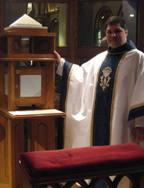 Did you ever get the feeling you were being followed? Father Art Mattulke felt that way when he was assigned to SS. Peter & Paul Parish in Hamburg as pastor in June of 2012. As an infant, he was baptized at SS. Peter & Paul Parish in Arcade because his father was a very close friend of Monsignor James Connelly who was stationed there at the time. His father insisted that all his children be baptized by Monsignor Connelly and so Father Art went along in the tradition of his two older brothers. Father Art recalled, "Wherever Monsignor Connelly went, we followed and were baptized." He grew up in Williamsville, NY as a member of SS. Peter & Paul Parish making his First Reconciliation, First Communion, and Confirmation all under the watchful eyes of Saints Peter and Paul.
While in high school his mother tried very hard to make Mass appealing. Before they were old enough to drive she told her sons that if they attended Mass, they could drive around the parking lot after all the cars were gone. For a teenage boy, Father Art recalled, this was "a pretty nice trade off." At the time, his mother was not Catholic but saw the value in attending Mass. As he got older, Art found himself attracted to a young lady who attended Mass on a regular basis. Each time he would go, he would seat himself closer and closer to where she sat. Once, when he was on his way to an even closer seat, he was greeted by Sister Lucette. She noticed that he was a regular at Mass and commented to him that it was so nice to see a young man so interested in his faith. She asked him if he would teach fifth grade religion and, finding it difficult to say "no" to a sister, he consented. He loved the experience of passing on his faith through teaching and, looking back, he feels that was probably the beginning of his call to the priesthood. Sometime later, his pastor, Bishop Trautman, asked Father Bob Yetter to take Art out for pizza and talk to him about the possibility of becoming a priest. All did not go as planned because when Art discovered the plot he told Father Yetter, "If that is what this is about, we're done and I'm leaving right now." Father Yetter replied, "Okay, I'll never bring it up again." And, to his credit, Father Art recalls, he never did. He did, however, plant a seed that would not stop growing no matter how hard young Art tried to suppress it.
After graduating from high school he spent two years at ECC North. He had been feeling called to the priesthood for a while and finally decided it wasn't going to go away so he should look into it. He moved into the John Paul II Residence and continued his education for one semester at Buffalo State College and then Canisius College where he finished up his undergraduate degree. He feels very grateful to the Palisano Foundation for the funding they provided to him because he was studying to become a priest. "God bless them for that. I never could have afforded Canisius otherwise," he added. He laments the fact that the John Paul II Residence has since been closed. The time he spent there was very productive in helping him to discern his call to the priesthood. He recalled, "We were like a religious fraternity. We all went to different colleges but we hung out together and participated in Mass, retreats, reciting the Liturgy of the Hours, etc. as well as going out socially." They were all contemplating the priesthood and they got to do it in a low pressure atmosphere. It was more of a "come and see" approach without any kind of commitment. Some of the young men went on to become priests, others did not. Father Art remembers feeling at that point, "if anyone would have pushed me, it would have been right out the door."
He entered Christ the King Seminary in East Aurora in 1992, the same year his father passed away after a heart attack. He took some consolation that "at least my dad knew of my intention to become a priest." He was ordained a Transitional Deacon on his birthday, June 15, 1996, and was ordained to the priesthood on May 17, 1997. Father Art's first assignment was to St. Gabriel Parish in Elma for one year. He had spent time there previously as a seminarian and also as a deacon. He very much enjoyed the people there and learned a lot from the pastor, Father Dan Palys. Father Dan was a great inspiration to him. He was then assigned to St. Margaret Parish in North Buffalo with Monsignor James Kelly for five years. St. Margaret's had a school and Father Art was happy to be involved there and found it a joy to minister to the people. After that he moved on to St. Bernadette Parish in Orchard Park. He spent four and a half years with Monsignor Richard Nugent and Father Ray McNicholas whom he described as, "good holy men who really loved what they did and loved the priesthood." He also exclaimed, "I've been blessed with some wonderful mentors. All have been fantastic guys who were great to work with and learn from."
Father Art began his first pastorate with three churches: St. Cecilia Parish in Oakfield, St Patrick Parish in Wheatville and Our Lady of Fatima Parish in Elba. Eventually, in 2009, they merged together to form St. Padre Pio Parish. During this process, Father Pat O'Keefe came to live with Father Art while awaiting a new assignment.
In the summer of 2012, Saints Peter and Paul came calling Father Art once again. He and Father Pat were both assigned to SS. Peter & Paul Parish in Hamburg, NY. This was a big move indeed as their new parish was three times the size of St. Padre Pio and also had a school. With a bigger parish comes bigger challenges and responsibilities as well as more staff and volunteers to help with all that is involved. As with many aspects of life, change is inevitable. In the priesthood, change is expected and Father Art looks forward to settling in and experiencing the opportunity to grow as he becomes more accustomed to running a large parish. He stated, "God knows what He wants and what He needs and we've promised ourselves to His service." Father Art is amazed at the constant activity and draws energy from all of it. The many opportunities for outreach and evangelization at SS. Peter & Paul are very inspiring to him and his ministry.
Father Art's mother still lives in the same family home in which he was raised. She decided to convert to Catholicism before he was ordained and secretly attended RCIA classes at another parish so she could surprise him by receiving Communion from him at his ordination. This made him very happy indeed! He also has two older brothers and three nieces.
There isn't a sport Father Art doesn't like. He enjoys following not only the Buffalo Bills and Sabres, but many other sports and teams as well. He played football and swam when he was younger but now it's difficult to even find time to watch them on TV. His dog, Maxim, keeps him busy as well and is a great source of companionship. When he gets the chance, Father Art loves to travel. He has been all over the world and appreciates the many wonderful experiences he has had.
As a priest, Father Art finds saying Mass to be most fulfilling. He feels that it is an honor to "be part of the Liturgy that is infinite." He notes that, "It is a celebration that is over 2000 years old and being a part of the events of the Last Supper can be for everyone. We are all part of the 'priesthood of the faithful' and we all participate in the Liturgy." Even when he's tired, he never finds celebrating the Liturgy to be tedious or wearing. All of the other Sacraments have special meaning to him as well. He expressed that, "Any time I get to be with anyone in celebrating the Sacraments is a moment of grace. To be part of that moment when God physically reaches out and touches his people is very inspiring."
"Living what we pray every day, 'Thy will be done,'" is probably one of the most difficult things for Father Art. He feels that he sometimes confuses his will with God's will. He stated that, "Becoming something new and allowing myself to become what God has in store for me when it is other than what I thought it would be is a very hard thing. The hardest part is knowing God's in charge because I have to trust and admit that I'm not in charge."
Concerning the priesthood, Father Art emphatically stated that, "It really is a wonderful life and a difficult life as well. It helps to be open to wherever it is that God is calling. Expect change and you won't be disappointed. You'll be tired but you'll get so much more from the people than you ever give. Work and pray and stay connected to Christ through the gift of his people. The best gift you can give is to give yourself."
If you're going to be followed, who better to look after you than two rock solid saints like Peter and Paul?
February 2013 Priest of the Month - REV. BILL TUYN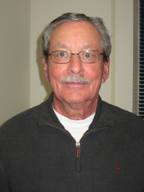 From a very early age, Father Bill Tuyn knew he wanted to be a priest. He was born on the west side of Buffalo and moved to Kenmore when he was ten years old. He attended St. Paul Elementary School and was inspired by his pastor as well as the other priests who were assigned there. He also greatly admired the seminarians who were studying for the priesthood from his parish. They would help out by training the altar servers as well as with other jobs at the parish. As he grew, he too became involved with helping out at the parish and felt that God was calling him to this life in a more permanent way as a priest.
Father Bill is the oldest in his family. He has five sisters and one brother. He has many nieces and nephews and enjoys spending time with them when the family gets together. His parents are both deceased as is one of his sisters. He feels fortunate that the rest of his siblings live in the Western New York area.
After elementary school, young Bill entered the Diocesan Preparatory High School and Minor Seminary where he spent six years. He then went on to Christ the King Seminary (which was part of the St. Bonventure Campus at that time) for two more years of study. It was then on to Rome to finish up his studies for the priesthood at the North American College. He was ordained to the priesthood on December 19, 1962. There were 63 men ordained that day. In order to accommodate the large number of people, the ceremony was moved from the usual location of the Chapel at the North American College to Cristo Rey Church. The ceremony was five hours long. With all those men to ordain, Archbishop Martin O'Connor had his work cut out for him. He did a very thorough job making sure every detail was covered. After the ordination, Father Bill and his family enjoyed a wonderful dinner at a local restaurant in Rome.
Back in Buffalo, his first assignment was as chaplain to the Alfred University and State College communities. He then returned to Rome where he spent two more years studying at the North American College. He returned again to the WNY area and served as a professor at St. John Vianney Seminary in East Aurora for five years. St. John Vianney then merged with Christ the King in Olean and became Christ the King Seminary in East Aurora. Father Bill taught at Christ the King Seminary for another two years and then moved on to parish life. At first he filled in for a few pastors who needed long term coverage. He was then assigned pastor of St. John Church in Jamestown where he stayed for 13 years. After that he was named pastor of St. Vincent Parish in North Evans where he stayed for 18 years. He retired from there in 2010 and moved to the campus of Christ the King Seminary where he currently resides.
He finds that he is just as busy now in retirement: "I recommend it hightly!" He enjoys living at Christ the King Seminary. He stated that, "It's been great! There's a lot of activity!" Father Bill helps out by filling in for priests who want to take some time off as well as celebrating scheduled Masses for places like the Sisters of Mercy Convent, Father Baker Manor, and Our Lady of Victory Senior Living facility. He used to find enjoyment in collecting things but now when he gets the time he likes to read, ski, and play golf. Father Bill recently celebrated his 50th anniversary of ordination to the priesthood with some classmates in Tampa, Florida.
When considering the best part of priesthood, Father Bill exclaimed, "The liturgy, of course!" This was followed closely by "Being with the people, trying to bring them closer to the Lord and helping them grow in their faith and commitment to God." When asked what the most challenging part of priesthood was, he admitted, "Doing just that!" He added, "Being able to involve people and get them interested can be very challenging. Unfortunately," he went on to say, "after Catholics, the next largest group of people consists of former Catholics. So many Catholics are 'Sunday Mass' Catholics. That has been the challenge throughout the years, to keep people interested in their faith."
He advises those discerning the priesthood to, "Pray a lot!" He also added, "Don't get discouraged and be open to the Lord and His promptings and the diretion He seems to be leading." Father Bill believes that a good spiritual director can also be helpful to those considering the priesthood. He had a lot of different experiences in his priesthood from studying in Rome to teaching at the seminary to pastoring a parish, and he is happy to report that he has met a lot of great people in the process. He exclaimed, "There have been good days and bad days. It's not easy but it's fulfilling, very fulfilling!"
January 2013 Priest of the Month - REV. TED BOCIANOWSKI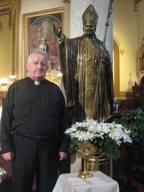 It was not unusual for a young boy growing up in Poland in the 1950's to consider becoming a priest. Catholicism was a part of just about everything he did. It was celebrated in the home, taught in public schools, and weaved into almost every facet of daily living. Young Thaddeus Bocianowski was no exception. As an altar server he was able to participate more personally in the Mass. Father Ted recalls knowing many men from his parish who became priests and the joy of attending their ordinations. The priests who were assigned to his parish as a boy were very present to him and all the parishioners. He felt a strong connection to them as together they participated in the life of the Church. In Poland, the seminary is considered to be the heart of the diocese. Without seminarians there would be no priests and without priests there would be no Catholic Church.
In 1964 Father Ted entered the seminary in Krakow, Poland. For a short time he was actually taught by Father Karol Jozef Wojtyla, known today as Blessed John Paul II. Also, while in the seminary he spent two years in the Polish Army. Father Ted was ordained in Poland on May 29, 1971. He served as a priest there until 1985 when he moved to the United States. A classmate of his had moved to South Dakota and when Father Ted was asked to consider moving there as well, he agreed. He spent five years in South Dakota. When members of his family emigrated from Poland to Toronto, Canada, he was able to move to Buffalo in order to be closer to them. His mother eventually became a citizen of the U.S. and lives with Father Ted.
When Father Ted first arrived in the Diocese of Buffalo he was assigned to Assumption Parish in Black Rock. He is now the pastor of St. Stanislaus Parish in Buffalo which is linked to St. John Kanty Parish also in Buffalo and St. Adalbert, an Oratory of St. John Kanty Parish. He is very impressed with the work that Sister M. Johnice Rzadkiewicz does at the Response to Love Center. He states that, "There are very good connections with St. Gregory the Great School, Canisius High School, and St. Joseph's Collegiate Institute. The kids who come to help have the wonderful values of the Church."
Father Ted believes that it is a wonderful thing to be a priest. He feels that it is not a job but rather a mission. He thinks it was easier to be a priest in Poland because there were more Catholics around. He could walk out in public dressed as a priest and people knew what that meant. He wishes more priests and nuns felt comfortable walking around in their religious clothing so people could see them and not think it unusual. Father Ted feels it would be a good idea for the seminarians here in Buffalo to spend some time in Poland to learn about how things work there. The Diocese of Czestochowa in Poland is over 1,000 years old. There is a lot of history there from which to learn.
While priesthood has many positive features, it is not always an easy life. Father Ted commented, "All jobs and vocations can be difficult at times. Doctors, lawyers, soldiers, etc., all have their challenges." He feels that to be involved in the mission of priesthood, one must be a witness to the Gospel. In order to foster more vocations to the priesthood and religious life, Father Ted feels that we need to look for different ways to reach the people. Priests need to talk more about their own vocations in their homilies and young people in all parishes should be encouraged to be open to a religious vocation if God is calling them to it.
As a priest, Father Ted finds that he really enjoys saying Mass and hearing confessions. "I like people," said Father Ted. He knows that people have many problems and so finds confession to be very important. He enjoys the social connections he has with his friends and parishioners. He very much enjoys Church music as well. He adds, "For me as a priest, I am happy when the people I'm helping are happy. I want to be a priest for the people. For weddings, funerals, baptisms, people need their priests, not as clerics in the office but as something more...this is our mission."
Father Ted worries about the priest shortage. He knows that when he retires many other priests will be retiring as well and fewer will be left to carry on the mission of service to the Catholic community. He prays often for vocations.
Soccer is a game he used to love to play. Now he follows the Sabres and Bills and attends games when he gets the chance. He related a story about a little boy who once came to him in confession. Father Ted asked him if he knew any prayers. Possibly because of his Polish accent, the boy thought he asked him is he knew any players and began to rattle off those he knew on the Bills and Sabres teams. Father Ted had to clarify, "Not players, PRAYERS!"
Father Ted is pictured in front of a statue of Blessed John Paul II as well as a relic of a drop of Blessed John Paul II's blood. St. Stanislaus Parish is the Official Diocesan Shrine of Blessed John Paul II. It is very fitting that he should be pastor of a parish that honors such a great Polish priest. Father Ted himself has many of the same wonderful qualities such as a real love of the priesthood and of the youth as the future of the Catholic Church.
November 2012 Priest of the Month - REV. TODD REMICK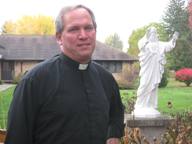 "Sometimes God touches you when you're sad and struggling," Father Todd said as he recalled the first time he thought about becoming a priest. He was with his best friend, whom he had grown up with in Mayville, NY, on the day of his friend's wedding. As they were preparing for the big event, his friend received the devastating news that his father had just suffered a massive heart attack and died. The wedding went on as planned and a few days later family and friends gathered once again, this time at St. Joseph's Cathedral in Buffalo to bid farewell to a Buffalo Police Officer and father of the groom. Father Todd remembers feeling that God was calling him to do something active at the funeral, however, he didn't know what. "Through that experience," recalled Father Todd, "I found God calling me to do something more with my life, something different."
Three years passed before he got the courage to pick up the phone and call someone to talk about the process of becoming a priest. He described feeling an overwhelming sense of God telling him he would not ask Todd to do anything he couldn't handle and, more importantly, that God would always be with him. The first person he called was Father Al Kuntz who had been a friend of Todd's family for a long time and had a very positive influence on him when he was growing up. Even though he was working as an engineer in the Rochester, NY area, he knew he wanted to serve in the Diocese of Buffalo because that's where his family lived. At first the idea of going back to school at Christ the King Seminary seemed almost frightening. He had never been to the seminary and, with tongue in cheek, recalled, "I envisioned it as surrounded by a chain link fence with barbed wire on top, guards with dogs and guns and I wasn't getting out!" To say the least, he admits it was a lot different than he thought it would be. The five years he spent on campus were enjoyable times where he learned a lot and met many great people.
Before he was ordained, Father Todd spent his pastoral year at St. Mary of the Assumption Parish in Lancaster under the guidance of Father Paul Steller. After that year, he spent the summer at Creighton University in Omaha, Nebraska to further his studies. Once ordained as a Transitional Deacon, he was assigned to St. Benedict Parish in Eggertsville with Father Gary Bagley. He very much enjoyed all of these assignments.
On the day of his ordination, May 27, 2006, Father Todd felt overwhelmed. He remembers that there were a lot of brother priests who came for the celebration and it meant a great deal to him, especially as they all approached during the Laying on of Hands to pray over him. He also recalls fondly that Bishop Kmiec, who had back and knee problems, knelt down during the Litany of the Saints. Father Todd was so impressed that he would make such an effort during this special time. It is customary for a newly ordained priest to bestow his blessing upon those who were there to celebrate with him. Of all the blessings he gave out that day, Father Todd was most moved when he blessed his parents who live apart from each other but stood together to receive a blessing from their son.
Father Todd's first assignment as a priest was as Parochial Vicar at St. John the Baptist Parish in Kenmore. He spent three years there with the pastor, Father Rick Reina. In 2009 he returned to the town where he grew up and became pastor of St. Mary of Lourdes Parish which has two worship sites - Our Lady of Lourdes in Bemus Point and St. Mary in Mayville. He is happy to have returned to the Lake Chautauqua area.
Celebrating the Eucharist at Mass with his community is one of the highlights of his priesthood. Recently Father Todd has enjoyed the opportunity to teach ninth and tenth grade religious education. He appreciates working with the youth and having the chance to get to know them better, as well as influence them in a positive way when so much of the world is trying to give them a different message. He feels it is special that as a priest he gets to be with people at the greatest times of their lives such as baptisms and weddings and he welcomes the chance to give them support when they need it most as they struggle with sad times such as funerals and personal troubles.
Father Todd enjoys so much being with people that it becomes difficult to find some solitude and get away to pray. He puts effort into spending time with his brother priests to relax but it isn't easy because they are so spread out. Besides the two worship sites at his parish, he has recently been named Administrator of Christ Our Hope Parish in French Creek. Administration can be a tough part of priesthood, especially when there are so many worship sites involved.
When he gets the time to relax, Father Todd likes to play golf. He has recently started playing a little hockey again and enjoys tennis every once in a while. He likes to travel to Florida to visit his father and to North Carolina to see his brother. In both places he spends time hiking. He also has a brother and sister who live in the Buffalo area. He is trying to improve his cooking skills as well.
Father Todd advises those who may feel a calling to the priesthood to be open to that possibility. He thinks men should give the seminary a try and realize that it is all part of the process of deciding if priesthood is what God is calling them to. He thinks that "just to go there and be a part of it is a great thing in itself. It is a time to reflect and move inwardly." He recalls that his time at the seminary was a gifted time in his life and he found a connectedness with God. As a priest, he feels it is important to tap on the shoulders of young men he feels may have a calling themselves. He realizes that it means a lot to guys if a priest asks them if they've ever thought about the priesthood. To be positively influenced by a priest can be very helpful and inspire openness to the possibility of the vocation for themselves. It is a great responsibility to have this kind of influence. Father Todd also advises men to talk to a priest or vocation director to see if the priesthood may be for them.
As a bridge inspector, Father Todd just didn't feel fulfilled. He is glad he finally picked up the phone and made the call that got him started on the road to priesthood. Every day he knows that God is making good on his promise to always be with him no matter what happens. Father Todd is pleased that, "Every day is different and there is an excitement to that."
October 2012 Priest of the Month - REV. JAMES FLISS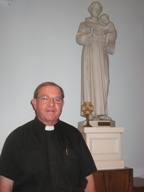 The family that prays together not only stays together but often provides an atmosphere conducive to hearing the call of God. When Jim Fliss and his brother, Paul, were boys they shared a bedroom. At night they would pray together before bed and Paul would often be heard to end his prayers with, "Dear God, make me a good little priest." Jim's prayers never ended that way as a child but after hearing a priest give a vocation talk in the seventh grade, he was inspired to consider the vocation for himself. His brother, Paul's petitions faded away and it was Jim who eventually answered the call to priesthood.
Growing up in North Buffalo in the 1950's, Jim's experience was similar to most Catholic families of that era. His parents were very involved in many aspects of the faith and this had a positive impact on the family as a whole. His father was a member of the Knights of Columbus and the Holy Name Society and his mother was happy to help with all sorts of events behind the scenes. He recalls, "Church was always part of our lives." Even with one brother and five sisters, they were considered to have a small family when compared with neighbors who had twelve or sixteen children. The Fliss family enjoyed the company of their priest friends. Young Jim got a chance to see priests as real people who laughed, shared meals, and wore regular clothes when relaxing. He remarked that this made him realize, "They were normal guys, content with their priesthood, real people I could identify with."
He attended St. Paul's Elementary School and the Diocesan Preparatory High School. His college years were spent at St. Mary's College in Orchard Lake, MI. He was ordained a Transitional Deacon there by Bishop Head and ordained to the Priesthood on June 19, 1975 at his home parish of St. Paul in Kenmore. Father Jim spent his first summer as a priest at the St. Vincent de Paul Summer Camp in Angola. He remembers that it was a beautiful summer with only two days of rain while the campers were there. Having been a Boy Scout, he loved the outdoors and camping. After seven weeks of summer camp, he was assigned to St. Hyacinth Parish in Dunkirk for a few months and then to his home parish of St. Paul in Kenmore for another seven years. He then moved on to St. Rose of Lima Parish in Buffalo and after that to Queen of Martyrs Parish in Cheektowaga and St. John the Baptist Parish in Kenmore. He was named Pastor of St. Anthony Parish in Farnham. After four years, Bishop Mansell asked him to take the linked parishes of St. Anthony and Our Lady of Mount Carmel in Brant. After four years of that, the two parishes were merged and as a diocesan policy requires, he had to put in his resignation as pastor. He reapplied to be the pastor of the newly merged parishes and his application was accepted. He is currently pastor of the two merged parishes at the St. Anthony worship site.
Father Jim really enjoys being a part of peoples' lives. He feels that it can be both joyful and painful to be close to people. "There are so many good times you share with them," he feels, "and so much sorrow as well. It can be very difficult dealing with death, especially of young people. It can be incredibly sad and yet it helps if you can bring them some comfort, some solace, in just being with them."
He finds it challenging to make the message of the Church relevant, especially to young people. He added, "Society has so many messages and society's messages are so against what we're all about. Society says, 'Take care of yourself.' They get this message 24/7. How do we tell them that 'stuff' doesn't really count that much?"
Father Jim enjoys golfing and gardening. He used to be an avid bowler but doesn't do much of that any more. He also likes photography.
In offering advice to men considering the priesthood, Father Jim says, "Think about it, just don't pass it up, think about it. Give it some real thought and ask yourself where you see yourself in five or ten years. What do you see yourself doing? Can you see yourself working with people and helping people or do you see yourself working for the rat race?"
When Father Jim was younger, he took a test to see at what career he might excel. The test revealed that he would make a good plumber or carpenter. He is truly grateful that he is a priest. He still gets to do the occasional plumbing and carpentry job as well as short order cook and a few other occupations associated with being pastor, but he added, "I can't even imagine what else I'd want to do with my life!" As a priest, he gets to do it all.
September 2012 Priest of the Month - REV. PATRICK O'KEEFE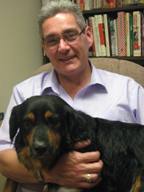 Originally headed for a vocation in the food service industry, Father Pat O'Keefe changed course and ended up as a priest instead. He maintains his passion for the culinary arts by cooking and baking whenever he gets the chance and admits that because he was open to the idea of becoming a priest, he was able to hear God's call.
Originally from South Buffalo, he and his older brother, Dennis and younger brother, Kevin grew up in Orchard Park. Patrick graduated from Orchard Park High School in 1985. His high school years were split between traditional classroom time and food service training. He planned to join the CIA (Culinary Institute of America) but was dismayed by their rigid agenda. He was more familiar with using a recipe as a guide and feeling his way through the process as his mother and grandmother had taught him. Also, during high school, Pat was very involved in the church with everything from maintenance work to teaching Religious Education. People told him they thought he would make a good priest. While he considered it, he still wasn't sure so he put it on the back burner.
He spent a year at Buffalo State College but didn't really enjoy the experience. After talking to the parochial vicar at his home parish of St. Catherine of Siena, he decided to look into the priesthood. He entered Wadhams Hall Seminary College a week after being accepted and graduated from there in 1991. He then went on to Christ the King Seminary in East Aurora. During the summers he worked at the St. Vincent de Paul Camp. As he progressed along he was promoted from "Bible Guy" to "Chapel Dude!" He became very close friends with Monsignor William Stanton while he was at St. Ambrose in South Buffalo. Considered his mentor, Monsignor Stanton preached at Father Pat's first Mass. After being ordained a transitional deacon, Father Pat was assigned to St. Mary in Swormville. He spent his first year as a priest there as well.
Ordination day, May 4, 1996, was a very exciting time for Father Pat. He remembers family and friends who shared in the joy of that celebration, some still living, others who have passed away since then. He recalls lying on the marble floor listening to the Litany of the Saints being sung, putting his hands into the hands of Bishop Mansell in a promise of obedience, and brother priests coming over to give him their blessing. All in all, it was a very overwhelming and powerful experience. The next day, he said his first Mass. A good priest friend, Father Kris Lauzon, whom he met at Wadhams Hall Seminary College, acted as the emcee at the Mass. When it was time to process in, Father Kris said, "OK, it's time to go." Father Pat recalled, "I froze!" Father Kris responded by slapping him and saying, "Come on, it's your turn now!" and Father Pat thought, "I'm not used to being the last one in the procession line for Mass!" and then told his friend, "That is the first and only time you will ever had permission to slap me and get away with it!"
After St. Mary in Swormville, Father Pat was assigned to St. Benedict Parish in Eggertsville where he spent five years. It was then on to Our Lady of the Sacred Heart Parish in Orchard Park for two years and St. Patrick in Randolph for another two years. After that, he lived with Father Art Mattulke at Our Lady of Fatima in Elba (now part of St. Padre Pio Parish) for four years. On June 1st, 2012, both Father Art and Father Pat were reassigned to SS. Peter and Paul Parish in Hamburg.
Father Pat enjoys being a special part of the Baptisms, First Communions, and Confirmations of his relatives. This October he plans to celebrate the wedding of his cousin's daughter as well as bake her wedding cake! He expressed great happiness at, "Helping people to develop the faith of who they are." Two years ago he was asked to take on the added responsibility of being the Chaplain for D'Youville College. He finds it very rewarding to be able to be a part of both a parish and a college environment. He's noticed that students who are away from home and on their own for the first time learn to develop their own faith and their own relationship with God. They are no longer home with Mom and Dad telling them to go to Mass, so when they come to church or attend retreats it's because they want to be there. He added, "I learn from them and they learn from me." Father Pat feels privileged to be able to offer insights and share his time, talents, and gifts in order to allow the students to be able to see through his example how they can do the same thing. The students come from different church backgrounds. Some are more liberal and some more conservative. Father Pat enjoys bringing them all together to share and learn from one another. He likes them to know that, "The Catholic Faith can be experienced in a variety of ways. The Church is who we are and what we bring to it."
"People who don't want to grow" tend to frustrate Father Pat. He finds it hard to deal with people who are constantly stuck in one place and get bitter about anything that has to change such as the recent changes in the Mass responses. Without change, he feels that there is no growth. He remembers some wise words his mother told him, "If you always do what you've always done, you'll always have what you've always had." He added, "God gives us so many opportunities to grow and change. We need to be open to that."
Along with baking and cooking Father Pat also likes to work with ceramics and creates things as gifts for people. He stated, "I love making things for people instead of just going out and buying them." He comes up with a different Christmas ornament each year to the delight of his friends and relatives. He loves all different kinds of music, "Everything from Meatloaf to Mozart!" He also enjoys the company of his dog, Seamus, who he has owned for two years. He found him at a shelter on St. Patrick's Day and took him home two days later on St. Joseph's Day. Seamus has been a well behaved, constant companion ever since.
To men discerning a call to the priesthood, Father Pat advises, "Allow people to offer their insight but be true to yourself. It should be something you feel called to and not what other people have to say. People may say, 'You should be a priest,' but if you don't feel it, you're not doing it for yourself, you're doing it for somebody else and you're never going to be truly happy or genuine in that role." He adds, "Go out and get a job and date women. If the vocation is there it will always be there. God will continue to call you. If you never try anything else you may think later that you missed out on something and have feelings of regret."
Father Pat expressed that he is very happy as a priest. He said, "I have no regrets. Life as a priest is full of new surprises and opportunities every day. I tried different things and was always open to the call to priesthood. There are challenges along the way, but God always puts people into my life to help me through."
August 2012 Priest of the Month - REV. ROY HERBERGER
 When asked what it was that attracted him to the priesthood, Father Roy explained that, “Listening to people talk about priests [when he was growing up] was always very positive. I always envisioned a priest as someone who was there with and for the people. He was someone who was there to help in times of trouble or crisis as well as to share in times of joy.” Father Roy added, “I’ve always been a people person so it just seemed to fit into my personality. I wanted to have something to do with people.”
When he was in the eighth grade at his parish school, SS. Peter & Paul in Williamsville, he had already come to the realization that he wanted to be a priest. Having successfully passed the entrance exam for the Diocesan Preparatory High School, he officially began his journey to the priesthood. From then on, he never wavered. He continued on through Christ the King Seminary and was ordained in 1968 at Our Lady of Victory Basilica in Lackawanna. Looking back, Father Roy recalled that he, his older brother and younger sister had come from a typical Catholic family where his parents were involved in the church in many ways. He had lots of friends and enjoyed spending time with them as often as he could.
His first assignment as a priest was to the missionary apostolate of Sardinia. He spent a year there which was the custom at the time for newly ordained priests. For three months in the summer he was assigned to Camp Ti-Wa-Ya-Ee, a Boy Scout camp in Holland, NY. He found it most humorous that in his youth he had been kicked out of the Boy Scouts for fooling around too much. “Now,” he quipped, “I’m their chaplain!”
Father Roy was then assigned to St. Leo the Great Parish in Amherst. The year was 1969 and Vatican Council II changes were being implemented throughout the diocese. Looking back, Father Roy realized that he may have presumed too much in his zeal to implement the changes. Many people were not comfortable with the changes the church was undergoing and Father Roy sees now that he upset some people with his “full steam ahead” approach. People complained about him and he was subsequently moved to another assignment. Although he was hurt by the rejection, he could still find humor in the circumstances. As he recalled, “I was one of those children who grew up being threatened with, ‘If you don’t behave, we’re going to send you to Father Baker’s.’ Eventually, the bishop did!” He was reassigned to Our Lady of Victory Basilica in 1972. For the first six months he remembers feeling very hurt and closed in on himself. Finally, one of the secretaries said to him, “Father, I know you’re hurting but so are we. We need a priest here! Please be a part of our lives!” It hit Father Roy like a slap in the face but he admits, “I needed that!” He ended up staying there for five years.
In 1976 the Diocese of Buffalo offered a program to help priests understand what life was like in primarily African-American innercity parishes. Father Roy was interested in being a part of this and got involved. He was then assigned in 1977 to two parishes, Our Lady of Lourdes and St. Boniface. The approach of “Team Ministry” was enacted where two priests and two religious sisters worked together for both parishes. Father Roy was there until 1988.
One of the highlights of his priesthood was his friendship and working experience with Sister Karen Klimczak, SSJ. She dedicated one of her summers to prison ministry and enjoyed the experience so much that she talked with other parish members in their prison ministry program into purchasing a van to take people to visit and pray with inmates and to provide an opportunity for family members and friends of inmates to keep connected. This led to a desire to acquire a house where newly released inmates could transition back into society in a safe and supportive environment. This dream became a reality in 1985 with the opening of “Hope House” across the street from ECMC Hospital.
Sister Karen’s enthusiasm was contagious and Father Roy found himself drawn to prison ministry as well. He would visit the Albion Prison and help with an afternoon Mass once a week. In 1988 he was assigned to St. John the Baptist Parish in Alden and worked as a part time chaplain at the Wende maximum security prison in the area. He was also named chaplain at the Lake View Shock Camp. This was a new military-style facility where prisoners could have their sentences reduced if they participated in the programs offered there. He was reassigned to St. Mary of Sorrows Parish where he stayed for three years. He found it difficult to juggle parish life with prison ministry and decided to become a full time prison minister when an opening became available at the Wyoming Correctional Facility. He spent five years there as a full time prison chaplain. During that time, Father Roy lived at the rectory of Our Lady of Good Counsel Parish in Darien Center. This parish was linked with Our Lady of the Sacred Heart Parish in Bennington Center. The pastor of the two parishes lived there. Father Roy helped out by participating in the Mass schedules of both parishes.
After four and a half years, Father Roy felt called back to full time parish ministry. An opening became available at SS. Columba & Brigid Parish and upon accepting it in 1999, he happily returned to life in the City of Buffalo. He currently resides at this parish which has many vibrant programs including one for homeless families. In 2006 Father Roy dealt with a terrible tragedy when his good friend, Sister Karen Klimczak, was killed at Hope House (re-named Bissonette House in 1989) by a former inmate who was residing there. It was something that was always a possibility in the back of her mind but one of those things she prayed would never occur. Sister Karen is remembered in several places throughout SS. Columba & Brigid Parish as her name and picture appear in the church building and in a Peace Garden established in her memory.
“It’s been an interesting 44 years of priesthood,” remarked Father Roy. He has enjoyed being there to help people, sometimes just listening, sometimes giving advice, and always offering a shoulder to cry on. He hopes that he has been an inspiration and that his homilies at Mass have given people good direction. He feels that men interested in the priesthood would benefit from talking with many priests. He stated, “All priests have different experiences and can shed light on different aspects of priesthood.” Some have served in city parishes, some in suburbs, and some in rural areas. Father Roy believes that those interested in priesthood should ask many questions so they can get a good personal insight into what it’s like. Just like high schools have “shadow” programs, men should take advantage of spending time helping in church and getting involved to see what parish life is all about. He affirms that priesthood is not all a bed of roses but any problems you face are outweighed by the blessings, joys, fulfillment and contentment that come with ministry overall. He also believes that all vocations have their plusses and minuses. People who are married and raising a family go through certain struggles and challenges as well. If a man enjoys reading, Father Roy suggests that he read inspiring stories about priest saints like St. John Vianney, etc.
“I’ve always been attracted to helping those who felt left out of mainstream Catholicism,” stated Father Roy. This is probably why he enjoyed prison ministry so much and also reached out to the gay community, the divorced and remarried Catholics, and addicts. He added, “I’m always open to those who need to be reminded of Christ’s love for them.” Father Roy finds it hard to picture himself in any other way. He stated, “If I was Jewish, I’d be a rabbi, if I was Methodist, I’d be a minister.” He is indeed someone who enjoys being a part of other people’s lives in a way that is deep and meaningful.
July 2012 Priest of the Month - REV. JAMES WALTER
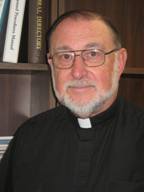 Father Jim Walter's interest in the priesthood began in elementary school with the influence of a holy, happy priest, Father Gene Radon. He also credits his strong Catholic upbringing and faith filled family with creating an environment for him in which the possibility of becoming a priest was welcomed and cherished.
Young Jim and his family joined the new parish of St. Andrew in Kenmore when it was just starting out. It was there that he attended elementary school and served as an altar boy. He remembers the young assistant, Father Gene, setting a good example for others and seeming quite happy doing it. This caused him to think, "I really want to be like him."
He feels blessed in that he followed that calling to its fulfillment without much distraction. He attended the Diocesan Preparatory Seminary for high school and the first two years of college and then went on to St. John Vianney Seminary (now Christ the King) for the last two years of college and four years of theology. As Father Jim recalls, there was not a lot of drama to it in the sense of changing his mind, leaving, coming back, etc. He just started and kept on going.
There were 24 men ordained with him in 1969. Because of the large number, the class was divided up into three groups of eight men. Eight were ordained at the new cathedral by Bishop McNulty, eight ordained at the old cathedral by Bishop Bennincasa and eight ordained at Our Lady of Victory Basilica by Bishop McLaughlin. On May 24, 1969, Father Jim was ordained by Bishop Bennincasa and to this day he will tell you, "I have found the life of a priest to be tremendously fulfilling." He feels that it is everything he hoped it would be and more.
His first assignment was to a Missionary Apostolate in Machias for one year. Although Missionary Apostolates are a thing of the past, when Father Jim was ordained it was common for newly ordained men to spend a year in a remote area under the supervision of a priest with more experience. It was a time of learning how to manage finances, say Mass, hear confessions and generally get your feet wet as a priest without a lot of pressure.
After that, he spent two years at St. Patrick in Lockport, six years at St. Mary (St. Elizabeth Ann Seton) in Dunkirk, seven years at St. Paul in Kenmore, two years at Christ the King in Snyder and six years at St. Gerard in Buffalo. He currently serves as the pastor of St. Vincent de Paul Parish in Springbrook and has been there for the past twenty years.
For the past three years, Father Jim has been the Coordinator for the Priests' Personnel Board. When a parish needs a pastor or parochial vicar, he gets involved with searching for the best man for the job. He finds it is becoming increasingly difficult because of the shortage of priests. It can sometimes be a challenge to divide his time between the parish and his responsibilities on the diocesan level.
When he and his friends get the chance, they enjoy spending time golfing. Father Jim also enjoys the company of his Golden Retriever, Tucker. He owned two dogs before Tucker and finds them to be good companions. Spending time with family is important to Father Jim. He has an older brother and younger sister. Recently, his siblings, their spouses and he spent time vacationing in Austria.
Having been the pastor of St. Vincent for twenty years, Father Jim has had the opportunity to be a part of the blossoming and maturing of many of the parish families. He has married some couples, baptized their children, and officiated at their children's weddings as well. Sometimes people comment that being a priest must be difficult because they don't get to have families of their own. Father Jim responds by telling them, "You're not alone and isolated but rather part of more people's lives than you would be if you were married." It's the involvement with people that Father Jim really loves the most about his priesthood. He feels privileged to be able to walk with them in their journeys of faith.
The life of a priest has its challenges as well. Father Jim remarked, "It is the challenge of a life of service but then if you are raising a family it's not just all about you, you are also living for others." Funerals, especially for young children or their parents, can be especially difficult. People will ask him, "How can you get through something like that?" He says, very honestly, "I don't do it. I feel the presence and spirit of God working through me." Father Jim gives the credit to God who gives him the words to say and the courage to face it. He adds, "You're not out there on your own, the Lord is with you every step of the way." It gives him great joy to know that the Lord would use him in that way.
June 2012 Priest of the Month - MSGR. JAMES CAMPBELL
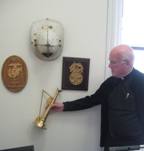 Monsignor Campbell might well be the only Catholic priest in the Diocese of Buffalo, or anywhere for that matter, who can attribute his call to the priesthood to public transportation. The one and only day he had to take the bus to work because his car needed repairs, he met up with a neighbor at the bus stop who remarked, "I always thought you'd make a good priest." After that encounter, Monsignor Campbell couldn't shake the thought and the rest, as they say, is history. Thinking back on many of the twists and turns of his life, he quipped, "God does have a funny bone."
Born on September 9, 1930 to Mildred and James Campbell, young Jim would have only three short years with his mother before she passed away. His father and extended family raised him and his younger brother William. He graduated from P.S. 72 and then South Park High School and attended religious education classes at his home parish, St. Thomas Aquinas. At that time the seminarians from St. Bonaventure taught in the parish. He recalled the wise words of his seminarian instructor to their eighth grade class, "If you want to be happy, you have to find out what God wants you to do and then do it." And he remarked, "That was something that drove me all my life."
He doesn't remember ever considering priesthood until that day at the bus stop. After graduating from Buffalo State College in 1952 with a BS in Education, he served active duty in the U.S. Marine Corps as a Lieutenant from 1952-54. The Korean War was on but he was never deployed to Korea. After the war, he was employed by Capital Airlines and worked out of the Statler Building in downtown Buffalo as a ticket agent. He stayed for two years and then went back to school on the G.I. Bill with the thought of becoming a lawyer. He spent one semester at UB Law School and decided that wasn't for him either. During that time he worked nights as a Buffalo Fire Fighter. That was a job he loved. It was then that the fateful bus ride occurred changing the course of his life once again. He attended the Diocesan Preparatory Seminary from 1957 to 1958 and then Christ the King Seminary from 1958 to 1960. He went on to attend the American College University of Louvain in Belgium from 1960 to 1964. He was ordained at the American College in Belgium on June 27, 1964 at the age of 33.
On the day of their ordination the rector of the seminary in Louvain took all 23 newly ordained men to the nearby Carmelite Monastery for a very special visit. When they had arrived at the seminary four years earlier in 1960, each of their names was given to a sister at the monastery who prayed for them every day. As they approached the barrier between the Carmelite nuns and the rest of the world, each new priest introduced himself to the nuns so they could finally meet the man they had been praying for. It was a moment Father Campbell would never forget when he realized that someone he didn't even know had been praying especially for him as he journeyed to the priesthood in Belgium.
Upon his return to the United States, he said his first Mass where his family had relocated at St. George's Parish in West Falls. Father Campbell's first year of priesthood or Missionary Apostolate as it was called then, was at Sacred Heart Parish in Angelica, NY. After that, he got to put his teaching degree to use as a professor at the Diocesan Preparatory Seminary. He received his MS in Education in 1970 from Canisius College and went on to teach math and history at Bishop Turner High School. He served as principal at Bishop Turner High School from 1980 to 1981 after which he was appointed Superintendent of Catholic Schools by the bishop. He always enjoyed his association with the Buffalo Fire Department and was named Chaplain there from 1971 to 1981.
While teaching, Father Campbell helped out with Masses on the weekends at various parishes. In 1984 he was assigned for the first time as pastor of Queen of Heaven Parish in West Seneca. He stayed there until 1997 when the bishop appointed him as Rector of St. Joseph's Cathedral, his current assignment. He has been involved in the Diocese of Buffalo on the Board of Directors of Baker Victory Services, the Diocesan Finance Council, and the Buffalo Erie County Historical Society. He is very interested in history, especially local history. He also served on various committees for the diocese including, the School Board, Board of Consultors, and Priest Council. In addition to his involvement with the Buffalo Fire Department, he also served as Chaplain to the Buffalo Police Department.
Monsignor Campbell advises those discerning priesthood to approach the Eucharist on a daily basis. Mass attendance and Eucharistic Adoration bring the opportunity for God to let you know what he wants you to do so you can be happy – just like the seminarian told him in his eighth grade religion class. He also believes that a spiritual director and regular participation in confession are very helpful for discerning any path in life. Monsignor Campbell feels that it's best to be as open as possible. "You have to know your weaknesses so you can know how to deal with them."
To be consistent in daily prayer life can be challenging especially when life gets busy. That's usually when you need a good prayer life the most. Monsignor Campbell tries to meditate every morning but sometimes finds himself daydreaming. In the struggle to re-focus on Christ, he says a little prayer to help himself, "God, help me to live in your presence." After all, that's where you are all the time, in God's presence. It's good to be conscience of that presence.
"Every one of my assignments has been delightful," remarked Monsignor Campbell. He added, "I've had a very adventuresome life and I don't regret any of the things that I have done. They all contributed to who I am today."
May 2012 Priest of the Month - REV. DAVID BELLITTIERE
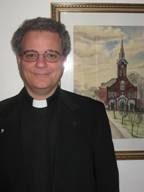 "Priesthood is an exciting and wild journey with Christ, no two days are the same," said Father David Bellittiere. He felt a call to the priesthood in the 4th or 5th grade in response to the great influence of the Franciscan Sisters who often promoted vocations. When he was a senior in high school he asked his parish priest what to do because he felt torn between entering the seminary and going to a different college. The priest asked him what he would do if he didn't become a priest and young David said he would run a business. The priest then advised him to go for his business degree.
As a boy, David's father owned a grocery store. He and his four older siblings often helped out at the store. He grew up in Amherst at St. Benedict Parish and attended the grade school there. His high school days were spent at Bishop Neumann. The Oblates of Mary Immaculate had a great influence also on David, since they were a spiritual and fun loving group of men. He went to Erie Community College and earned a degree in Business. With thoughts of the priesthood still on his mind, he decided he should take a closer look and entered Wadhams Hall Seminary College in Ogdensburg. He remembers wondering, even after that first year, if that was where he was supposed to be. He knew a few men who had entered the seminary but ended up leaving to pursue other callings. When he asked them if they thought their time in the seminary was wasted, they told him it was not. They felt they would be better fathers and husbands because of the time they spent there.
During the summers between his academics at Wadhams Hall Seminary, he helped out at Camp Holy Cross or assisted Father Francis McDonough in Vermont. Because Father McDonough had lost his eyesight in a car accident, he needed someone to assist him as he functioned as pastor of a parish. "He was a great mentor for me and our friendship grew over the years. I hope he is still caring for me from his place in heaven as he did all those summers."
After spending about a half a year at the John Paul II Residence it was then on to major seminary. David left the Buffalo area to study at St. Cyril and Methodius Seminary in Orchard Lake, Michigan. There were a large number of immigrant seminarians, mostly from Poland. He really enjoyed the experience of working with the immigrants and helping them adjust to a new culture. As graduation day approached, he still had reservations about the serious and permanent step he would be taking towards being ordained a Catholic priest. He confided those feelings to a friend who told him the answer to his dilemma could be found in the Bible. David shrugged it off thinking, "Is it going to say on page 467 that David Bellittiere should become a priest?" That night he believes God gave him the answer he was seeking. He focused on the Passion of Christ in the Bible and thought about Jesus and the Agony in the Garden of Gethsemane. He was inspired by the thought that Jesus didn't die for us because the Father wanted him to die for us, He did it because he wanted to die for us. In the Agony, the will of Jesus and the will of God the Father were finally forged into one will. Jesus began his time praying in the garden, feeling strong and empowered to fulfill God's plan because he had made it his own as well. David began to see his call to the priesthood in the same way. He thought, "God doesn't want me to be a priest because he's asked me to be one. If I don't become a priest, He'll be just as happy with me. I should become a priest because I desire it. I have the ability to fuse my will to God's."
After spending a wonderful year as a deacon with Father Louie Dolinic at Our Lady of Czestochowa, his ordination took place on June 10, 1989 in his home parish of St. Benedict in Eggertsville. At that time, Bishop Head presided over all ordinations in the home parishes of the men being ordained. It was a blessing to have the ordination there because some of the parishioners who had supported him throughout his life would not have been able to make the trip to St. Joseph Cathedral. He remembers feeling nervous but said the most touching moment he recalled was when Bishop Head approached his parents directly after the ceremony and thanked them for giving their son to the Church. He mentioned that Bishop Head would thank them even after that day whenever he saw them out somewhere.
Father David's first assignment was to All Saints Parish in Riverside with Father Bob Mack. He then spent two months at St. Bridget Parish in Newfane as administrator to fill in for the pastor who was helping at another parish. After that, he was assigned as parochial vicar to Christ the King Parish in Snyder for almost eight years. He was then named administrator once again, this time at Holy Trinity Parish in Dunkirk. He was named pastor there and about a year and a half ago moved to his present position of pastor at Fourteen Holy Helpers Parish in West Seneca.
Woodworking and wine making are two of Father David's hobbies. He has enjoyed woodworking for many years and hopes to set up his tools in West Seneca soon. Wine making as well as vinegar making are new hobbies he has recently taken up and he looks forward to trying to make cheese in the future. He also likes to cook for people but finds it difficult to scale things down to make a meal for just himself.
For Father David the best part of the priesthood is ministering to the people of God. Those things include counseling, celebrating the sacraments, guiding people in their spiritual lives. Also, Father David is the chaplain for the Friends of St. Peregrine. This group goes through the Diocese celebrating Masses of the Anointing of the Sick in honor of St. Peregrine. One of the most challenging aspects of priesthood for Father David, besides the administrative elements is, as he put it, "Seeing the needs of your people that you can't meet because there's only one of you."
Father David advises that, "You don't go to the seminary to become a priest, you go to the seminary to discern whether or not you want to become a priest." He believes that a man's time in the seminary is all part of his discernment process. In order to discern, Father David would say, "Be a man of prayer which is the most crucial element of priesthood." A strong spiritual life will get you through anything. He also noted that a spiritual director once told him that 80% of what you experience in the parish as a priest will not be taught in the seminary. The way you make up for that 80% is by having a strong relationship with God and with other priests.
"To become a priest is not merely to hear God calling you but rather is a mutual call," reflected Father David. A man must open himself up and ask God what it is He wants his life to be about. He also must be open to listening and acting upon what he feels God is calling him to do. In terms of the leap of faith that Father David took when he wasn't really sure if he and God wanted the same thing, he says, "There are days when I'm not what the world would call 'happy,' but overall, I'm fulfilled. With God's grace I am energized through my ministry. I'm at the right place, where I'm supposed to be and I'm content with it and at peace."
April 2012 Priest of the Month - REV. MICHAEL PARKER
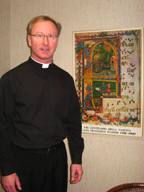 "My vocation story is very boring. It's from the womb to the tomb," quipped Father Michael Parker as he described his "road to the priesthood" story. Inspiring, committed, well-rooted, yes but boring, absolutely not.
After his father passed away when he was six years old, his mother raised him and his 3 older brothers with the help of her parents and close family and friends. She made sure the boys remained close to their Catholic Faith because she knew it was essential to their well-being. She asked young Michael to help a neighbor who had trouble walking. She relied on him to go to the store and do some chores she found difficult. He recalled that the neighbor would see him out playing with his friends in the yard and always seemed to call him when he least wanted to leave the fun. Later, it dawned on him that sometimes it seems that way when God calls. It's not always easy to let go of everything you're involved in to say, "Yes Lord, your servant is listening", but when He calls, you need to respond.
He grew up in Dunkirk, NY at St. Hyacinth Parish and was very involved in CYO, altar serving, and various other activities. He attended the parish elementary school and can't remember a time when he didn't want to be a priest. Immersed in the Catholic culture surrounding him he remarked, "Our center was really with the Church." He credits his Polish heritage with his devotion to Catholicism. Father Michael proudly admits, "To be Polish is to be very much involved in your Catholic Faith." He also remembers the Felician Sisters being very influential in the parish community. He and his friends often found themselves helping the sisters with anything and everything they needed.
When it came time to think about high school, young Michael could have gone to the local Catholic School but he decided that since he was fairly certain about becoming a priest, he wanted to learn more about the secular world and have experiences outside of his church community. He thought it would be a good challenge and got involved in track, swimming, and other various opportunities at school. During his junior year in high school, he and his mother, who was a guidance counselor, started looking into colleges. He got involved in a Home Seminary Program which met once a month and was led by a priest who helped the boys in the group to better understand the priesthood. This aided in solidifying his decision to become a priest and upon graduation from high school, he went on to spend four years at Wadhams Hall Seminary College in Ogdensburg. In the summers between college, Michael worked at his uncle's marina along the shores of Lake Erie in Dunkirk. He fixed docks, managed the care of the boats, and pumped gas. Once again he found himself exposed to people not necessarily connected to the Catholic Church with different perspectives on things. And once again he appreciated the opportunity to learn and grow from his acquaintances with them.
When he graduated from Wadhams Hall, he was invited to study in Rome for the next portion of his education. He declined the offer due to a sense of responsibility towards his mother, grandmother, and aunt who were all widows and needed his help with the upkeep of their homes. By continuing on at Christ the King Seminary in East Aurora, he could still go home on weekends and help with whatever needed to be done. He felt that they had supported him this far in his decision to become a priest and couldn't leave them now.
At the time of his ordination, July 8, 1983, then Bishop Head ordained priests in their home parishes. Bishop Head felt that more people would be able to attend the ordination if it were held in their parish. Father Michael recalled, "It was the hottest day of the summer but such a blessing for the parish. They were very happy to see me ordained there because they had been so involved in my journey to the priesthood." Father Michael was the thirteenth person from his parish to be ordained a priest. He was grateful to the 70 or 80 priests who made the trip to Dunkirk to be a part of the ceremony. He recalled that, "They were a great source of support especially after I was ordained a deacon. They would invite me to celebrate Confirmations and join them at various functions."
Father Michael's first assignment as assistant pastor was to Our Lady of Victory Basilica in Lackawanna. He enjoyed the experience of serving with the pastor, Monsignor Murphy and also getting involved with Monsignor Wurtz who was stationed across the street at the Homes of Charity. He was reassigned after five years to Nativity of Our Lord Parish in Orchard Park where he spent five and a half years. After ten years of priesthood, it was acceptable to go on a sabbatical. Father Michael then decided that he would take that opportunity to further his studies in Rome. He took courses in Spirituality at the Angelicum Dominican School for one semester and then returned to Buffalo. Assigned as administrator of St. Mary's in Mayville, Father Michael enjoyed the close proximity to the Chautauqua Institute. He was able to get involved there with the Catholic community. After that, he then spent two and a half years at St. Amelia's in Tonawanda and was then assigned as pastor of his original home parish in Dunkirk, St. Hyacinth's. It was wonderful for Father Michael to be able to give back as a priest to the community that nurtured and supported his vocation from the time it began. After the first six years as pastor he took on the added responsibility of chaplain of the Newman Center at Fredonia. When St. Hyacinth merged with St. Hedwig to become Blessed Mary Angela in 2008, Father Michael's ten year reign ended as pastor. It is common, when two or more parishes merge, to reassign the pastors of all parishes involved and start the new parish with a new pastor. Since another ten years had passed, he decided to take another sabbatical to Rome. He met with Pope John Paul II many times while he was there and became involved with the Pope John Paul II Foundation. This foundation provides for people from places like the Ukraine who don't have the opportunity to further their educations to come to Rome and study. They stay for one or two years and then go back to their homes to teach others what they have learned. Because of his ongoing involvement with this foundation, he travels to Rome as often as time permits. He feels as if he has a home at his parish as well as a home in Rome which makes for a universal church connection. He commented, "I feel blessed with what the Lord has shown me and what others have shown me as well."
Upon returning from his second sabbatical to Rome, Father Michael was assigned to St. Pius X in Getzville. That only lasted a short while and he was then assigned as pastor to St. John the Baptist in Kenmore where he currently resides.
Father Michael finds great joy in working with people in different capacities in the parishes in which he has served. He feels that being with people is what it's all about as a priest. Sometimes as a pastor, the administrative work can get in the way of ministering to the people. Father Michael also notes that, "There are times when we hope the Lord will make a difference through all of us as we journey in faith together." Unfortunately, he feels it can be discouraging when we try to help people be all that they can be spiritually and they just don't run with the ball.
Having grown up in Dunkirk, Father Michael has always enjoyed water sports such as boating, sailing, and swimming. He continues to cut the grass at home when needed and also enjoys bicycling, gardening, reading, and cooking. He likes to get together with family and friends and appreciates the opportunity to travel to Rome and other places as well.
For those considering a vocation to the priesthood, Father Michael advises, "Always keep your heart open. If the Lord is calling, you'll know that." He feels that a good prayer life is essential. He adds, "Don't worry if the Lord is calling softly or loudly, just pray, 'Fill my heart with your spirit and guide me.'" He also asserts that men interested in the priesthod should trust that the Lord will lead them in the right direction. Men need to take each step as it comes along. You don't know if you're going to be a priest or not but if you don't pursue it, it will always be on your mind. He recalls duriing his own journey that eight years seemed like a long time to spend studying for the priesthood. It helped him to take it one step at a time. There may be bumps in the road but most likely you'll have people who support you and friends who will be by your side as you journey. Paraphrasing a quote from St. Augustine, he remarked, "If you're searching for the Lord, you've already found him because you've opened yourself up to Him in the search." He sums it all up by saying, "There is a lot of joy in the search. You may ask yourself along the way, 'Is it worth it?' In the long run it's worth it, it really is!"
March 2012 Priest of the Month - REV. LOU KLEIN
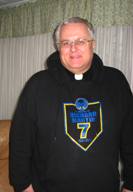 Father Lou Klein asserts that everyone has a vocation. It's up to each person to discover the vocation God has in mind for them. Not all vocations are to the priesthood or religious life. Some are to married or single life as well. In his thirty years of priesthood, he feels certain that God called him to the vocation of priesthood and he is a very happy man because of it. Father Lou admits, "I go to bed happy and I wake up happy." That's not to say he doesn't have sad, hurtful or unhappy experiences during his days, just that when he puts it all in perspective, he is very happy doing what he does.
St. John Kanty Parish was the setting for the early years of young Louis Klein's life. He attended the parish school for grades K–8 and attended high school at Seneca Vocational in the City of Buffalo. While there he studied electronics. When he was eleven years old, his father went off to work one day and never came home. He died of a heart attack at the age of 49 at Ryerson Steel Plant. At the time his sister, Helen, was thirteen and his mother was 41. His mother did a wonderful job continuing on as a single parent. She taught her children through her words and her actions to trust in God and to thank Him always for everything they had. She took them to May and October devotions and kept them active in the life of their parish.
Young Lou attended the ordination to the priesthood of his cousin, Father Andrew Wawrzycki, in Florida in 1970. At that time he thought about the possibility of a vocation to priesthood for himself although he didn't act on it right away. He studied at the University of Buffalo and graduated with a BS in Accounting. He then worked for three years as an accountant and auditor for the City of Buffalo. He remained active in his home parish as a lector, treasurer of the annual lawn fete, C.Y.O. advisor and girls' softball, girls' basketball and co-ed volley ball coach as well as one act play coach. He remarked that the girls used to ask him, "Are you going to be a priest?" and he would respond that he already had a job with the city.
One day, while in confession, his confessor asked him if he had ever thought about becoming a priest. After admitting he had, the priest advised him to think about it and pray about it some more and come and talk to him if he wanted. Lou thought and prayed and did eventually approach that same priest, who is now Bishop Edward Grosz, to tell him he would like to look further at the possibility of priesthood. He recalled, "I thought this might be something for me but I didn't tell anyone, not even my mom. I knew she'd be so happy but a decision like this had to be mine. You can't be influenced by family." Much to his delight, he found out he wouldn't have to start right away but rather could attend meetings to discern the possibility of priesthood once a month for a year. So he did that without telling anyone what he was doing. In May 1975, he decided to begin formal studies for the priesthood and he told his mother he would be starting in the fall. She was indeed very pleased. He spent a year at Wadhams Hall in Ogdensburg catching up on some credits he needed in Philosophy. Then it was on to Christ the King in East Aurora to continue with his studies.
As a seminarian, he spent two summers at Queen of All Saints parish in Lackawanna with Father Jerry Sullivan. He and three other seminarians ran a day care staffed by the summer youth program workers for four to seven year olds. He also spent time in the summers at St. Brendan's in Alfred Almond and one full year as a Transitional Deacon at SS. Peter and Paul in Arcade with Father Kevin O'Neill.
On May 30, 1981 Father Louis Klein was ordained a priest in his home parish of St. John Kanty. At that time Father Peter Karalus was an altar server for the Mass and Msgr. David LiPuma sang in the choir with his fellow seminarians. His first assignment was to St. James in Jamestown for seven years. He spent the next three and a half years at St. Joseph's in Niagara Falls (now called, Holy Family of Jesus, Mary and Joseph). He was the moderator of that school and commented that, "The Home School people did a phenomenal job of getting together to do things that enhanced the value of Catholic Education by getting the extra things they needed." He then went to Annunciation on the West Side of Buffalo and then to Our Lady of Victory in Lackawanna. When he was there about seven months, he asked then Bishop Head for a leave of absence to take care of his mother who had become ill. Within the six month period he was granted, she was diagnosed with cancer and passed away. While he cared for her at home with his sister, he helped Father Duke Zajac with the duties of hospital chaplain at Sisters' Hospital. He always had a tremendous love for the sick and suffering. On September 1, 1995, Bishop Mansell appointed him as full-time chaplain at Sisters' Hospital. Since 1999, he has served predominately at St. Joseph's Hospital. He still helps Father Duke out on his day off at Sister's Hospital as well.
In 2004, Father Lou was made temporary administrator of Queen of Martyr's Parish to help Father Dan Lapinski, who was waiting for a bone marrow transplant. Father Dan passed away, and in 2006 Father Lou was named pastor of the parish. His campus hosts a regional school, Mary Queen of Angels which serves the surrounding area. Msgr. Kevin O'Neill is the canonical administrator of the school and Mrs. Mary Alice Bagwell is the principal.
When he was in Jamestown on assignment, Father Lou decided to take up Karate. He earned a black belt and says, "Those First Communion kids get tougher every year. A man's got to defend himself!" His sense of humor no doubt comes in handy when dealing with the stresses that can accompany priestly ministry. He also enjoys following sports which can unfortunately lead to more stress on occasion in the Buffalo area. He is a die-hard Buffalo Bills fan who has been fortunate enough to attend three of the four Super Bowls in which the Bills played. He hopes to attend another Buffalo Bills Super Bowl someday. He and his sister share in the responsibility of owning a dog. Oscar is a Maltese who loves to go for walks. Father Lou gets his exercise as well while accompanying Oscar. Father Lou admits, "I can't do everything I'd like to do because there are just so many hours in a day, but I'm happy!"
"Ministering to people and letting them know how much God loves them" is one of the many things Father Lou enjoys about the priesthood. He also finds a real sense of fulfillment in "relieving people of any unhealthy guilt and letting them know that God forgives totally all their sins when they are sorry" in the Sacrament of Reconciliation. Ministering in a hospital setting, Father Lou spends a lot of time anointing the sick. He finds this to be a comfort to those who are sick as well as to their families. He also ranks high on his list of priestly privileges, celebrating the Eucharist, baptizing, and presiding over weddings and funerals. Each area of his ministry brings him closer to the people he serves and that brings him joy. One of the things he finds most challenging about priesthood is making the proper choices of how to spend his time. There are so many things to attend to, he finds he has to prioritize in order to fit them all in. Even then, he finds he can't do it all and sometimes has to let some things go in order to avoid too much stress in his life.
Father Lou believes that if someone is interested in the priesthood he should spend time in prayer discerning whether God is calling him to that vocation. He feels that it is good to have someone trustworthy to whom he can share thoughts and ideas. "Some people enter the seminary to please someone else and not for the people they will minister to," notes Father.Lou. "Sometimes they begin studies for the priesthood and decide along the way that it is not for them. Lots of people enter and leave and then go on to be great contributing members of society, just not as priests." Most importantly, Father Lou advises that whatever vocation a man feels called to, he should be genuine and truthful to what he is experiencing.
February 2012 Priest of the Month - REV. JACOB LEDWON
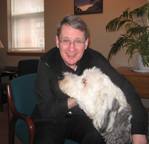 "I'm what they call a 'Lifer'", Father Jacob "Jack" Ledwon responded when asked about how early he considered the priesthood as his vocation in life. Thoughts of the priesthood were common for many boys when he was growing up and St. Mary's Parish in Lancaster was vibrant enough to foster over forty vocations to the priesthood prior to his ordination. As he recalls, lots of boys went into the minor seminary for high school and college. It was not an unusual thing. "They were the coolest guys going," thought Father Jack. "So that was the thing, you wanted to be like them."
Music played and still plays a very important part in Father Jack's life. He was born on the East Side of Buffalo and moved to Lancaster when he was in the fourth grade. His family lived in the village and owned a delicatessen. He attended St. Mary's grade school and was involved as an altar server. When he was in eighth grade, the principal of the school asked him if he had ever thought of becoming a priest. No one in his family was a priest or a sister but even before the question came, he was heading in that direction. He attended the Diocesan Preparatory High School for four years plus two years of college and then went to St. John Vianney (now Christ the King) Seminary in East Aurora for another six years. Of the 125 students in his Freshman Class at the Diocesan Preparatory Seminary, twelve years later twelve of them were ordained.
He was immersed in music at a young age. His father had a dance band and his older sister studied piano and eventually became a music teacher. Young Jack also studied piano and while in the seminary was encouraged to further his musical training. He studied at the Pius X School of Liturgical Music at Mahattanville College near White Plains, NY and earned a degree in Piano Performance. He also earned a Ph.D. in Musicology from SUNY Buffalo where he specialized in the study of medieval chant manuscripts.
Father Jack was ordained in May of 1972. Since then nearly all his ministry has been within the city limits of Buffalo. His first assignment was at St. Lawrence Church where he was an assistant pastor for three years. He then spent another three years at St. Joseph New Cathedral on Delaware. After that he was given a study leave to finish his Ph.D. at SUNY Buffalo and spent a year doing research in Rome as well. After finishing the degree, he was assigned to Holy Cross Church on the West Side of Buffalo for another three years and then he spent six years at the Cathedral in downtown Buffalo. In 1990 he began his campus ministry at the University of Buffalo and within months joined the pastoral team at St. Joseph University Parish where he continues to serve as pastor.
From 1973 to 1983, Father Ledwon directed the Good News Singers, a gospel-rock group that performed in concert and on television and produced two record albums. He founded OPERA SACRA in 1975, the longest continually presenting opera company in Western New York. It has produced over fifty productions in thirty-six seasons. For two years he chaired the Music Panel of the NYS Council of the Arts. He served as Chaplain for the Buffalo Police Department for seven years, taught music and religion courses at the Wyoming Correctional Facility in Attica and was Music Director at Christ the King Seminary. In 2005 he was awarded an Honorary Doctorate from Niagara University for his contributions to the religious and cultural life of Western New York. In 2006 Father Ledwon was one of six Catholic priests in America to receive a "Clergy Renewal Grant" from the Lilly Endowment. This prestigious grant was used for a six month sabbtical that included theological studies in Rome and at Oxford University, and retreats in various European monasteries.
He is deeply committed to his priesthood and feels it is a wonderful vocation which allows for a variety of experiences. He feels blessed to be able to express his musical interest through his priesthood and delights in the opportunity to be involved in the lives of those to whom he ministers. He said, "I think it's a privilege to be invited into people's lives at very profound times and at very deep levels, moments of great joy and moments of great sorrow, at baptisms, weddings, funerals, crises in relationships, etc. People have incredible trust in letting us, as priests, share those experiences. So it's a profound responsibility to be attentive to that." He also enjoys the opportunity to work with young college-age people who are searching and trying to figure out the meaning of their lives.
As a priest, Father Jack feels that the center of his priesthood revolves around the Liturgy of the Mass. "The Liturgy is vital to the Church historically. Good Liturgy fosters and strengthens faith, poor Liturgy can weaken and even destroy faith," exhorts Father Ledwon. He also feels that the preaching aspects of Liturgy is very important. In his experience, he finds that "people are really hungry for something that makes sense to them. It's a blessed burden to preach." Father Ledwon embraces the words of St. Paul who calls ministers in the church to be "strong, loving and wise." He senses that we can all benefit from a balance of those three attributes in everything we do, whether we are priests, parents, teachers or any other caretakes of people's souls and destinies.
In general, Father Ledwon believes it is important to keep a delicate balance between the institutional maintenance of a parish and response to the Holy Spirirt. "Lots of time and energy goes into institutional maintenance and many times we keep programs going because they were always there," reflects Father Ledwon. He feels that often the upkeep of past programs, which may or may not even be effective any more, can keep parishes from responding to the Holy Spirit who may be calling them to broaden and brighten their ministries. He added, "We are not just caretakers of the past but always responding to where the Holy Spirit is calling us."
When he finds time to relax, Father Jack enjoys travel, the arts, theatre, music, opera and the company of his Old English Sheepdog, Ripley. Ripley, along with her recently deceased "brother" Quigley, were rescued thanks to the generous compassionate heart of Father Jack. Before Ripley, Father Jack owned two Golden Retrievers, Duffy and Ryan. Father Ledwon admits he likes to eat but not to cook. He has friends who like to cook, so when they get together the encounter is mutually beneficial.
"The priesthood is one of the most exciting ways you can spend your life," exclaims Father Jack. His experience has been that every day is a new day and as a priest you never know what you're going to be dealing with. While there are responsibilities and routines built into daily life, Father Jack acknowledges, "God always surprises us every day with wonderful gifts that are only limited by our imagination and our time and energy." He points out that the Catholic Church is very diverse and provides those who seek many ways in which to serve. Whether you feel called to do street ministry, scholarly service, lead a contemplative life, educate, preach, etc., Father Ledwon acknowledges, "There is a place for all personalities, all gifts and all talents in the priesthood."
He completely agrees with the definition of "vocation" coined by author Parker Palmer, who says that it is the juncture where your deepest passion and the world's deepest need intersect. No matter what your vocation, Father Ledwon feels that you should pray and discern about where your passions lie and what the needs of the world are and how you can make those two fit together. If you can make that connection, you'll be very happy, challenged and fulfilled in your vocation, just as he is in his.
January 2012 Priest of the Month - REV. MSGR. JAMES WALL
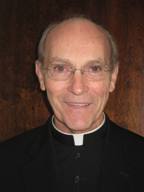 Truly a man for others, Monsignor James E. Wall, who much prefers to be called simply, Father Jim, is the Vicar for Priests as well as Co-Director of Continuing Formation for Priests in the Diocese of Buffalo. He has a caring, concerned way about him that makes him perfect for these positions.
As a child, he was the second oldest of four brothers and one sister who grew up on the West side of Buffalo. He attended grammar school at his parish, Nativity of the Blessed Virgin Mary School. His family moved to the East side of Buffalo and he spent his eighth grade year at St. Agnes. At graduation he thought he wanted to be an electrician. He told his parents he would pursue electrical engineering and they responded by saying, "Whatever will make you happy." The night before he was to commit to Hutch Tech for high school, he couldn't sleep. He tossed and turned wondering if he had made the right decision. Electricians could help people have light and warmth in their homes, he thought, but priests could give light and warmth to people in ways that will matter for eternity. It was the first time in the thirteen years of his life that he had trouble sleeping. In the morning he approached his parents and told them that he would prefer to study for the priesthood instead. They responded with the very same answer, "Whatever will make you happy."
He entered the Minor Seminary which was on Main Street in Buffalo. The seminary moved to Dodge Street where he finished out his high school years and two years of college. From there he went on to Our Lady of the Angels Seminary at Niagara University where he received a BA in Classical Languages and an MA in World History.
Father Jim was ordained at the New Cathedral on Delaware Avenue by Auxiliary Bishop Leo Smith who was the administrator of the diocese at the time. Bishop Burke had recently passed away in Rome and his successor had not yet been named. Father Jim remembers many things about that day such as lying on the cold marble floor while the litany of saints was prayed. There were 19 men ordained that day and the cathedral was filled with friends and relatives. They all wanted a blessing from every new priest. This took a very long time. Father Jim was one of the last to leave the cathedral. Spirits were bright but that day, March 9, 1963, was a cold, damp, rainy day. After the ceremony everyone rushed to their cars to escape, as best they could, the cold and rain. In the excitement his own family left for his reception without him! His dad returned a short time later to retrieve him. "Everyone at the reception had a good laugh over that one," Father said. That stood out in his mind as one of the most memorable moments of his ordination day. He remembered thinking, "This must be a portent of things to come!" He also felt akin to the astronaut who had recently landed on the moon, Neil Armstrong, who said, "I have been preparing for this moment my whole life, what am I going to do with the rest of it?" Fr. Jim had begun preparing for the priesthood when he was 13 years old. Another 13 years had passed and at age 26, he thought, "Now what do I do?"
The answer came quickly enough as he headed to Puerto Rico for the first year of his priesthood. His mission was to help out at two parishes while learning the Spanish language. When he returned to the Buffalo area, he was assigned to the Missionary Apostolate of Brant and North Collins where he ministered to the Puerto Rican farm workers and their families. After that, he became part of the first missionary band of priests from the diocese to serve in Bolivia, South America. He spent two and a half years there and then returned to SS. Columba and Brigid Parish during the time of the race riots in 1967.
His first assignment as pastor was to St. Joseph Parish in Fredonia. He was then assigned to SS. Peter and Paul in Jamestown and after that, appointed Director of the St. Columban Retreat Center in Derby. He spent 15 years in that position and while he was there he was also named Vicar for Priests for the Diocese of Buffalo.
In that capacity, Father Jim looks out for the well-being of priests. He works with the Continuing Formation Committee for Priests to arrange for priest retreats and the presentation of programs geared towards continuing formation for all priests. The Stella Maris Retreat House in Skaneateles, NY is one of the places priests are sent for pastoral preparation. Father Jim is involved with this as are other Continuing Formation Directors from the Upstate Dioceses. He helps with the annual Priest Convocation which is held at Christ the King Seminary in June.
In March of 2012 he will be involved in facilitating a preventative program designed to help priests avoid the negative consequences of too much stress. This will be held at Christ the King Seminary. Father Jim also helps priests by covering for them when they are ill or on vacation. He tries to visit them when they meet in their vicariates so that he can get to know them better. He lives at Christ the King Seminary and provides spiritual direction for a number of priests and seminarians of the diocese.
"I have really enjoyed every place I've been. Each has taught me something," exclaimed Father Jim. He likes his position because he can be supportive of priests. He feels that because of the shortage, priests are taking pastorate positions much sooner than their comfort level might allow. He served as parochial vicar in various parishes for 19 years before becoming a pastor. Now a priest can be expected to be a pastor with only three or five years of priestly experience. It can be a daunting task.
He really enjoys celebrating the Eucharist, hearing confession and anointing the sick. Father Jim feels that "sacramental encounters are valuable in that they really connect you with people." He believes, "A priest learns to be compassionate when he meets the people and understands the struggles they have."
The preparation of good homilies is something Father Jim finds very challenging. The homilist has to be able to reach a variety of people, young and old, rich and poor, from a variety of backgrounds all at the same time. He has the opportunity to impart the Church's view and understanding of many topics and the way he presents his message determines whether it finds a home in their hearts. Father Jim feels that funeral homilies are especially challenging because people come to funerals from different faith backgrounds mostly to support the family of the deceased or out of respect for them, not necessarily with an open mind about the Catholic Faith. Their view of Catholicism can be positively or negatively influenced by what the priest says during the homily and how he celebrates the Eucharist. There is a window of opportunity there for the priest to impart the beauty of Catholic teaching and have it positively influence the listener. Many times Catholics who have lapsed in the practice of their faith will return after an experience at a Funeral Mass because the priest spoke to their heart at a time when they were moved to listen. That's an awesome responsibility!
Skiing, walking and biking are a few of the activities that Father Jim enjoys. He likes to exercise because it relieves stress. Even pursuing these activities though wasn't enough to ward off a massive heart attack. On October 4, 2011 (the Feast of St. Francis) as he was saying Mass at Christ the King Seminary, Father Jim suffered just such an attack. If not for the quick thinking of seminarians and priests around him, the outcome could have been tragic. Help arrived in time and after having a stent inserted in the heart to relieve a blockage, he made a full recovery. Statistics were not in his favor and he and his doctor consider it a real miracle that he came out of it so well. Some two months later, his doctor pronounced him fully healed and has placed no restrictions on his activities. Father Jim is immensely grateful to the many, many people who prayed for him.
Father Jim believes prayer is the place to begin when discerning any important point of life. A vocation candidate should spend a great deal of time in prayer "asking God to indicate in some way that this is the direction in which he should go." If someone feels called to the priesthood, Father Jim feels that it is never wrong to try it. If a man enters the seminary to discover the plan God has for him, his time there will never be wasted. He may not become a priest but better to have taken steps to be sure than to wonder his whole life if that was what God intended for him all along.
December 2011 Priest of the Month - REV. JACEK MAZUR
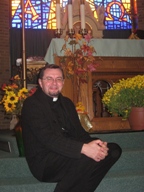 When men consider a vocation to the priesthood, they can't help but think about what it is they will have to give up in answering this call from God. In the case of Father Jacek Mazur, he gave up more than most but if you asked him, he'd tell you that what he has gained in the process has been more than he could have ever imagined.
Jacek Mazur was born in the town of Paczkow in Poland. He is the oldest of three children and his parents, two sisters and most of his extended family members still reside there. When he was about 16 years old, he felt God's Grace touch him and he knew he wanted to become a priest. He remembers being very positively influenced by his teacher, Father Peter. Jacek attended the local public school so it seems very strange that a Catholic priest would be teaching there but because Poland is 95% Catholic, religion is taught in all the schools. As Father Mazur explains, "They see it as something beneficial for society as a whole." He recalls that Father Peter was very much like the late Pope John Paul II in that he enjoyed spending time with young people, hiking, and participating in outdoor activities. Father Mazur added, "He was a marvelous young priest who changed my ideas on the priesthood concerning what a priest can be and what he can do."
He entered the Pallotine Seminary in Poland. At that time, Pope John Paul II was encouraging young priests and seminarians in Poland to go west and evangelize. As a seminarian he thought that was good advice for someone else. In 1998 he made his first trip to the United States when he went to Chicago to study English. He was not in a very good section of Chicago and his experience of America was less than positive. When he returned to Poland, God sent people into his life who wrote letters encouraging him to come back to the U.S. They told him he would be helpful to immigrants and that he was very much needed in America. God revealed to him that the United States was where he needed Jacek to serve. Jacek did not agree with that plan at first but eventually decided to follow God's will rather than his own. He said, "God is always showing me bigger horizons. He has constantly challenged me over the years. I love challenges, they keep me going."
So he changed the course of his priestly studies and entered Orchard Lake Seminary in Michigan, where many seminarians from Poland study while adjusting to the United States. Once there, he had many choices of dioceses to which he could apply. His classmates were shocked to learn he passed up places like Venice, Florida, Houston, Texas and Los Angeles, California to go to Buffalo. He had visited Buffalo twice and found that he loved the people and felt very much at home when he was there. He remarked that, "This diocese has given me so many opportunities; I wouldn't want to live anywhere else." He also mentioned that he has many wonderful places to visit now that his classmates have chosen other locations.
Father Mazur was ordained a deacon by Bishop Mansell in 2003. He spent a year at St. Andrew's in Kenmore and still keeps in touch with many of the friends he made there. After he was ordained to the priesthood in 2004, he returned to Poland to say his first Mass. His wonderful teacher, mentor and friend, Father Peter preached at that Mass. When he returned to Buffalo he was assigned to St. Paul's in Kenmore for a year and a half. He was then reassigned to St. Teresa of the Infant Jesus in Niagara Falls as administrator for another year and a half.
In 2008 five parishes in Niagara Falls were merged together to form the new parish entity of Divine Mercy. Father Mazur was appointed as Pastor of Divine Mercy Parish and considers it a very successful merger. They were able to use many of the statues and other meaningful things from the five parishes that closed so that everyone had something of their own to add to the new parish. Divine Mercy has a vibrant choir, bereavement group, religious education, and a growing St. Vincent de Paul group. They have a food pantry to help local families as well as social events and prayer time together. In May of 2011, Father Mazur was given the additional assignment of Pastor of St. Mary of the Cataract Parish in Niagara Falls. He is currently the Pastor of both St. Mary and Divine Mercy Parishes.
Father Jacek enjoys hiking, music, and animals. He has a dog and a few doves as pets. He also likes meeting new people and traveling. He has been back to Poland a few times to visit his family. He celebrated his sister's wedding and a year later baptized her daughter. He would like to visit more friends around the United States and see more of his family in Poland but his new position keeps him very busy.
He very much enjoys his priesthood. Celebrating the sacraments and being there with people who are in need of the assistance of a priest are most special to him. He wishes he had more time for counseling people who need help. Father Mazur was involved with WLOF Radio twice a week as a talk show co-host. When he was first approached to do this he said it was the last thing he had considered doing. He felt unprepared and nervous because he is not a native speaker but the more he did it, the more comfortable he became. This is another activity he finds he can't do any more because of the business of parish life. He has been asked to speak at a Divine Mercy Conference in San Diego, California and is very excited about participating in that. When time permits, he would like to become involved in prison ministry so he can further promote the teachings on the Divine Mercy of Jesus Christ.
As mentioned before, Father Mazur enjoys challenges. He feels that the priesthood is very mentally and physically challenging. There are many things a priest has to deal with that can be uncomfortable but each new challenge brings an opportunity for growth. One of the biggest challenges he finds is bringing lapsed Catholics back home to the Church. He finds that there are many reasons why people leave the Church and he feels it is very important to do everything he can to welcome them back home.
"Don't be afraid to say ‘yes' to Christ" is the advice Father Mazur would give to a man considering the priesthood. He adds, "If you hear his voice, pay attention! Don't try to put it aside." He feels that God has a plan for everyone's life. By answering "yes" to His call, you will find the happiness you seek. If you ignore it, you may end up being unhappy because you are not doing what God intended you to do. He recommends that men pray for an increase in virtues and pray for the courage to say "yes" on a daily basis to God's will. He admits it is not easy to say "yes." Sometimes God demands so much. As in his own life, God asked him to leave everything behind to follow Him… literally!
If one thing is for sure, Father Jacek Mazur is very happy being a priest. He feels it is an adventure and he exclaimed, "I thank God every day for giving me this opportunity to serve Him and His people, to be a part of His Church and work in His vineyard. It's been nothing but a great experience and I would never want to do anything else. I love where I am, the people I serve and what I do."
November 2011 Priest of the Month - REV. PAUL BOSSI
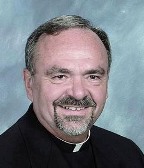 One step at a time, one day at a time – that is how Father Paul Bossi takes life. He is currently the pastor of Blessed Sacrament Church on Delaware Avenue in Buffalo. Looking back on his 42 years of priesthood, it is easy to see how each step of his life has been guided and inspired by God.
He grew up in St. Lawrence Parish on East Delavan in the Pine Hill section of Buffalo. His mother's family owned a commercial construction company. It was started by her father who moved from Canada to the USA in 1917 and started the company in 1925. His mother worked as a bookkeeper and his father worked as a bricklayer. His father came to Buffalo in 1936 from Detroit, Michigan and in 1939 he married the boss's daughter and young Paul arrived, after his older brother, in 1944. His parents were very devout Catholics. His father was an usher and active in the Holy Name Society. He always wore a coat and tie to church, and their faith was a big part of their family life.
After graduating from 8th grade at St. Lawrence, Paul attended Canisius High School. In his senior year, he and six others from his class felt called to the priesthood and decided to apply to the Jesuit Order's junior seminary. Paul was advised to spend some time in college first before entering the Jesuits. So he attended Canisius College and continued to discern his vocation to the priesthood there. He then thought about the priests who had influenced his life, Monsignor Leo Pulling, Father Harry Melly, Father Daniel Myszka and others who were a wonderful example to him when he attended St. Lawrence elementary school. Father Kerrigan at Canisius College told him to ask himself, "What is the essence of priesthood?" He thought about it and what was drawing him to this vocation. The charisma of the Jesuits leaned more towards teaching, missionary work, and education while the charisma of the diocesan priest was more centered on ministering to the daily needs of God's people and to the liturgical life of the Church.
On a cold February evening in the middle of philosophy class during his second year at Canisius College, Paul was hit by the thought, "I need to make a decision now about what I want to do for the rest of my life." He came to the conclusion that God was calling him to become a diocesan priest. The time seemed to fly between that February evening and the beginning of the next school year. He left Canisius College and entered St. John Vianney Major Seminary in East Aurora. He recalls praying to Jesus on the first night in the seminary, "Lord, you got me here, I don't know how I got here so quickly and I don't know if I should be here but, Lord, I'll take it one day at a time with you."
Father Paul was ordained in 1969 along with 23 other men for the Diocese of Buffalo. His first assignment, as was common in that day, was for one year in what was called the Missionary Apostolate. Back in the 1940's Bishop John O'Hara saw a need for greater evangelization in the southern tier in the areas of Chautauqua, Cattaraugus, and Allegany counties. Many small churches were started in those areas and for many years, until 1970, the newly ordained priests staffed them. Father Paul was sent to St. Jude Church in Sardinia, New York. Once a week all the new priests met at the parish of Blessed Sacrament in Delevan, New York to share their experiences and receive whatever guidance was necessary from the director. Father Paul had never lived in a rural area before and was a bit nervous and uneasy about the move. But, fortunately, he found the people very warm and welcoming. It was a wonderful year.
His next assignment was to St. Rose of Lima Parish in North Buffalo as an associate pastor. There were three priests in residence which was the norm because of the large amount of priests in the diocese at that time. He spent six and a half years under two pastors who helped and guided him in his ministry. In 1976 a classmate who was teaching in a diocesan high school, which was one of 27 diocesan high schools, asked him to consider teaching at Baker Victory High School in Lackawanna. Thoughts of his original intent to enter the Jesuits were still in the back of his mind and he thought, "I wonder if I could teach?" He agreed to give it a try and very much enjoyed the experience. Besides teaching, he was also the Guidance Counselor. He lived with six other priests during that time and found their companionship to be a wonderful source of support and affirmation. He helped out on the weekends at Our Lady of Victory Basilica and after two years at the school, the pastor, Monsignor Robert Murphy, asked him to become the parochial vicar to that parish.During the six years he spent at OLV, he was able to make some meaningful contributions. He was put in charge of overseeing the replacement of the church pipe organ. Having played organ in churches during high school years, he was familiar with many of the aspects involved. While at the Basilica, Father Paul also saw the need to minister to the many pilgrims who came to visit the awesome Church and grounds inspired by then Venerable Father Nelson Baker. He started by introducing a visitor's book so people could sign in and to record their visit. This became helpful in requesting donations later to provide for the upkeep of the Our Lady of Victory Homes of Charity facilities. Father Paul also created, with the assistance of the institution director, Monsignor Robert Wurtz, a three-fold brochure about the parish and its history which he placed in all the area hotels. This promotion increased the attendance of visitors. The gift shop was re-opened and enlarged, tours were given by a group of volunteers and now many people come to this destination to witness the great inspiration of Father Baker's dream.
Once again it was time for Father Paul to move on to another location. In 1984 he was asked by Bishop Edward Head to become pastor of Holy Cross Parish on the lower west side of Buffalo. Father Paul had been ordained for 15 years by that time but, because of the large number of priests in the diocese, it was unusually early to become a pastor. It seems strange today as many men are named pastors after only a few years of priestly ministry because of the shortage. Holy Cross Parish was a good fit for Father Paul because of his Italian heritage. It was originally founded as an Italian parish but then included many Puerto Rican families. Although he did not speak Spanish, Father Paul learned enough to be able to say Mass in that language. He very much enjoyed ministering to the people of the parish. The Italian families had spaghetti dinners and St. Joseph's tables and with Father Paul's blessing, the Puerto Rican families enjoyed dances and other religious and cultural activities like the "Children of Mary" group and the annual Posada. They got along together and often experienced each other's cultural celebrations. Father Paul remarked about the unity of the parish. "It was just a matter of loving people and being with them as they celebrated the things they found important." While he was there he began another Legion of Mary group which he also started at St. Rose of Lima and Our Lady of Victory. They were all very open to this great devotion to Our Lady.
While at Holy Cross, Father Paul helped start a new regional school that would serve the students of all the parishes in that region, now referred to as a cluster of the new vicariate. There were quite a few parish elementary schools that had closed and he worried about what would happen to the families of these parishes who wanted a Catholic school for their children. After meeting with all the parish leaders in the region, they came to the conclusion that it would be best to have one new school supported by all. Catholic Academy of West Buffalo was very successful from the start, at first with an enrollment of 600 students. Two sites were needed to accommodate everyone. Today, after 23 years, the school is still strong with about 225 students but only one campus at the location of the former Cathedral School next to Blessed Sacrament Parish on Delaware Avenue.
Social justice issues are of great important to Father Paul. He became involved in remedying situations involving the marginalization of members of his community while at Holy Cross. Block Clubs were started to deal with rising crime rates in the area and to give the residents a chance to take ownership of their problems. Due to certain needs in the 1990's, Father Paul became involved with a group called VOICE-Buffalo in an effort to bring attention to the needs of the people living in poverty and crime areas. He points out that the Catholic Church is the largest charitable organization on the planet and feels that we need to take the Gospel values to the streets. The Church has a strong social justice theology that goes back to Pope Leo XIII and right up to the present with many documents given by our United States Conference of Bishops and our late Holy Father Pope John Paul II. He stated that, "Our Church should strive to be involved in issues outside the doors of the church which impact and affect the poor and marginalized." Influenced no doubt by the time he spent at Our Lady of Victory, Father Paul noted that Father Baker saw the needs of his day and sought to help people. He saw abandoned children and youth and so took them in at an Orphanage and Protectory. He saw the need of unwed mothers and so started the Infant Home and later started a maternity hospital, and more. Toward the end of his life in his 90's, Father Baker said that if the Lord had given him more years he would have built a home for the elderly and started a junior college so as to meet the educational needs of everyone from early childhood on.
In 1995, when Monsignor Paul Juenker was retired as pastor of Blessed Sacrament Church, the site of the Catholic Academy of West Buffalo, Bishop Edward Head asked Father Paul to take over that parish as pastor. The bishop knew that Father Paul was instrumental in the creation of that regional school and wanted someone there as pastor who had a vested interest in preserving it. When it was started in 1988, it was the only regional school in the nation. Bishop Head was very proud of its existence and saw the value of it succeeding. Father Paul now acts as Canonical Administrator for the school. Students in the school come from 27 different zip codes and 25 different parishes. The students are the largest recipients of the Bison Fund Scholarship program in the Western New York area.
As far as his priesthood is concerned, Father Paul states that, "I am very happy in my ministry!" He feels that there is such a variety of experiences every day. "There is always something new in parish work," he added. In his days at St. Rose of Lima, he was also involved with a group of priests who formed a vocation team and spoke at local high schools to promote vocations to the priesthood. He very much enjoyed talking to young men about being open to the possibility of God's call to them as priests. He gave talks with priests from different religious orders such as Franciscans, Maryknollers, Divine Word Fathers, Oblates, Barnabites, Jesuits, and others. Monsignor Richard Nugent was the Diocesan Vocation Director at the time and asked Father Paul to join. They would each talk about life in their situations as priests so as to give the young men a more complete vision of what priesthood is about. Father Paul would often tell the students, "You may not feel as if God is calling you to the priesthood. If it's not you, the guy next to you might have a vocation. Pray for him." He would pray with the group, "Lord, you're calling some here to the priesthood. We pray that they could be open to your invitation."
The loss of population in Western New York, as well as the shortage of priests, has created some problems for the priesthood. The financial aspects of being a pastor is challenging with less people contributing to the needs of the parish. Many priests now live alone in a parish, and that is a challenge. Father Paul finds that this can hinder a sense of support and companionship that he enjoyed as a younger priest. Father Paul encourages priests to become involved in groups that are formed to bring them together in a spiritual environment such as Emmaus and Jesus Caritas groups. He finds that Jesus Caritas group which he belongs to is a wonderful blessing for his ministry and his priesthood. He recalls that he was also involved in an ecumenical spirituality and prayer group which included laity, nuns, and protestant ministers. Their meetings consisted of prayer and discussion. This provided him with a bond to other religious groups within his community. Contributing much to the needs of the Church, Father Paul was involved in the Church Musicians' Guild as moderator for over 18 years. He was elected to the Priests' Council and the Priests' Personnel Board. Bishop Henry Mansell and Bishop Edward Kmiec appointed him to multiple terms as the Episcopal Vicar of Northwest Buffalo.
"The Lord is ever active calling men to ‘Come follow me,'" exclaims Father Paul. He advises men to pray about it, think about it, and ask the Lord how they can be generous back to Him with the blessings they've been given. He believes men should consider themselves disciples of the Lord wherever they are. Some are being called to be full time disciples for the Lord, but every Catholic is called to live out their faith in one way or another – as consecrated religious or as husbands, wives, or single people. If you find yourself called to the priesthood, Father Paul suggests, "Take it one day at a time. God will give you the grace you need to get through every day."
October 2011 Priest of the Month - REV. SEBASTIAN PIERRO
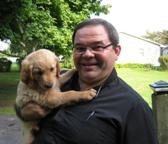 Thoughts of the priesthood began to surface for Father Sibby when he was in the fifth grade at Holy Cross Grammar School. The Felician Sister who taught the class at Holy Cross Parish School on the West Side of Buffalo gave her students an assignment to write an essay about what they would like to be when they grew up. Young Sebastian, known as Sibby, wrote about the possibility of becoming a priest. He went on to graduate from Bishop Fallon High School and continued his studies at Canisius College. He very much enjoyed his freshman year at Canisius but somehow felt something was missing. Studying Law and Accounting kept him busy but he also found time to be involved in parish life at Holy Cross Church. As a youngster, he was very positively influenced by the exemplary priests he encountered at his home parish such as Msgr. Joseph Gambino and Msgr. Dino Lorenzetti as well as the Caligiuri brothers – Anthony and Angelo – and the Amico brothers – Richard and Charles – two sets of brothers who became priests. The wonderful influence of those priests helped Sibby to be open to the call from God that led him to speak to Msgr. Lorenzetti about the possibility of looking into the priesthood. Sibby went to visit Wadham's Hall Seminary College in Ogdensburg, NY with the then vocation director, Father Theodore Kraus. He began his sophomore year there and upon graduation went on to Christ the King Seminary in East Aurora where he received his Master of Divinity Degree.
Nearly thirty years have passed since his ordination to the priesthood on January 30, 1982. Father Sibby fondly remembers his early assignments to Nativity of Our Lord Parish in Orchard Park where he spent five years as a parochial vicar as well as the seven years he spent in the same capacity at SS. Peter and Paul Parish in Hamburg. After spending a year and a half as a parochial vicar at Christ the King Parish in Snyder, he was assigned as Pastor of Holy Trinity Parish in Dunkirk where he spent five years and then to St. Peter Parish in Lewiston where he was the pastor for twelve years.
One of the challenges he finds about the priesthood concerns the current shortage of priests. When he was ministering in parishes back in the 80's and 90's, there were usually two or three priests in residence at a parish. It was helpful to have the support and fellowship of other priests in day to day ministry. It was during this time that Father Sibby served in his various assignments with Monsignor Thomas Beasley, Monsignor Donald Armbrewster, Monsignor Jim Licenthal, and Fathers Jerry Sheehan, James O'Connor, Paul Litwin, Robert Hora, and Michael Oliver who helped support and shape him in his ministry and priesthood. For the past seventeen years, Father Sibby ministered as the only priest in the parish communities of Holy Trinity and St. Peter as pastor. During this time he was dependent upon the parishioners to assist him in building up the Body of Christ in these parishes for it is impossible for one priest to do it alone. Father Sibby underwent various knee surgeries in 2008 to 2010 and has just completed a three month sabbatical which dealt with wellness in the areas of health, nutrition, physical fitness, grief and loss and spirituality. He feels it is important to find a balance between time for God, time for ministry and time for one's self. When one of those areas is ignored, the other two will suffer. When there is a good, healthy balance, things work much better.
In September of 2011, Father Sibby was asked by Bishop Kmiec to assist Father Mark Wolski at SS. Peter and Paul Parish in Hamburg, a place he knew well. He exclaimed, "It was an easy decision for me to say yes to Bishop Kmiec since I spent seven wonderful years there." Father Mark was ministering alone in that large parish since the departure of Father Jim Kirkpatrick who moved on in August to further studies at Catholic University. Father Mark welcomed the help Father Sibby could provide as a seasoned priest of the diocese.
Father Sibby and his younger brother, Joe, were blessed to have parents (Nick and Connie) who enjoyed 58 years of marriage. Their father passed away in February of 2010 and their mother still lives independently in the family home in Tonawanda. Father Sibby enjoys spending time with his mother and she enjoys his company along with having someone to cook for from time to time. He enjoys cooking himself as well as rooting on the Buffalo Bills and Sabres and the New York Yankees. Listening to music and reading books provide much needed relaxation for Father Sibby. For the past sixteen years, he has enjoyed the company of two golden retrievers. Harley was around for thirteen years and now Sonny is three years old. He feels that, "golden retrievers are wonderful dogs because they love you unconditionally."
When Father Sibby was younger, he and his father spent a lot of time working on cars together. This proved to be a special bonding time for both of them. Father Sibby has owned with his dad a few classic cars such as a ‘57 Chevy, '69 Chevy Malibu Convertible, '73 Corvette and a ‘64 Corvette. He is now the proud owner of his "dream car" a 1955 Chevy which has been completely restored. It is a modified hot rod and he enjoys driving it and taking it to car shows and car cruises. He has even won a few awards for it.
Father Sibby enjoys his priesthood very much. He feels there is nothing he would rather do. He finds it extremely rewarding, "being able to minister to people by celebrating the sacraments, especially the Eucharist." He feels, "The gift of Jesus Christ, his body broken, his blood poured out for us, and sharing in the ministry of Christ to do what happened at the Last Supper is the greatest blessing I can receive as a priest." He also finds it important "to meet the needs of God's people to the best of his ability, to reach out to the sick, the poor, to work with children and to assist people in their struggles." Father Sibby finds celebrating the Sacrament of Reconciliation to be a most humbling experience as we are all in need of God's mercy, forgiveness and love in our lives. It is through his ministry that he prays that he is able to bring God's blessings and love to others.
Men who are discerning the priesthood, in Father Sibby's opinion, need to reflect on why they are being called to this ministry of priesthood. They need to make sure the reason they want to be a priest is to follow the way of the Lord; to imitate him and be his disciple in the world today. "Hopefully a man considering priesthood has a positive relationship with the Lord in prayer; is not just full of book knowledge but wants to become a true minister of the Gospel; due to his experience of the Sacraments, his spirituality and his commitment to serve the People of God and remember that Christ came to serve and not be served," explains Father Sibby.
Father Sibby describes his thirty years of priesthood as "positive, fruitful, life giving years for me and hopefully for those to whom I have ministered." He continued, "My priesthood has been a blessing filled with joys and sorrows, with successes and failures, filled with many friends, a gift and true calling from God who has blesed me in abundance." He looks forward to many more years of ministry and asks for your prayers for him as he prays for all the People of God in our Diocese.
September 2011 Priest of the Month - REV. RICHARD "DUKE" ZAJAC
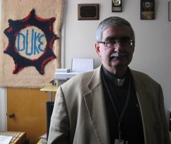 Coaching baseball and residing in a hospital have a much less tragic connection than might be thought of when talking about the life of Father Duke Zajac. One did not lead to the other but both have provided much joy and fulfillment for Father Duke.
As a young boy, Richard Edward Zajac and his brother, Robert, spent a lot of time working at their father's grocery store. The Black Rock Food Center was one of many businesses in the area that provided for the needs of the community. Close by were a drug store, appliance store, sports equipment, pet, and shoe stores. As Father Duke puts it, "The stores back then were like community centers. Anything you needed to maintain your life was within walking distance from your home." Everyone knew each other and felt comfortable sharing their joys and sorrows, accomplishments and problems. The gamut of life walked in and out of the family store every day and as young Duke listened to all of it, he thought that someday he'd like to be able to help people with their problems. That, combined with the inspirational leadership of Father Walter Matuszak at Assumption Parish led young Duke to consider the priesthood as his life's vocation. He attended Assumption Grade School and helped out as an altar server as well. Then it was on to the Diocesan Preparatory Seminary High School where he was one of 120 boys who began that freshman year. In 1967 he graduated from high school with a class of 70. In 1971 he earned a B.A. in Philosophy from St. John Vianney Seminary in East Aurora, now called Christ the King.
It was during his time in undergraduate school while working at his father's store on summer break that his life would turn to baseball very unexpectedly. Duke was asked by the local optometrist and Assumption School Board President, Dr. Stephen Gladysz, if he would coach baseball for the boys at Assumption. Duke had played some baseball but didn't consider himself a great player. He probably never would have taken up coaching had he never been asked but as he puts it now, "That asking opened a door to my life that has been unbelievably rich and rewarding." He agreed to coach that summer and it changed his life. For the next fourteen summers and the fall as well, he coached various teams including the parish school team at St. Ambrose, his first assignment. He got to know the boys well and performed many of their weddings when they got older. Among them was Mike Buczkowski, the General Manager of the Buffalo Bisons, as well as Mike's daughter whose wedding he performed years later.
After receiving a Master of Divinity Degree from St. John Vianney Seminary in 1975, Father Duke spent a year and a half as a deacon at Our Lady of the Blessed Sacrament Church in Depew and was ordained to the priesthood in May of 1976. His first assignment was as Associate Pastor of St. Ambrose Church in South Buffalo. Father Duke and the newly appointed pastor of the parish, Father Bill Stanton, arrived at their assignments the same day. The parish was in great need of renewal and together, Father Bill and Father Duke began the process. Father Duke was told earlier that, "Your first assignment makes or breaks you." Looking back, he feels that the seven years he spent at St. Ambrose made for an extremely positive experience. When talk of reassignment came in 1982, Father Duke was greatly saddened. Facing the reality that he had to move on was very difficult. While coaching a baseball game at St. Ambrose he received word that the next chapter of his life was about to begin. An opportunity had become available earlier that summer to do Clinical Pastoral Education at Mercy Hospital, a prerequisite for certification for chaplaincy. Father Duke had taken advantage of it not realizing that an assignment to a hospital would be in his immediate future. That assignment to Sisters Hospital would lead him to help people who were in great need of comfort and that took a little of the sting out of leaving St. Ambrose. After all, that was what attracted him to the priesthood in the first place.
From 1982 to the present, Father Duke has been a Chaplain at Sisters of Charity Hospital in Buffalo. Twenty-nine years of service to those in need has brought him great satisfaction. He is a member of several boards including American Veterans Post #45 Parochial Baseball League, of which he is the current president, The Amherst Meals on Wheels, Baker Victory Services and Timon/St. Jude High School. He is the present Chairperson of the Medical Ethics Committee at Sisters Hospital and also a member of the Priests' Council of the Diocese of Buffalo, the Ecumenical Commission of the Diocese of Buffalo, the Perinatal Bereavement Network of WNY, the Ethics Committee of the Catholic Health Care System, the Small Grants Committee of Sisters Hospital Office of Development, the Alumni Association of Buffalo Seminaries and the Catholic Health System Long Term/Home Health Care Ethics Committees. He is also a former member of several organizations.
For Father Duke, the best part and the most difficult part of priesthood are both contained in two things. The first has to do with relationships. He loves dealing with people and has made many lasting friendships throughout his priesthood. Nevertheless, it is often difficult to be with families going through tragedy such as the loss of a child in an accident or due to illness. It is also hard to deal with the many issues that surround broken families. It can be both gut-wrenching and fulfilling at the same time to minister to those in need. The second is preaching. Father Duke spends at least 24 hours preparing a Sunday homily. Besides saying Mass at the hospital, he helps out at St. Joseph Hospital and St. Ambrose Parish on the weekends. He loves to preach and he uses imagery to assist in making his point. When he was in grade school, a priest gave a homily at a May Day event. The priest used the imagery of a beatnik to lead into a description of various species of birds and how they relate to us. Father Duke recalled being fascinated with what he had to say. It made such an impression on him that he decided he would try to make his sermons as interesting as possible when he became a priest. Father Duke enjoys attending lectures and retreats at the Chautauqua Institute at least once a year. As much as he loves preaching, it is a lot of work and extremely time consuming to produce the type of homily he desires. Throughout his years at the hospital, Father Duke has mined the fields of great preachers from the past whose books he has read and continues to read in the middle of the night after answering a call to minister to someone in need. Not able to immediately fall back asleep, the reading of those sermons serves as "wind down" from the call before he can fall asleep again.
Once inside Father Duke's office and living space at Sisters Hospital, those things that are most important to him become very apparent. His walls are filled with pictures of family and baseball coaching memories, including a large photograph of a scene from a Diocesan championship game. Among the many awards he has received was being named Man of the Year of Parochial Baseball in 1974, 1990, and 2010. He also wears a ring he was given when he was inducted into the Western New York Baseball Hall of Fame for his 40 years of administration of the Parochial Baseball League. The wall space that is left is filled with books he uses as references for his well thought out homilies. He has even authored a few books of his own filled with the best of his homilies called, Life Injections/Connecting Scripture to the Human Experience, volumes I, II and III. He has also written a book with Robert Duggan called Living the Word/Not Only on Sunday.
Father Duke recommends to anyone considering priesthood that they make it a way of life, not just a job. It can't be something you do just on Sunday and then put aside for the rest of the week. He expressed, "It will bring you tremendous joy as well as pain. You'll be tired but it will be because you've put effort into things that really matter."
August 2011 Priest of the Month - REV. DANIEL YOUNG
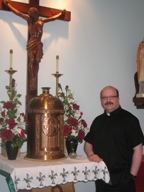 At six years old, many boys think they know what they want to do. Often it is something exciting like a fireman, policeman, astronaut, etc., which turns out not to be what they actually become when they reach adulthood. Father Dan Young felt called to the priesthood at the age of six and, after putting it on the back burner for a while, he later made it his choice for life.
He was born and raised in Wilson, NY and attended the Wilson Public School system from elementary through high school. His father was a math teacher and his mother a homemaker. His father was not Catholic but did not object to his mother raising him and his two sisters in the faith. His parents were childless for the first eight years of their marriage. Father Dan's maternal grandmother, a convert to Catholicism since her marriage to his grandfather, was inspired to help her daughter and son-in-law become parents. She and her daughter began praying the rosary with the intention of bringing children into their family. They had a great devotion to our Blessed Mother and a "never say never" attitude. Their prayers were answered with the birth of Father Dan's older sister Debbie. After that, Father Dan was born followed by another sister Diane. When baby Dan's parents brought him home from the hospital, his grandmother consecrated him to the Sacred Heart of Jesus with a prayer: "God, if you want this child to be a priest, I pray for this." Father Dan knew nothing of this as he grew up, but clearly another prayer was answered.
In the small town of Wilson, NY, Dan and his sisters, at the prompting of their mother, became very active in the community as well as in their parish of Our Lady of the Rosary (now merged and called St. Brendan on the Lake). He was greatly influenced by Father Frank Skupien (now Monsignor). His influence and example fanned the flames of a fire already burning inside his young heart. When Dan was only thirteen years old, his mother died from cancer. His father carried on his mother's wishes and dutifully dropped the children off for Mass every Saturday evening.
Dan went on to graduate from Daemen College with a degree in Humanities. He had a lot of course work in Elementary Education and wanted to be a teacher like his father. During college the desire to become a priest grew even stronger. He attended retreats and was very active in campus ministry. Upon graduation a job became available at Daemen College as a financial aid technician. Dan was working at that job for about a year when his father passed away. Much to his amazement, his father converted to Catholicism before he died. Never say never!
After another six months passed, Dan decided to look into priesthood as the call continued to increase not only from God but also from many around him who saw the spark of vocation growing. He entered the John Paul II residence on the campus of St. Rose of Lima Parish. This was a place, no longer in existence, for men discerning the priesthood to live while they finished up coursework needed to enter Christ the King Seminary in East Aurora. He was ordained in 1995 by Bishop Edward Head at St. Benedicts, the parish he belonged to at the time. There were five men ordained that year, each in their own home parishes as was the custom at the time. Father Dan remembers feeling, "I'm not worthy." With both his parents gone by then, he remembers thinking they most likely approved his decision. He also wondered what the future would hold. He had a great devotion to Divine Mercy and still does. When he was walking up the aisle he thought, "Lord, I'm putting my whole future in your hands and I trust you."
His first assignment was to Infant of Prague parish in Cheektowaga. He spent ten weeks there as a seminarian and a year there as a deacon. At that time it was also customary to spend the first year of priesthood at the same place. After that, he spent a little more than seven years at Nativity of the Blessed Virgin Mary in Harris Hill. Father Dan was then assigned pastor of two linked parishes, St. James Major in Westfield and St. Thomas More in Ripley. At that time, he was the youngest priest to be named a pastor. It was then on to St. Anthony and St. Joseph parishes which he eventually had to close and merge with St. Patrick's in Lockport. The new name became All Saints. In Medina the same situation occurred where Father Dan had to merge three parishes, this time to form Holy Trinity. In September of 2008 he was named pastor of Good Shepherd and St. Augustine parishes which soon became merged. The name Good Shepherd was retained: One God…One Parish…One Heart…Two Worship sites. He has been at this assignment for three years and finds that even though the two worship sites are in two different counties (Niagara and Erie), things seem to be working out well since the merger.
Father Dan expressed a great love for celebrating the Eucharist. He remarked that, "The Eucharist is the source and summit of who we are as a person and as a community of faith as a church." He also feels that hearing confessions is one of the most important things he does as a priest. Bringing people back to Christ in Reconciliation is such a blessing both for him and for them. "Sometimes," remarks Fr. Dan, "I hear people say, "Bless me Father for I have sinned. It's been 30, 40, 50 years since my last confession. It is such a tender Sacrament. People are so vulnerable and they want to be reconciled with God and the church." This brings him great joy because he knows that it brings great joy to God.
One of the greatest challenges during his priesthood has been his involvement with church closings and mergers. He noted, "People know they are the church, the body of Christ, but the buildings still mean something and there's an emotional attachment." He tries to move people to see the greater picture while still being the understanding shepherd they need. Sometimes this can be difficult. "We are still Roman Catholic, even if the church building closes or changes. It is difficult because we are human and change is hard." Not everyone always agrees if you have made a good decision or not! When he was an assistant pastor, one of the greatest challenges he faced was conflict management. Trying to help the parishioners to see the wisdom and value of a pastor's decision when it might not make sense to them at the time, is one example of this and Father Dan feels priests must pray for guidance from the Holy Spirit.
When Father Dan finds some free time he enjoys gardening and reading. He is a great lover of antiques as well. He likes to relax on his day off and enjoys going out to dinner or seeing a movie with friends. He appreciates being able to walk or bike ride near the waterfront.
St. Luke's Mission on the East side of Buffalo relies on the generosity of priests to help them out. Father Dan is the Associate Spiritual Director for the lay people who make a special commitment to the mission of St. Luke's, referred to as Associates of St. Luke's. Father Dan came a year after the mission began and has been helping out ever since. He is not assigned by the bishop but is given permission to minister to them by saying Mass, hearing confessions and spiritually guiding them when needed. Several other priests, such as Father Jack Mattimore, SJ, help at St. Luke's as well. Father Dan sums up his feelings by saying, "I enjoy it because it grounds me in what Christ wants us to be doing as far as serving the poor."
Another way Father Dan donates his time is as Spiritual Director for the people who are involved with the Catholic radio station, WLOF. He helps when they have their fund drives by saying Mass in the chapel at the station as well as speaking words of promotion on the radio. He prays and gives advice to Jim and Joanne Wright, co-founders of the station. He would like to be even more involved with them but finds that there just aren't enough hours in the day.
For any man discerning the priesthood, Father Dan advises him to have a very good prayer life. "He's got to be before the Blessed Sacrament who is giving him the vocation." An hour a day would be optimal in Father Dan's estimation. He would give the same advice to a woman contemplating religious life. He adds, "In this lifestyle, we're sustained by prayer." He also feels that a potential priest should seek out the company of a priest whom he trusts to talk about what the priesthood is like. A retreat is another way of taking time to really discern what God is calling you to do. It is a time of reflection. Men should also listen to those around them as another way of discerning the Holy Spirit. If people are saying, "You should be a priest" or "Have you ever thought of being a priest?" there is probably something there and God may be leading them in that direction.
Having felt called to the priesthood as early as six years old, Father Dan knows this is what God had in mind for him since even before his grandmother offered him as an infant. He is "thrilled", as he puts it, to be a priest – even on the most difficult of days. He can't imagine finding fulfillment in any other vocation and his peaceful contentment is inspiring.
June 2011 Priest of the Month - REV. DAVID RICHARDS
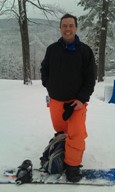 For Father Dave Richards the call to become a priest came first as a whisper, then, as sometimes happens when whispers are ignored, it came more like a decree. As he was living the life he thought would make him happy, God intervened to let Father Dave know that He had different plans in mind.
Father Dave is the oldest of four children in his family. His father was a police officer who lost his battle with Leukemia at the age of 28. At that time Dave was 8 years old, his sisters Liz and Molly were 6 and 4 and his brother John was 2. Father Dave related that, "My mom devoted her life to ensuring that we had a good education, food on the table, and a heated home. She was a very faith filled person and I think that just carried over to us."
As members of St. Aloysius Parish in the Buffalo/Cheektowaga area, Dave attended St. Al's elementary school until grade 6. He then attended Nardin Academy Elementary School for grades 7 and 8. He went on to Canisius High School and then Canisius College where he graduated with a degree in Economics. He began a job in sales but felt the need for a change by the end of 1999. In February of 2000, he joined his two best friends in the Silicon Valley area of California. There he was driven to accumulate wealth partly as a form of following the "American dream" but also with a strong desire to donate money to help find a cure for Leukemia. Beyond the money he made at work, he raised funds by competing athletically. "We were committed to raising thousands of dollars while training for a specific event. I did a couple of Ironman competitions and a bunch of triathlons including a few adventure races. It was absolutely amazing!" recalls Father Dave.
During this time, he met Jennifer and fell in love. After dating just over a year, they got engaged on January 11, 2004. Looking back, Father Dave remembers that there was this calling he felt to which he had never responded. He had spoken to a few priests along his journey in life concerning a feeling of being called to the priesthood, but he always left the conversations feeling that was not the life for him. The call gradually became stronger and he recognized how unfulfilled he felt in his career. He was torn, however, by the strong feeling of love he had for Jennifer.
He remembers specifically that the date was March 8, 2004 when God expressed His will in no uncertain terms. Father Dave recalled that, "there was a clear, succinct message that was practically laid out for me in black and white and almost bullet points. They were directions. Basically, I was being directed to discern the priesthood. God was asking for my undivided heart in the priesthood." It was at that moment on March 8th that he decided he needed to drop everything he was doing in California in order to move back to Buffalo and enter the seminary. "It was excruciating!" recalls Father Dave. "I had never felt pain like that in my entire life." It took several months to heal from that break. As time went on, by the grace of God, he was able to move forward.
He entered Christ the King Seminary in August of 2004 and was ordained to the priesthood on October 9, 2010 by Bishop Edward Kmiec. His first assignment was as parochial vicar at St. Gregory the Great Parish in Williamsville where he currently resides. As Father Dave put it, "Things are going fantastic!" He went on to say that he has had so many "firsts" in his seven months as a priest. He celebrated his first wedding, his first funeral, heard his first confession, all of which have happened many more times as would be expected in a big parish.
Father Dave really enjoys celebrating the sacraments of Eucharist and Reconciliation. He finds that he is growing more used to preaching and feels that "it is a really good way to be creative." He enjoys including catch phrases that we use today to relate to bible passages from long ago. Hearing confessions is a very powerful experience for Father Dave. He feels privileged to stand in the place of Christ and let God work through him to forgive the sins of others. He also mentioned that God often works through others to help him as well. He noted that every day is different and brings with it its own challenges and blessings. It's good to be flexible when working in different situations with different people. He has seen people at their happiest as well as at their saddest moments. He recognizes that sometimes those who are suffering just want someone to be present with them, to rest with them in their time of distress.
Sometimes Father Dave feels it is difficult to carve out time for prayer in the midst of a busy parish life. This, he realizes, can be spiritually dangerous. It's easy to get caught up in daily activities and put off time for prayer but Father Dave realizes that his prayer life is the foundation that sustains him. Without it, over time, everything else suffers as well. To be able to make holy hour in front of the Blessed Sacrament every day would be ideal according to Father Dave, but most days other pressing issues win out. Finding a good balance between prayer time and other responsibilities is something he strives for daily.
In the winter, Father Dave enjoys snowboarding when he has the time. Summer interests include golf, running, and riding his road bike. He currently plays on two summer league softball teams but admits that as things get busier in his life it may be difficult to keep up with everything. Besides sports, Father Dave also devotes some of his free time to playing his guitar.
For those who feel called to the priesthood, Father Dave suggests staying close to the sacraments, especially Eucharist and Reconciliation. He is very fond of a quote by Archbishop Timothy Dolan's mother, "Trust in God, be yourself and everything's going to be O.K." Father Dave feels that there is a sort of surrender that needs to happen to someone who is seeking to do God's will. "You have to be willing to let go and let God take the wheel!" He also recommends spending time in prayer as the best way to stay in touch with God and His will for you.
Humbly, Father Dave admits that he still is and always will be in a continual growth pattern. He feels blessed to have been influenced by many Holy Priests like Father Jack Mattimore when he was growing up. His great uncle was a Jesuit priest and there are several Carmelite nuns on his mother's side of the family. Father Dave likes to think that those religious members of his family, as well as his dad, are all up there in heaven praying him through the challenges of his priesthood and celebrating his joys as well. He is very happy being a priest and says, "I can't imagine any other reason God made me."
April 2011 Priest of the Month - REV. RICHARD CSIZMAR
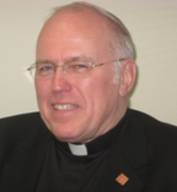 Father Richard Csizmar gives his parents, four brothers and three sisters credit for preparing him for life in the seminary and as a priest. The family owned Csizmar's Restaurant when Father Dick was growing up and he recalls how working together, sharing, caring, and enjoying each other's company provided him with the social and business skills needed to succeed in priesthood. He recalls that, "They first taught me how to live and love in a family." His family's experience of owning a restaurant was mirrored in Tom Dudzick's play, "Over the Tavern" Father Dick and his family saw the play together when it showed in Buffalo and they found that the Dudzicks and the Csizmars had a lot in common.
Young Richard attended elementary school at Ascension School in North Tonawanda. He fondly remembers his fifth grade teacher, Sister Marie Louise Schum, who encouraged every girl to be a nun and every boy to be a priest. She inspired him to accept the call he felt even then.
He graduated from Bishop Duffy High School in Niagara Falls in 1960. When he was a sophomore in high school, he was named newsboy of the week because of his success as a paper boy. The paper featured an article honoring him for his award but his girlfriend at the time was not pleased to read that he wanted to become a priest. His guidance counselor, Father James Cassidy, asked him what he wanted to do with his life. He responded, "I want to be a priest," to which Father Cassidy replied, "You want to go to Princeton?" He went on to receive the degrees of A.A. in classical languages from the Diocesan Preparatory Seminary in Buffalo; B.A. in philosophy from St. John Vianney Seminary (now Christ the King) in East Aurora; and M.A. in Religion and Religious Education from Catholic University in Washington, DC. He also participated in summer courses at Stonehill College, North Easton, MA; Georgetown University in Washington, DC; Franciscan University of Steubenville, OH; College of St. Joseph in Orange, CA; and the University of Rochester.
Father Dick, as he is affectionately called, was ordained to the priesthood at St. Joseph's Cathedral, Buffalo, by Bishop Pius Benincasa on May 25, 1968. "It was an awesome experience!" he recalls. "All of a sudden, life changed for me. I achieved what I had wanted since the fifth grade." On the day of his ordination, he visited his grandmother at Kenmore Mercy Hospital. She was too ill to be with him so he came to her with Communion and anointed her. She passed away the following January.
He served at St. Elizabeth Church in Cherry Creek and Nativity of Mary, Harris Hill before being assigned to Notre Dame High School of Batavia in 1969. For the next twenty-five years he served there in various capacities: instructor of religious guidance, the school's first development director, director of spiritual life, and associate principal. Over those years, Father Csizmar served as curriculum committee chairman, religious guidance department chairman, moderator of student retreats, moderator of the Sports Boosters Club, Assistant Athletic Director, and for fifteen years served as tennis coach. In addition, he also served on a human relations team for the Batavia City School District.
In 1976 the Lay Advisory Board of the Diocese of Buffalo awarded Father Csizmar a grant to study religious education at Prince of Peace Abbey, Canon City, Colorado. In 1992 he received the prestigious St. Elizabeth Ann Seton Award for meritorious service to Catholic Education. Also, he has been recipient of the Religious Educator of the Year Award by the Diocese of Buffalo and Educator of the Year Award by the University of Rochester. In June of 1998 he was installed in the Notre Dame High School Hall of Fame for outstanding service to the school.
Over his twenty-five years at Notre Dame, Father led student retreats for most of those years. Since 1976 he has been spiritual moderator of the Notre Dame charismatic prayer group. He served as weekend associate at St. Anthony's and St. Joseph's Parishes and also assisted at Masses at St. Mary's Parish for three years.
In September 1994 Father Dick was assigned to St. Joseph's and St. Mary's Assumption Parishes in Albion, first as administrator, and as pastor since December 31, 1994. He has since presided over the merger of the two parishes into Holy Family Parish. On November 1, 1995 he was appointed by Bishop Henry J. Mansell to the new position of Episcopal Vicar of Orleans, the delegate of the Bishop of Buffalo to parishes in Orleans County. In January of 2010 Bishop Edward U. Kmiec appointed him to the new position of Episcopal Vicar of Eastern Niagara-Orleans, now covering the eastern part of Niagara County and all of Orleans.
In Albion, Father has been a leader in the ecumenical movement, serving as president of the Albion Ministerium for three-and-a-half years and vice president for many years. This group provides a dozen gatherings for over 15 congregations in the Greater Albion area, highlighted by the annual Baccalaureate Service for Albion High School, a summer ecumenical picnic, luncheons during Lent and Advent, and services for Thanksgiving and Good Friday. This group led a service which brought over 450 people together at a Noon Worship Service in 2001, three days after the 9-11 attacks.
Sharing in the Sacraments with people has been one of the highlights of priesthood for Father Dick. He enjoys being involved with them at the special moments in their lives from Baptisms to Funerals and everything in between. He has been honored to have baptized and married a niece, a cousin, and the son of close friends who are also his god children. He loves dealing with young families, especially those with teenagers as most of his priesthood years were spent in a high school environment.
The challenges of priesthood for Father Dick include fundraising and keeping schools and parishes functioning financially. Father Dick incorporates creativity into every aspect of his ministry in order to help people overcome the challenge of keeping their faith lives new and exciting. Sometimes he feels it is hard to know how people are hurting and how to respond to them.
Father Csizmar is in the minority of men who actually enjoy shopping. He likes buying gifts for those close to him for Christmas, birthdays, and special events. He enjoys sports and follows the Buffalo Bills and Sabres as well as the Cleveland Indians.
Father Dick sees the priesthood as being a very exciting life. He feels it produces wonderful challenges and is a great way to serve people and bring them closer to Christ. He sees it as a very fulfilling life where there is a natural inroad to the lives of others. He feels privileged to be trusted by so many and to be able to share with them and pray with them. He advises that if priests will love their people and let the people love them, they will be happy and at peace with where they are. All in all, he exclaims that his life as a priest is, "Much more fulfilling than I could have ever imagined."
March 2011 Priest of the Month - REV. RICHARD CILANO
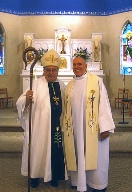 Father Richard Cilano is one of a very few people who have received two sacraments not normally administered to the same person. Having experienced thirty years of marriage and five years of priesthood, you might say he has been blessed to have the best of both worlds.
In the fifth grade, young Richard was impressed and inspired by the associate pastor of his parish, Father Joseph Nothnagle. This priest was a happy, holy man who trained him as an altar boy and Richard wanted to be just like him. So he set his sights on priesthood. After graduating from St. Andrew's Grammar School in Rochester, he attended St. Andrew's Seminary High School and St. Bernard's Seminary and College where he received a BA in philosophy. Along the way, he met the woman who would soon become his wife. He went on to receive a Teacher Certification in English from SUNY Brockport. Richard spent the next 32 years as an English teacher in the City School District of Rochester. Together, he and his wife Mary raised four children. With retirement nearing, Richard and Mary made plans to enjoy more time together. Unfortunately, that time never came.
Mary Cilano suffered a pulmonary embolism in 1999 and died in the arms of her husband. A few months later, Richard wondered if it would be possible to resume his studies for the priesthood or if that door had been closed forever. When he inquired at his home Diocese of Rochester, they told him that he was four years past the maximum age of 50 required to enter the seminary. He didn't have to look much farther than the neighboring Diocese of Buffalo, which has no such restriction, to receive a positive response. His youngest daughter, Anne, was a high school junior at the time and she became the first to find out.
One day at the kitchen table, he explained to Anne that he felt that God was calling him to be a priest. He knew that Anne was the one of his four children who would be most affected by this decision and wanted to receive her permission. She replied, "Dad if you think God is calling you to be a priest, that's what you should do."
"All my children were happy that I would now have something to do with the rest of my life," Father Richard said.
In 2001 Richard entered Christ the King Semionary and was even given credit for previous religious studies. In May of 2005, he graduated with a Master's of Divinity Degree. He spent time as a Transitional Deacon from June to November 2005 at Prince of Peace Church in Niagara Falls. On November 19, 2005, at the age of 60, he was ordained a priest at St. Joseph's Cathedral by Bishop Edward Kmiec. Father Richard remembers thinking on that day, "It was incredible to me that God would bring this around a second time. I was blessed in marriage and again in priesthood." Father Richard celebrated his first Mass as a priest the day after his ordination at Prince of Peace Church.
His first assignment was as parochial vicar at Nativity of Our Lord Parish, Orchard Park. In December 2007, he was made pastor of Immaculate Conception Parish, East Bethany and St. Mary Parish, Pavilion. On August 15, 2010, the feast of the Immaculate Conception, the two parishes merged to form Mary Immaculate Parish. The merger of the two parishes was celebrated at a Mass presided by Bishop Kmiec at the Pavilion site. The celebration continued with a picnic held at the East Bethany site.
Father Richard finds the celebration of the Eucharist, preaching and performing baptistms to be among the most enjoyable aspects of priesthood. The most challenging would be administration work, especially all that goes along with the merger of two parishes. In reflecting on the comparison of married life and priesthood, Father Richard says that they are very much the same. They both involve total dedication and are both life giving. In marriage the dedication was to his wife and children. In the priesthood one has full dedication and fidelity to God and His people. It is life giving in the sense that Father Richard shares God's life and love with the people he shepherds.
His free time and vacation time are spent mostly with his children and grandchildren. He is a "family man" whose family has grown now to include those to whom he ministers.
The advice Father Richard gives to those considering the priesthood depends on their age. When talking to younger men, he reminds them that there are a lot of things they can do with their lives. They should not eliminate the possibility of priesthood. With older men, he relies on his own experience and advises them to consider where they are in their lives and how God is calling them to serve. They should consider the obligations they have to family and follow their inclinations. The Holy Spirit speaks to different people in different ways as well as through different people and it is the responsibility of all to listen and act in union with the promptings of the Spirit. To sum it up, Father Richard exclaims, "Always remain faithful to the Church."
Father Richard can't imagine being happier doing anything else other than being a priest. Although he once had different plans for his retirement from teaching, plans that didn't work out, he is very happy. He hopes that he radiates the same joy that he saw in Father Joseph who inspired him as a boy. He revealed that, "My greatest joy as a priest would be to inspire someone else to enter the priesthood."
February 2011 Priest of the Month - VENERABLE NELSON H. BAKER
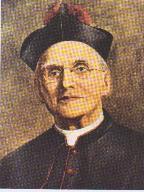 February 2011 features a priest who is near and dear to the hearts of many Western New Yorkers even though he went on to his eternal reward 75 years ago. He has many nicknames, among them, "Padre of the Poor," "Apostle of Charity," "Little Man of God" (due to his short stature – just about five feet tall), but he is known to most as "Father Baker." He was born February 16, 1841 and this year is the 170th anniversary of his birth.
Nelson Baker was the second eldest of four sons born in Buffalo, NY to Lewis Becker (later Baker) and Caroline (Donnellan) Baker. His father, a German Evangelical Lutheran, was a retired mariner. Lewis opened a grocery and general goods store on Batavia Street (now called Broadway) in Buffalo and is said to have instilled an astute business sense in young Nelson, who worked there after graduating from high school in 1858. When he was nine years old his mother, a devout Irish Catholic, had Nelson christened a Roman Catholic.
In early July 1863, Baker enlisted as a Union Soldier as part of the 74th regiment of the New York State Militia during the Civil War. His regiment, which saw duty along the Pennsylvania front at the Battle of Gettysburg, helped quell the New York City draft riots. After returning home from his military service, he and his friend, Joseph Meyer, another Civil War veteran, started a successful feed and grain business. Already feeling a strong affinity toward his Catholic faith, he joined the St. Vincent DePaul Society and began taking Latin classes in the evenings at St. Michael's residence in Buffalo, which would later become Canisius College in 1870.
With thoughts of the priesthood surfacing in his life, he decided to take a steamer trip along the shores of the Great Lakes to sort out his future. When he returned to Buffalo, he was firm in his decision to begin the process of becoming a priest. His mother was thrilled with the news while his father, brother, and former business partner had reservations.
He entered Our Lady of Angels Seminary (now Niagara University) in September 1869. While a seminarian in 1871, he was taken ill with erysipelas, known in the Middle Ages as "St. Anthony's Fire," an infection of the skin which causes painful swelling and high fever. At one point he was so close to death he was given last rites. Nelson's long road to recovery, which involved learning to walk again, took almost a year. After recovering, he went with a large group on a pilgrimage to Europe. While in Paris, France the group toured the Shrine to Our Lady of Victory. It was noted that this visit to the Marian shrine in France marked the beginning of his lifelong devotion to Our Lady of Victory. While in Rome, the group briefly met Pope Pius IX at the Vatican.
Father Nelson Baker was ordained on March 19, 1876 (the feast of St. Joseph) by Bishop Stephen V. Ryan at St. Joseph's Cathedral in Buffalo. His first assignment was at a parish in Limestone Hill (now known as Lackawanna, NY) which consisted of St. Patrick's Church, St. Joseph's Orphanage, and St. John's Protectory. Of course, this was the future site of Our Lady of Victory Parish and Homes of Charity. He stayed there for five years and was then transferred to St. Mary's Parish in Corning, NY (then part of the Diocese of Buffalo). He only spent one year in Corning and in 1882 was recalled to Lackawanna as Superintendent.
Upon his arrival back to Limestone Hill, he was met by a group of creditors who informed him that the three institutions had amassed a sizeable debt and they demanded immediate payment. His prior experience as a businessman was instrumental as he endeavored to handle this crisis. Besides using up his remaining personal savings, he began the "Association of Our Lady of Victory." Membership in this group was 25 cents a year. Father Baker, with the help of postmasters in towns across the country who provided him with the names and addresses of Catholic women, wrote to the women requesting help in caring for the children residing at the orphanage and protectory. He also started a journal, The Annals of the Association of Our Lady of Victory, in 1888 to solicit more help. Later, in 1895 it would be known as Victorian Magazine and last until the early 1970s. By 1889 his efforts had been successful and the creditors were paid in full. In answer to his prayers of never falling into debt again, a gas well was miraculously discovered on the land of the Our Lady of Victory Homes in 1891.
Father Baker was horrified by the news of infant bones being dredged out of the Erie Canal. The practice of dumping unwanted babies in the waterway was becoming all too common. In response, Father Baker expanded his ministry to include the construction of Our Lady of Victory infant home, which opened in August 1908, to offer refuge, prenatal care, and adoptive services for infants and unwed mothers. Understanding the need for confidentiality, he made it known that a crib would be left inside the door to the infant home into which anyone could surrender an unwanted newborn any time with no questions asked.
Honored in his community as "Buffalo's most influential citizen of the 20th century," his name was given to a major bridge on Route 5 in Lackawanna. He has also received church honors, both during his lifetime and since his death. He was named Vicar General of the Buffalo Diocese in 1902, given the title Monsignor in 1905, and Rome commended his religious leadership on June 23, 1922 by naming him Prothonotary Apostolic ad instar Participantium, an honor accorded to only five other clergymen in the United States at that time. He unceasingly promoted devotion to the Eucharist and Our Lady of Victory.
Father Baker was constantly making improvements and upgrading the facilities in his care to accommodate more and more people in need. His final and most magnificent tribute to his patroness came in the form of constructing the Basilica of Our Lady of Victory. With no funds available for such a project, Father Baker realized he would need to reach out to those who had been so generous in the past. He asked the people in the Association of Our Lady of Victory to donate $10 blocks to the building of the basilica. There was an outpouring of support for the beloved priest from all over the nation. He spared no expense and utilized the finest materials imported from Europe, Asia, and Africa. It took only four years to complete and in May 1926, the year of his Golden Jubilee (50 years of priesthood), the OLV Shrine was consecrated, 100% debt free. Later that year in July, the OLV Shrine was named a Minor Basilica by the Vatican.
He administered the Basilica Parish with the adjacent Homes of Charity (orphanage, elementary school, home for infants, facilities for unwed mothers and maternity hospital) for the rehabilitation of countless underprivileged men, women and children until late in life. Father Baker died on July 29, 1936 in Lackawanna. Tens of thousands attended his wake service and funeral. On March 11, 1999, his earthly remains were moved from the cemetery into the basilica. Currently, OLV Basilica contains a museum and gift shop honoring Father Baker. It is a treasure for the local community and a valuable destination for anyone visiting the area.
In the summer of 1987, the Congregation for the Causes of the Saints approved the initiation of Father Baker's cause and confirmed the title "Servant of God – Nelson Baker." This is the first of four stages of being named a saint. The next is "Venerable" then "Blessed" and finally, "Saint." On January 14, 2011, Pope Benedict XVI authorized the Congregation for the Causes of Saints to promulgate a decree recognizing Father Baker's "heroic virtue," a prerequisite for his eventual beatification. He is now to be considered "Venerable!"
In October 2008, this Vocation Website featured another Father Baker - Father David Baker. (See archived priests.) He is now serving as parochial vicar at Our Lady of Victory Basilica. As you can imagine, visitors to the Basilica are perplexed when it is announced on Sunday that the Mass will be said by Father Baker! After every Mass at OLV the following prayer is said for the canonization of Venerable Nelson H. Baker:
"Lord, you gave us Your Servant Nelson Baker as an example of service to the poor, homeless, and young. By Father Baker's ardent concern for those in need, inflame our hearts and lives with compassion for the poor, justice for the oppressed, hope for the troubled, and courage to those in doubt. We pray through the intercession of Our Lady of Victory, if it be Your will, that Your servant, Nelson Baker, may one day be canonized. Amen."
January 2011 Priest of the Month - REV. MSGR. RICHARD SIEPKA
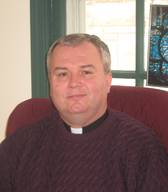 Father Richard Siepka describes himself as one of the last "Lifers" of the Diocese of Buffalo. By that he means that he was one of the last priests who began studying for the priesthood at the age of fourteen and stayed with it ever since.
After graduating from Resurrection School in Cheektowaga in 1970, Father Rich began his studies at the Buffalo Diocesan Preparatory Seminary. In 1974 he would be among the last class to graduate from that high school. After that it was on to Wadhams Hall Seminary College in Ogdensburg, NY. He graduated in 1978 but instead of following the path to priesthood locally, he decided to travel to Rome to continue his studies. He arrived the day before Pope John Paul I was installed. He and his classmates were thrilled to be there for the installation but were disappointed to have missed the election process. Little did he know that in a short time the opportunity would return. He attended the funeral of the first Pope John Paul and witnessed the election and installation of Pope John Paul II. In 1982, Fr. Rich was ordained to the priesthood at his home parish of Resurrection in Cheektowaga by then Bishop Edward Head. He then returned to The North American College in Rome for one more year and graduated in 1983.
His first assignment as a priest back in the United States was to St. Andrew's Parish in Kenmore where he spent four years. He was then transferred to Christ the King Parish in Snyder. During his first year there, he noticed an opening advertised for a faculty position at Wadhams Hall Seminary-College in Ogdensburg. He enjoyed the time he had spent there as an undergraduate student and he also expressed a real love for parish life which led him to want to share that fondness with seminary students. Opportunities like that didn't often occur so Father Rich applied and was accepted.
While at Wadhams Hall, Father Rich held various titles. In 1992, after the death of the President Rector of the college, Father Rich was appointed to that position. He stayed as Rector there until 1996 when he desired to return to the Buffalo area to be closer to his aging parents. He thought he'd be appointed to a parish but instead, then Bishop Mansell asked him to become Rector of Christ the King Seminary in East Aurora. Father Rich spent twelve years as Rector there and joked that God made up for the time he went to Rome to study instead of attending Christ the King Seminary.
In 2008, Father Rich was appointed pastor at St. Andrew's Parish in Kenmore, the very same place he spent his first assignment as parochial vicar. He was happy to once again be a part of parish life. He finds that as a priest he really enjoys "being able to serve the people of God during the most significant moments in their lives." He comforts them at the funerals of their loved ones, rejoices with them in the celebration of the Sacraments, and engages himself in the lives of the students at St. Andrew's School. Father Rich is also pleased to serve his family as he did when he recently baptized his great nephew.
The business end of the priesthood can sometimes present challenges. Most priests do not enter this vocation looking forward to dealing with administrative issues, but it's all part of the ministry. Keeping the school running during difficult economic times can be unsettling but the benefits of having a school far outweigh the hassles.
Possibly stemming from his studies in Rome, traveling is one of the ways Father Rich likes to spend his time. He has been involved in running trips to various locations and really enjoys the opportunity to do so.
Recently, Father Rich interviewed Confirmation candidates from his parish and his advice to them is the same advice he would give to anyone considering the priesthood. "God has a calling for each and every person and his plan fits their person well. This plan is the best way to be the most fulfilled and happy." Father Rich also feels that people should explore whatever occupation or vocation they feel called to. God doesn't call people to lives where they are going to be miserable. God is always calling us to be the best people we can be. One shouldn't consider where he will be the most successful or how he can make the most money but rather how he can best use the gifts and talents God gave him.
It's hard for Father Rich to believe he's been a priest for 28 years and that 20 of those years have been spent as faculty member or administrator of two seminaries. Being a priest is far from dull and boring. There are always new challenges and different opportunities around every corner. The time has passed so quickly for Father Rich because he has been following the plan God had for him all along. Looking back, he admits that at fourteen years old most people don't know what they want to do for the rest of their lives. He recalls, "God led me along the right path and I listened to what He had to say. I'm glad I guessed right!"
November 2010 Priest of the Month - REV. CHARLES AMICO
 I was born in Buffalo in 1928, the fifth of six children. My parents were immigrants from the Sicilian region of Italy. They were both very devout Catholics from the town of Mussomeli, well-known for its fervent Catholicism and as a nurturer of numerous priestly vocations.
Growing up in Holy Cross Parish on Buffalo's lower West Side, I became an altar server in fifth grade. I greatly admired the priests of the parish, especially Father (future Bishop) James Navagh, Father (future Monsignor) Joseph Schieder, Father (future Bishop) Pius Benincasa, and Father Raymond Bosch. What impressed me particularly was their happy spirit and how generously they treated us altar servers with parties, picnics, movies, and sports. Little wonder that more than a few of us boys decided to enter the Seminary.
At the time Holy Cross Parish had no parochial school but provided a thorough catechetical program, staffed by the dedicated Missionary Sisters of the Divine Child. Classes were held twice weekly for one hour right after a full day at the public school.
After sixth grade, I transferred to the St. Louis Parish parochial school. This meant walking a mile to and from school, even though I was only eleven years old. There were several of us doing this from Holy Cross Parish so it was no great chore. There, in grades seven and eight, I was taught by the equally dedicated Sisters of St. Joseph. The eighth grade teacher, Sister Gregory, was widely known for fostering priestly vocations.
At the age of thirteen, I began high school studies at the "Diocesan Preparatory Seminary" (then called the "Little Seminary of St. Joseph and the Little Flower"). There I spent four happy years of high school and one year of college. We were given an excellent education, integrated with athletics and many other activities. The staff of priests was exemplary.
In 1946, shortly after World War II, at the age of eighteen I was sent with two classmates to Rome at the Urban College (Seminary) of Propaganda Fide for seven years leading to priestly ordination. The Seminary is located on a hill facing the Vatican. From my window I could see St. Peter's Basilica and late into the night the light in the window of Pope Pius XII.
The seminarians were from about thirty-five countries - all living together as brothers. The superiors couldn't do enough to provide a genial atmosphere. These were among the happiest years of my life.
Of course, from Rome I enjoyed occasional visits to my parents' birthplace in Sicily where I met my grandmther - in her upper nineties - and other close relatives. This proved to be a very important influence in my life, retracing my roots and discovering how deeply religious they were.
I was ordained a priest in Rome on December 21, 1952. I celebrated my first Solemn Mass in Mussomeli on Christmas Day. The day before, the whole population of twelve thousand turned out to greet the "new priest." If the Pope himself had visited the town, the reception could not have been more solemn.
Upon my return to Buffalo, I served in three parishes over five years before being sent once more to Rome, this time for two years leading to a doctorate in theology in 1960. These were especially exciting times, coinciding with the first two years of the pontificate of the charismatic John XXIII.
Returning to Buffalo in 1960, I began teaching in various seminaries: the Diocesan Preparatory Seminary, St. John Vianney Seminary in East Aurora, and various places abroad. Since 1990 I've been a theology professor at Christ the King Seminary in East Aurora.
At the age of eighty-two, I look back over fifty-eight years of priesthood with gratitude to God for the grace of achieving not only one but both of my boyhood dreams - to be a priest and to be a teacher.
October 2010 Priest of the Month - REV. JERRY SULLIVAN
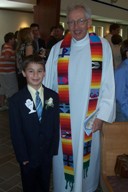 Father Jerry with great-nephew, Jacob
W. Jerome Sullivan was born to the family of a traveling salesman and along with his older sister and two younger brothers, moved five times before the age of nine. His father worked as a pharmaceutical salesman covering a large area of New York State. Finally settling in Williamsville, Jerry was influenced by Monsignor George Zimpfer, a pastor of great vision at SS. Peter & Paul Church, who built a strong Christian community and was in many ways ahead of his time.
The Catholic faith and music, always present in his home, were very instrumental in forming young Jerry. His mother, Gertrude, a teacher, served as organist and choir director at their home parish, St. Felix in Clifton Springs, NY. His father, William, a natural salesman, was successful because he cared for all he encountered on his routes. As he got older, Jerry would travel with his father during the summer months to help with the driving. He remembers that his father knew the daily Mass schedule for all the areas he visited and made good use of it. This attention to faith undoubtedly influenced Jerry's future vocation choice. The Sullivan home was often the gathering place for the entire neighborhood, hosting daily softball games during the summer months.
When he was 14 years old and in the eighth grade, Jerry's teacher asked the class if anyone was interested in taking the entrance exam for the Diocesan Preparatory Seminary. Young Jerry's hand went up. His friends were a little surprised but he felt it was something he really wanted to do. After six years there, the future Father Sullivan completed his college education at St. Bernard's in Rochester in 1958. He was then assigned to the North American College in Rome to begin theological studies at the Pontifical Gregorian University. He was ordained to the priesthood on December 20, 1961 at St. Peter's Basilica in Rome. Not long after, in 1962, he received his Licentiate in Sacred Theology.
He then returned to the Diocese of Buffalo and began his ministry in the missionary apostolate at St. John Fisher Parish in South Dayton. Within a short period of time he was asked to return again to Rome to continue his studies. In 1966 Father Jerry earned his Doctorate in Church Law from the Lateran University in Rome. It was exciting for him as a young priest to be in Rome while the Second Vatican Council was in session. Returning once again to Buffalo, he served as Assistant Chancellor for the diocese putting to good use his Doctorate in Canon Law. He had a real desire to work with the poor, so in 1969 Father Jerry began twenty-one years of urban ministry in parishes, first as a parochial vicar at Our Lady of Perpetual Help in Buffalo until 1974, then as administrator of Queen of All Saints in Lackawanna until 1980, along with Assumption in Lackawanna until 1977, and as pastor of St. Mary of Sorrows in Buffalo from 1980 until 1990. He was given the title Monsignor in 1988 and served as Vicar for Central City from 1987 to 1988. While serving in the city, Father Jerry encouraged neighbors to come together and organize themselves uniting for such issues as municipal housing tenants' rights, a just share of government presence and funding, equal opportunities for minorities throughout the area, in short, advocacy for those whose voices needed to be heard. He also enjoyed singing with the Central City Choir. His time spent in urban parishes was a blessing not only to the people he served but to himself as well. He said, "I originally came into Central City that the poor might hear the Gospel. I realized more each day that it was most often the poor who lived the Gospel and made it clearer for me."
From 1990 to 2007 he served as Pastor of St. Mary of the Lake Parish in Hamburg. He successfully led the growth of that parish in the building of a new church facility. During his time as pastor, he also served as Coordinator of the Priests' Personnel Board from 2003 to 2009. He served on the boards of Catholic Central School, Christ the King Seminary, and Immaculata Academy. In other service, he has been on the Diocesan Review Board since 2005, a Consultor for the Diocese of Buffalo since 2006, as well as Bishop's Liaison for Retired Priests, positions he presently holds. He served in various other capacities during his priesthood, too many to name here. He was also honored at the Cure of Ars in 2004.
Family has always been important to Father Jerry. They are mostly concentrated in the Depew and Rochester areas and his brothers and sister have brought the joy of thirteen nieces and nephews and twenty-three great-nieces and nephews into his life. He also enjoys being involved in the continuing formation of priests. During his time in the Chancellery when he didn't have the benefit of a parish, the well-being of his brother priests became a focus.
The early exposure to music as a child with his mother's influence and later as an adult with the influence of his talented brothers and sister, continues to be a source of enjoyment for Father Jerry. His favorite kind of music is jazz and classical. He also enjoys sports, especially baseball and golf, reading, in the areas of religion and history, and he loves to travel – especially by car. Maybe because of all that time spent with his father along the sales route, he exclaimed, "I love to drive!"
Working with the poor in the inner city really helped Father Jerry feel closer to Jesus. When he reflects on the best part of being a priest, he remembers spending time with people who had so little and yet loved God so much. They had no place else to go but to God and it was God who saw them through. Praying and singing with them during the celebration of the Eucharist at Mass was a very powerful experience. There were also times when Father Jerry found himself with people who were at the lowest points in their lives because of tragic events. Seeing parents grieving over the loss of a young son, yet still strong in their faith, gave Father Jerry a renewed sense of his own faith. He remembers in so many cases feeling privileged to share in these times and, "being grateful that God had intervened" in situations that seemed impossible to survive. "Blessed are the poor…" takes on a whole new meaning. He recalled, "You're so close you can touch God's grace."
The challenges of priesthood, for Father Jerry, involve stressful times such as the building of a new church when it doesn't seem financially attainable and having to take action when people use poor judgment and need to be corrected. It is often difficult to unite opposing groups of people who have to learn to get along or deal with administrative paperwork that seem endless.
Of course every vocation has its challenges – married, single or religious life. Father Jerry asks men considering the priesthood, "Why not go for it?" It's hard to know what the ministry of a newly ordained priest will look like in the future but when Father Jerry began in the early 1960's during the start of Vatican II the future was uncertain then as well. He recalls the words to an old hymn, "We've come this far in faith, leaning on the Lord" and feels that if we trust in God, there is nothing to fear. Father Jerry exclaims that through it all his priesthood has been a most rewarding time.
September 2010 Priest of the Month - REV. JAMES WAITE
 Father James Waite is the Pastor of St. John the Baptist Parish in Lockport. Father Waite grew up in Buffalo at All Saints Parish. He is a graduate of St. Joseph Collegiate Institute and Canisius College. Before he was ordained to the priesthood, he was an Instructor of General Education and Chair of the Graphic Design and General Education Departments at Platt College in Newport Beach, CA. He graduated from Christ the King Seminary with a Master of Divinity Degree. After his ordination in 2004, he served as a parochial vicar at Fourteen Holy Helpers Parish in West Seneca and at St. Gabriel's Parish in Elma. Father James is a member of the Diocesan Committee for the Continuing Formation of Priests.
"I became interested in priesthood as a child. My grandfather was kind of a hero to me because he could fix anything and was very wise. When he died, I was ten years old. I remember attending his funeral and thinking, ‘I wonder if he accomplished what he had hoped to in his life.' I began thinking about what kind of a difference I could make in my own life and reasoned that being a priest would be a great way to serve God and others.
I continued thinking about priesthood through high school and at Canisius College. While in college, I was in a pre-theology program run by the Diocese at the former John Paul II Residence. I went to Christ the King Seminary in East Aurora for a semester and then decided I needed to give the idea of priesthood a rest. I wanted to see what else I might do in my life, so I moved to California and went to school for Graphic Design. I still enjoy computers and design today and do not feel at all that those years were wasted. I had a great time serving on the faculty of Platt College. The school hired me to teach General Education courses and teaching is still a great love of mine. In the past year, I have served as an adjunct Lecturer for Christ the King Seminary in their Continuing Education Department."
While in California, a friend from Buffalo came to visit James and their conversation turned to his interest in the priesthood. James showed his friend the nice car he had, the nice income, the nice California weather…but somehow it all seemed hollow to him at that point. He knew in his heart that God still wanted him to be a priest.
"In a leap of faith, I called the Diocese of Buffalo Vocation Office and asked if I could resume my formation towards priesthood. I was re-accepted at the Seminary and reconnected to my beloved Western New York.
In my career as a priest, I have always promoted technology as a way to evangelize. When the position of pastor for St. John the Baptist was announced, the parishioners said they were looking for several qualities in a pastor: someone with energy and fresh ideas, a priest who could preach well, and a priest who could bring the parish into the twenty-first century. Those are still the goals I have for myself in shepherding the parish."
August 2010 Priest of the Month - REV. F. PATRICK MELFI
 The idea of becoming a priest wasn't even on the radar when Francis Patrick Melfi was a young boy. The youngest in the family of seven, he grew up in Olean with three sisters and three brothers. "I was an altar server growing up but can't say I was a model altar server," recalls Father Pat. After high school he spent four years in the Navy. During those four years he remained close to his Catholic Faith. Fortunately for him, there were Marines aboard the ship he was on and typically a priest was assigned to the Marines. When they were out to sea the priest would say Mass every day and Pat would make it a priority to attend. Going to Mass helped him feel connected to home which was a comfort when dealing with being so far away.
Thoughts of the priesthood began to surface after the Navy when he deliberated about what to do next. At the time he was living in Richmond, VA attending college. He felt close to the Franciscans having been baptized by a family friend who was a Franciscan and growing up in Olean so close to St. Bonaventure University. He went to Washington, DC to speak to friars from a branch of the Franciscans called the Capuchins. They sent him to Cleveland to learn more about their order but that didn't seem to feel right to him at the time. Pat returned to school and graduated with a degree in Mathematics. He took a few education courses before graduation so that he could teach math but never really felt "on fire" enough about the subject to do it justice in the classroom.
Whenever he visited home, he would attend Mass and speak with the parish priest. The priest asked Pat if he had ever considered the priesthood and encouraged him to give it another try. This time, Pat looked into the diocesan priesthood. He moved into the John Paul II Residence in order to more seriously discern the possibility of this vocation. While there, he attended classes at Canisius College to fulfill Philosophy and Religious Study requirements. It was a valuable year spent there but after it was over he didn't feel called to enter the seminary.
After obtaining a degree in Civil Engineering, Pat went to work for the State of New York as an engineer designing bridges. During his years with the State, Pat found the job rewarding in the sense he was able to make a contribution to his community. He always remained close to his faith, becoming involved in various ministries at his parish and keeping in touch with priest friends he had made.
A defining moment came in the 2000 Jubilee Year, when he and a friend from work decided to make a pilgrimage to the Holy Land. It was led by three Dominican Priests and included a trip to Rome as well. Father Pat remembers that while in the Holy Land the Bible "came alive" because he was walking in the very places Jesus walked when he taught and preached. Rome was very inspiring as well and it was on this pilgrimage that he began to think, "Yeah, I could do this!" About the time he returned, Catholic radio was entering the air waves and he found himself listening and learning more about his faith. Another co-worker had mentioned about becoming a minister and Pat thought, "Me too!"
In 2001 he made the call to Father Leon Biernat who then was the Vocation Director for the Buffalo Diocese. In May 2001 he ran into Father Joe Gatto whom he knew from the John Paul II Residence and told him he was thinking about entering Christ the King Seminary. Father Joe said, "Well…what are you waiting for???" Pat had the small matter of a house to sell and a job to put on hold. He would need to enter the seminary in August which gave him only three months to sell his house. It seemed that the right time had finally come as he signed the contract for the sale of the house the day he headed out to the seminary.
As he looks back, Father Pat remembers feeling God was always there with him. He credits his faith to his father. After dinner and the chores were finished, his father would often sit and read the New Testament with Pat. His father would explain anything that seemed hard to understand in an effort to endear his son to the Word of God.
When he entered Christ the King Seminary there were eleven other men in his class. As time went by, a few left, got sick, entered other dioceses, etc. and by the time he was ordained on May 27, 2006, there was only one other priest ordained with him, Father Todd Remick. Father Pat remembers feeling overwhelmed in a good sense. He was really touched by it all especially when the other priests in attendance approached for the "laying on of hands" during which they prayed over him. He felt a special bond with his fellow brothers in Christ.
Father Pat spent the first three years of his priesthood as a parochial vicar at St. Christopher in Tonawanda and was named to his current position of Pastor of Our Lady of Peace in Salamanca and St. Patrick in Limestone in 2009. As a priest, Father F. Patrick Melfi finds it a privilege to be with people in their time of need. In situations of bereavement he feels it is not always easy to know what to say but just being there helps to comfort people. He very much enjoys celebrating the Eucharist and bringing people together as well. He finds it challenging to be a pastor after only three years of priesthood, but with the challenge comes the sense of bringing people closer to God. Father Pat also mentioned the administrative end of being a pastor can be challenging as decisions have to be made that affect the whole parish.
Father Pat enjoys exercising and reading as well as golfing and keeping up friendships with fellow priests and others. He advises those considering priesthood to be open to the idea and to allow themselves the opportunity to explore it. Listen to the advice of people you trust and don't just rely on what you are thinking and feeling at the time. There will always be challenges no matter what vocation you choose in life. Rely on your faith and take the time to find out what God intends for you. As he reflects back on all the starts and stops along his way to the priesthood, Father Pat feels that he really can't see himself doing anything else.
July 2010 Priest of the Month - REV. PETER J. KARALUS
 When God calls a man to the priesthood, it often begins as just a whisper. In order to hear and respond to God's call, it helps if the conditions of his life enable him to do so. When Father Peter Karalus was growing up, St. John Kanty Parish in Buffalo was not merely some place his family visited for an hour on Sundays; it was like a second home. His parents were very involved in the life of the parish, as was Peter and his two older sisters. All three children attended elementary school there and Peter was an altar server. He remembers well feeling very comfortable anywhere on the parish grounds, even sliding down the banister of the rectory staircase as a young first grader while his family spent time visiting the priests. Father Mark Wolski grew up with Father Peter's mother and Father Peter remembers priests always being around in his life. When he entered the seminary, friends and relatives mentioned that they "told him so" when he was younger. They knew he would make a good priest and they often encouraged him in that direction. Finally, he was making good on their prediction. It brings a smile to his face to think that on his ordination day his picture was taken at the top of the rectory staircase…a place he knew well!
After graduating from St. John Kanty Elementary School, Peter followed in his sisters' footsteps to St. Mary's High School in Lancaster. Many of his classmates did the same as the Metro Bus made it easily accessible. He graduated in 1987 and went on to study at the University at Buffalo. At first he thought he might like to be an engineer but by Thanksgiving of his freshman year he came to realize that very few engineering students had developed a sense of humor and he couldn't see himself working with them for the rest of his life. So he changed his major to Art History and graduated in 1991 with a Bachelor of Arts. He specialized in Museum Studies and wanted to work in a museum using art as a way to teach.
During the summer of 1989, Peter spent time studying at Richmond College in London, England. He was awarded the Evelyn Rumsey Lord Fellowship in 1990 which stipulated that he study in a country whose language he did not speak. He spent time in Eastern and Western Europe just after the fall of the Berlin Wall and had his first real experience of the Catholic Church as Universal. While attending Mass in Budapest, he felt connected to home as he was comforted by the ebb and flow of things while not understanding much of what was being said. It was then that he began to seriously address the issue of becoming a priest.
In 1996 Peter earned a Master of Divinity from Christ the King Seminary in East Aurora. While studying Theology and Church History at the seminary, Peter felt especially prepared because of all the visual aids he had accumulated in his Art History classes pertaining to the Church. He was ordained a Transitional Deacon that same year and on May 17, 1997 was ordained to the priesthood. There were six men ordained that day. It was the biggest group the Diocese of Buffalo had seen in a long time and remains the largest group to be ordained together to this day. Father Peter remembers feeling like they were brothers in Priesthood journeying together. They tried to stagger their first Masses and receptions so that they could attend each others events and celebrate together. With family in town staying at his parents' house, Father Peter decided to spend the night before ordination at St. Joseph's Cathedral. He remembers the long walk down the aisle of the packed cathedral as they processed in and the cold floor as they lay prostrate. He profoundly recalls the Laying on of Hands when he felt, as he put it, "the infusing of the spirit of ordination flowing through the hands of the bishop and his brother priests."
Father Peter spent his year of Diaconate and his first year as a priest at St. Joseph & St. Mary's Parishes now called Holy Family in Albion. He was then assigned as Parochial Vicar at St. Gabriel Parish in Elma from July 1998 to December 2003. Bishop Henry Mansell, who ordained Father Peter, then named him administrator of St. Martin Parish in Langford, St. Mary Parish in New Oregon and St. Frances Cabrini Parish in Collins Center from December 2003 to February of 2006 at which time Bishop Kmiec named him Pastor of the three churches. Along came the Journey in Faith and Grace and the three parishes merged into one at the Langford site called Epiphany of Our Lord. Father Peter is currently the pastor there.
In addition to his responsibilities in Langford, Father Peter continues on the Council of Priests, a position he has held since June of 2005. He is currently the secretary of that group as well as a delegate to the Priests' Council of New York State. For four years he has been on the College of Consultors in the Diocese of Buffalo and has been the Episcopal Vicar of the Tri-County Vicariate since September 2009.
Father Peter serves on the Board of Trustees at St. Mary's High School in Lancaster, his alma mater. He also serves as the Coordinator for the Diocesan Delegation to the Summer High School Youth Conferences at the Franciscan University of Steubenville in Ohio and has done so since 1999. One of Father Peter's great gifts is working with and inspiring young people. He has served as World Youth Day Coordinator for groups in the Buffalo area and has accompanied delegations to Paris, France in 1997, Toronto, Canada in 2002, Cologne, Germany in 2005 and is looking forward to Madrid, Spain in 2011. He is thrilled to be able to combine his love of traveling with inspiring the youth of the Diocese of Buffalo to be proud of their Catholic Faith.
Besides traveling, Father Peter enjoys photography, swimming, biking, reading and of course, the arts – both visual and performing. He spends time whenever he can with his family. His two sisters each have two daughters and keeping up with all the events and celebrations connected to his family fills what little room is left in his schedule.
Father Peter finds the celebration of the Eucharist to be "the most amazing thing I do every day." Standing in the person of Christ and being able to be the instrument the Lord is using to feed his people, forgive sins, lead people to marriage, welcome their children through the waters of Baptism, and send their loved ones home to the Lord when their earthly lives have ended is totally exhilarating, totally exhausting and totally what ordination is all about. His priesthood is not just for him, it is for him and his community. He has enjoyed every community he has had the pleasure to serve; all have graciously welcomed him and even made his family feel as if they belonged.
"It's not all a bed of roses, though", admits Father Peter. The schedule of a priest can be really challenging. "There are challenges across the board and you have to keep reminding yourself and others that you're only one person and you can't do it all." It's difficult to address all issues in a timely manner. Another difficult aspect of the priesthood is dealing with tragedy. When people are going through a tough time they often look to their priest for answers. Father Peter admits he doesn't have all the answers, no one really does. He feels that even if he can't give answers, at least he can provide a sense of comfort just by being there for them.
When Father Peter entered the seminary, he recalls the priest who was the parochial vicar in his parish while he was growing up telling him, "It's a wonderful life!" Father Peter stresses that priesthood, like life in general, is what you make of it. Men considering priesthood should ask themselves what gifts they have that they can bring to their priesthood. A priest needs to be joyful and happy and show this to the world. It is a privilege to be a priest, admits Father Peter but if you think you are going to be privileged as a priest then you are in it for the wrong reasons. He feels that, "nothing great comes easy." God calls but He does not do all the work. The men who respond have to do their part as well. Jesus called certain men to be his disciples. They had their specific gifts and talents but they had their flaws as well just like those who are called to the priesthood today. It's good to be open and to let your vocation unfold with a joyful spirit. A sense of humor is important. You have to be able to laugh. God gave us this life, it is a gift and He wants us to enjoy it all while loving and serving Him. A man who entered the seminary once told Father Peter that it was at World Youth Day in Germany when Father Peter was asking him to be involved in a powerful evening of prayer and music with people from many nations that he felt called to serve God as a priest. Once again, the Universal Church setting was inspiring a vocation to the priesthood and this time Father Peter was the instrument God was using to inspire someone else.
June 2010 Priest of the Month - REV. GREGORY FAULHABER
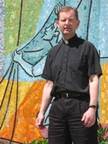 We are blessed to have Christ the King Seminary here in the Diocese of Buffalo. Not every diocese can boast a major seminary in their midst. Christ the King Seminary is a place where seminarians study to become priests, lay people come to take classes, earn degrees, go on retreats, and have all kinds of other gatherings. Father Greg Faulhaber is currently the Vice-Rector, the Director of Formation, and Professor of Moral Theology at Christ the King Seminary. He remembers feeling called to the priesthood at an early age. He said, "It was the only vocation that I ever pursued seriously." When asked why he wanted to be an altar server in the sixth grade, he responded that he was interested in becoming a priest and that was the path he pursued.
On October 14, 1953 Joseph and Mary Faulhaber welcomed Gregory into their family. He was the third of eight children in a family whose roots were deep in Lancaster, going back to at least 1850! After graduating from St Mary's Elementary School, Greg entered the Diocesan Preparatory Seminary in Buffalo in an effort to continue on the road to priesthood and graduated from there in 1971. He decided not to go onto the undergraduate seminary at Wadhams Hall in Ogdensburg which would have been the next step. At the time his father was not well and he wanted to stay closer to home. Somewhere in the back of his mind he also felt that maybe he should slow down on this trek to the priesthood just in case it wasn't really for him. Looking back on those years he spent at Canisius College, he felt they did a lot to confirm his vocation to the priesthood. Greg continued playing basketball and baseball, sports he loved in high school, sang in the folk group, worked as a janitor, dated, and taught 9th grade religious education. It was the time spent teaching religion and working with the students and other teachers outside of the classroom, coaching sports, doing retreats, going on bike hikes, etc. that most solidified his decision to become a priest. He graduated from Canisius in 1975 with a BA in Math and German and then entered Christ the King Seminary in East Aurora where he graduated in May of 1979 with a Masters in Theology.
Ordained a Transitional Deacon on October 28, 1978, Reverend Mr. Greg Faulhaber was assigned as a Deacon Intern at St. Gregory the Great Parish in Amherst from May 1978 to October 1979. When he began at St. Greg's, there was no youth group and he was asked to help start one. There were 100 young people at his first meeting and the St. Greg's youth group is still going strong to this day.
On October 19, 1979 Father Greg was ordained to the priesthood at St. Joseph's Cathedral by Bishop Edward Head. He said his first Mass at his home parish of St. Mary in Lancaster two days later on October 21. His first assignment as a priest was to St. Barnabas Parish in Depew where he again hit the ground running. They were in immediate need of a Director of Religious Education for the 1500 students at the parish and Father Greg arrived just in time. He spent six years at St. Barnabas and was then re-assigned in November 1985 to St. Amelia Parish in Tonawanda. At both St. Barnabas and St. Amelia, Father Greg enjoyed sharing his love of sports as well as the Catholic Faith with the young parishioners.
He moved on, once again, in August 1989 to become Campus Minister and Director of the Newman Center at the University of Buffalo, South Campus. He noticed that there were quite a few students attending Mass at St. Joseph Church near the campus and became involved in the process of merging the Newman Center and the Church. The result: St. Joseph-University Parish. Father Greg was there for one year when the bishop called because the Franciscans ended their administration of Christ the King Seminary. He asked Father Greg if he would consider going back to school to study Moral Theology so he could eventually teach at the seminary. He agreed because he felt that, "This institution is so important for the diocese and the future!" and began studies in September 1990 at the Catholic University of Louvain, Belgium.
While studying in Europe, he continued to engage in youth ministry in Germany, Holland, and Belgium. He held retreats and became involved in parishes, military bases, and campus ministry whenever he could work it out amidst his studies. He graduated in June 1994 with a PhD in Moral Theology and began teaching full time at Christ the King Seminary in August 1994.
Besides teaching and directing the formation of seminarians at Christ the King, Father Greg helps out as a regular weekend associate priest at his home parish of St. Mary in Lancaster, along with assisting at a number of other local parishes. He also has given over 100 presentations to various groups, organizations, confirmation classes, etc. and has been a member of many advisory boards and committees as well as an advocate and defender of the bond on the Marriage Tribunal. He has had several pamphlets and articles published as well as a book titled Politics, Law and the Church – An Examination of the Relationship Between Catholicism and American Law.
Father Greg enjoys sharing who God is with people at important moments in their lives. He loves participating in all the things he does as a priest at the seminary and at various parishes throughout the diocese whenever they ask for help. He enjoys several sports and has a real knack for tinkering with all types of machinery. He still gets together with his ordination classmates once a month for lunch or dinner and they always celebrate the anniversary of their ordination with a Mass and dinner with their parents. The big anniversaries are celebrated with a larger group of family and friends.
Father Greg's family had a great deal of influence on his decision to answer "yes" to the call to priesthood. When he was growing up his family lived next door to his cousins. He remembers playing with a favorite cousin who was the same age as he. This cousin died very young and Father Greg remembers the wake being in the family home. He also remembers feeling very strongly that death is not an end. The opportunity to encourage others beyond their grief was a strong motivation on his journey to the priesthood. His family prayed the rosary together and their faith was strong. They had a baseball diamond in the back yard and Father Greg recalls that their house was where the neighborhood convened to play baseball almost every day during the summer and football under the lights at night in the fall.
Father Greg's brothers, sisters, nieces and nephews and other relatives still get together just about every Sunday. "They are an important part of who I am," states Father Greg. Even in high school and college he babysat, changed diapers, coached their sports teams, attended events they were involved in, and much more. He was the celebrant at his younger sibling's weddings and has always been closely connected to all of them. They worked, played, and prayed together. During the 1990s he was on a town league fast-pitch softball team with his four brothers and oldest nephew with most of the team being made up of relatives.
Because of his unique position at the seminary, one of Father Greg's greatest challenges involves evaluating the seminarians. He feels it is difficult to confront people about unpleasant issues. However, difficult as it is, it has to be done. Father Greg observed that sometimes one bad priest can do more damage than three or four good priests making a positive contribution. Ultimately though, he realizes that he is never alone in his work. In observing the importance of working with God and following in His ways, Father Greg mentioned his favorite Psalm, Psalm 127, "Unless the Lord builds the house, they labor in vain who build."
When Father Greg finds himself speaking to seminarians or future seminarians, he advises them to pursue their hearts and desires and to find what energizes them. Not everything is always exciting in the priesthood. There are hard times as well but if a man is not interested in the things a priest does, priesthood is probably not for him. It is not a place to run from life, rather, a priest has to embrace life maybe even more than others.
May 2010 Priest of the Month - REV. RON SAJDAK
 Sometimes what looks like a detour in a person's life actually ends up being part of God's plan all along. Father Ron Sajdak's road to the priesthood seemed to take a detour away from a religious order vocation to a secular life of serving the poor, only to end up back on a different road to a diocesan priesthood vocation.
Born and raised in Sloan, NY near Cheektowaga, Ronald Sajdak was the youngest of four children. He attended St. Andrew Grade School and credits his experience there as having influenced him greatly in his desire to become a priest. As early as the second grade he felt called to the priesthood.
After graduating from John F. Kennedy High School, he entered Wadhams Hall Seminary College in Ogdensburg, eager to continue on that road to the priesthood. During his junior year of college he attended a retreat at a Carmelite Monastery.At that retreat he felt a strong sense of belonging even though he had no knowledge of what they were all about. He attended another retreat a year later and came to the conclusion after hearing a talk about the "Thirst for God" that he needed to spend more time developing a better relationship with Jesus Christ before moving forward towards ordination.He really wanted to slow down and get to know the Lord better, so instead of going to Christ the King Seminary to continue his studies for diocesan priesthood, he applied to the Carmelite Monastery with the intention of becoming a religious order priest.
In 1977 he left Buffalo and moved to Boston, MA where he entered the community and spent two years as a novice. After professing his simple vows, he relocated to a monastery in Washington, DC where he began graduate studies at the Catholic University of America. In 1983 Ron felt that his need for contemplation and time spent seeking a deeper relationship with God had been met and what he needed now was a little "reality therapy." He decided to leave the religious community but continued to live in Washington for the next ten years.
He worked with the homeless poor at S.O.M.E. (So Others Might Eat) and also as the Director of Religious Education and Worship at the Church of Our Lady of Sorrows in Tacoma Park, MD. While at Our Lady of Sorrows, he began a vibrant Youth Ministry Program reaching out to immigrant African, Haitian, and Island Youth.He also promoted Multi-Cultural/Multi-Lingual Events and Celebrations. In May of 1989 he attained a Masters in Theological Studies from Washington Theological Union Seminary.
In 1990, while listening to an African American priest preach during Mass one Sunday at a "Rejoice" Conference for African American Catholic Gospel Musicians held at Howard University, Ron felt God asking him why he was sitting there in the congregation when God needed him up front doing what the priest was doing. At first he thought, "Been there, done that!" but in time he continued to feel God calling and decided to give the priesthood another look.
The thought of returning to Buffalo, after being away so long, made him a bit uneasy. He had grown so much in the time he had been away. He felt that if he returned, he might not be welcomed back and some may treat him as if he were still the boy who left so long ago. In a dream he saw his deceased father with his arms opened telling him, "Never be afraid to come home." It was a difficult decision to make as Ron loved the work he was doing and the friends he had made but he remembers thinking, "God, if you haven't already given away what you wanted me to do, I'm ready now." He applied to Christ the King Seminary and upon being accepted decided to return home.
In May of 1995 he earned a Master of Arts in Pastoral Ministry degree from Christ the King Seminary in East Aurora. He was ordained a Transitional Deacon on June 24th, 1995 by Bishop Henry Mansell and ordained to the priesthood by Bishop Mansell on May 4th, 1996.
He spent time as a deacon and also his first year of priesthood at St. John the Evangelist in Buffalo. He was then assigned to St. Bernadette in Orchard Park from August 1997 to July 2002. Father Ron became pastor of St. Martin de Porres in the city of Buffalo in July 2002 and that is where he currently resides.
Father Ron has held several positions throughout the diocese in conjunction with his desire for peaceful relationships among all God's people. He was Programs Director of the South Buffalo Ecumenical Association from 1995 to 1997, a member of the Hamburg Association of Churches and the Hamburg Ministerium from 1997-2001, reorganized the Justice and Peace Committee at St. Bernadette Parish in 1998, was a board member of the Interfaith Hospitality Network of Greater Buffalo (IHN) 1998-2002, and has been chaplain for the Buffalo Catholic Worker from 1997 to the present.
While he was serving as parochial vicar at St. Bernadette, he was led by the Spirit to minister to African refugees arriving in Buffalo and formed what now is known as ROTA: Reaching Out 2 Africa. Over the years, this ministry has helped African refugees from Sudan locally with humanitarian assistance, welcomed and assisted African clergy, and has worked internationally.
Through his years as Pastor of St. Martin de Porres, the church community has welcomed three African Bishops to visit Buffalo, participated in digging a clean-water well, and the building of a young women's dormitory at the St. Charles Lwanga Butende Technical Institute in Uganda. In April of 2009 Father Ron returned from a mission trip to Sudan Africa where he and "Lost Boy of Sudan," Fidele Diing Dhan broke ground for a new medical clinic in the Village of Koiyom, Aweil State, Southern Sudan. Bishop Edward Kmiec has also appointed Father Ron Chairman of the Justice & Peace Commission of the Diocese of Buffalo in 2004, the Clergy Personnel Board in January 2010 and most recently, Director of the Pontifical Mission Society/Buffalo in March 2010.
Had it not been for the "detour" he took on his road to the priesthood serving the poor in Washington, Father Ron might not have been inspired to "reach out" as he has to such a vast global community.
Having been ordained for 14 years, Father Ron feels that there are many aspects of the priesthood he enjoys. At the top of the list of his Sacramental joys is the Eucharist. He also very much appreciates the beauty of "Laying on of Hands." Father Ron loves to watch God work in healing ministry. On Sunday morning, the 9:30am Mass at St. Martin de Porres is vibrant and spiritual as is the congregation. There are no missals in the pews; instead you'll see bibles. The chapter and verse of each reading is announced and the congregation is encouraged to go directly to the bible to find it.
The challenges in Father Ron's life include the re-visioning of priesthood in light of the shortage of priests. Because of the way the world has changed, priests are now being challenged to pastor in new and creative ways to more people. His experiences have led Father Ron to look at the way he pastors from a more "missionary" point of view. Lay people are becoming more involved in parish life out of pure necessity. They have a deep respect for the Sacrament of Priesthood in that they recognize that the priest is the only one who can bring us the Body and Blood of Jesus Christ. Everyone has a role to play in sustaining parish life and now parishioners are being called upon to do their part. Father Ron feels that people need to take ownership of their Faith and participating in parish life is the best way to do that. Ultimately, God is in charge!
When he gets time for himself, Father Ron likes to read and enjoys seeing movies. He has a real love for live Jazz music. He and his brothers and sister take turns caring for their mother who is in a nursing home. He has an incredible love for the Lord and he feels anyone considering priesthood should share this feeling as well. "You can't be a priest because of what a priest does, you have to want to be a priest because of who a priest is," asserts Father Ron. Men considering priesthood should have a deep prayer life and should constantly be praying for a better prayer life. They should pray to know God better, pray for Him to reveal Himself more clearly, and to let them know what He wants of them.
Father Ron thinks the best way to weather the sacrifices you are called to make as a priest is to have a personal relationship with God. It's about making the distinction between doing the things we want to do and doing the things we are called to do. If you're only doing the things you want to do, you'll be doing them alone. If you do the things you feel called to do, you will surely be doing them with God.
April 2010 Priest of the Month - REV. MARK NOONAN
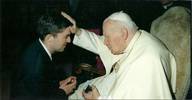 While there is no typical "road to the priesthood" story, some involve more miles than others. The journey of Father Mark Noonan is both extraordinary and inspiring and the road he followed was filled with twists and turns winding through Belize in Latin America and Rome, Italy before returning back to the Western New York area.
One of eight children, Mark Noonan grew up with five sisters and two brothers in Cheektowaga, NY. His family belonged to St. Aloysius Gonzaga Parish in Cheektowaga and he attended school there for grades K-8. He went to St. Joseph's Collegiate Institute for high school and graduated in 1994. In 1998 he graduated from the University at Buffalo with a dual degree in Political Science and Philosophy.
As a child, he thought of becoming a priest. This, he believes, was a consideration of many young Catholic boys at the time. Around the age of 14 or 15 years, young Mark's thoughts tended away from the priesthood and towards girls. During those years he played music and sang at church on Sunday with a group of guys he grew up with, which he credits with keeping him close to God. In high school and college he dated a lot but never quite found the girl he was looking for. After graduating from UB, Mark decided to try law school. He entered Cleveland-Marshall Law School right after college but would end up spending only one year there. Although he was quite successful as a student, God had other plans. When one opens himself up to the will of God, one must be ready to change course mid-stream.
While living in Cleveland, Mark joined a Catholic young adult group and found himself attracted to one of the girls in that group - a beautiful, happy, and deeply committed Catholic; just the type of person he thought could be the one for him. Some people mentioned that she attended Perpetual Adoration at the church they belonged to. They advised Mark that she usually showed up later in the evening to pray. Thinking he would run into her there, he began to go to that chapel late in the evening in hopes of meeting her, even though he did not yet believe that Christ was truly present in the Eucharist. However, every time he went there with hope of meeting her, she was not there. As time passed, and he spent many late nights praying in that chapel, he really began to grow in faith. The more time he spent in that Adoration Chapel, the less he came in hope of finding the girl and the more he began to believe that Christ was truly present before him in the Eucharist.
Just after Easter, during his second semester at law school, he went before the Blessed Sacrament late one evening and felt that it was truly God who was calling him to be a priest. For a moment he thought, "What about law school?" but when the moment passed, he thought, "I'm done with law school; it is over." Mark commented that, "It was really my belief in the Eucharist that led to my vocation. Once I started to believe what the Church professes, namely that Christ is truly and substantially present in the Eucharist, I knew I could do whatever he was calling me to do. And it was clear at that point that God was blessing me with the call to the priesthood."
Over the next year as he worked to pay off his student loans, Mark became familiar with a religious order called the Society of Our Lady of the Most Holy Trinity (S.O.L.T.) and decided to join them. In May 2001 he entered SOLT, a missionary community made up of Priests, Sisters, and Brothers. He spent his first year with SOLT teaching in Belize at the mission of Our Lady of Mt. Carmel High School. In 2002, SOLT sent him to their seminary in Rome. He and the other SOLT seminarians studied at the Pontifical University of St. Thomas Aquinas (The Angelicum), which is run by the Dominican Fathers. While there he had many incredible experiences including the opportunity to sing in one of the Papal Choirs, to meet Pope John Paul II, and to attend the canonization and beatification of many Saints and Blesseds, including Blessed Teresa of Calcutta. He was there when the Pope passed away, and following his death, Mark waited in line for seven hours to view his body. Upon finally approaching the casket, he spent an hour praying there in the middle of the night. A week later he and his brother seminarians slept on the street in order to attend the Pope's funeral. Father Mark was also present in St. Peter's Square on April 19, 2005 when the white smoke blew from the Sistine Chapel and Pope Benedict XVI was elected and introduced as our Holy Father. During those years Father Mark explained that he received countless blessings through the help and guidance of many saintly priests. In June of 2005, he graduated from the Angelicum.
During his time in Rome, Father Mark discerned that he was being called to serve as a parish priest. Although he loved the missions and missionary work, he did not feel at that time that he was being called to religious life. He decided to return to Buffalo in order to become a priest for our Diocese. Because of all the training he had already received during his years with SOLT, he only spent three semesters at our diocesan seminary, Christ the King in East Aurora. During his time there he was inspired, yet again, by the priests he encountered in our diocese, particularly Father Paul Seil as well as the current rector of the seminary, Father Peter Drilling – whom Father Mark credits with helping him transition to the diocesan life and into the priesthood. Father Mark loved the great fraternity he found amongst the Buffalo seminarians, particularly his friendship with his only classmate, Father David Baker. He describes the relationship amongst priests and seminarians as one where "iron sharpens iron."
He spent the summer of 2006 at St. Joseph's Parish in Albion and beginning in January 2007 he spent a year at Queen of Heaven in West Seneca. He was ordained a Transitional Deacon on April 20, 2007 and ordained to the priesthood on December 1, 2007 by Bishop Edward Kmiec. Father Mark was assigned first to Nativity of our Lord in Orchard Park and then to St. Amelia in Tonawanda where he currently resides.
In thinking about the priesthood, Father Mark mentions that being a priest is far better than he thought it would be, yet more challenging as well. He relates, "The day I was ordained a priest I just meant every promise I made so profoundly. I thought of all the great priest-saints who have inspired me, like St. John Vianney, St. Louis de Montfort, St. Edmund Campion and others on their ordination day, and resolved to follow their example and give myself completely to our Eternal Father. As the Second Vatican Council taught, ‘A man cannot fully find himself except through a sincere gift of himself', so I strive to give everything in myself to God and in service to his children on earth as a spiritual father. As priests, we belong to Christ so deeply. I just cannot imagine myself not having that depth of relationship with God. My heart is His forever!"
Father Mark particularly loves celebrating the Sacraments as they pour out God's graces on His people. When he says Mass at a nursing home, he sometimes just anoints all the participants when it is over. "They are all so elderly, sick and frail, it just means so much to them. They really love it!" he exclaims. Whenever he preaches on the benefits and importance of going to the Sacrament of Reconciliation, he inevitably finds that people thank him in the weeks that follow, telling him outside of the confessional that they had not been to confession in years, but feel their life has been restored to grace and peace through that Sacrament. Above all, Father Mark is thankful for the opportunity to be a conduit of God's grace.
The priesthood is a challenging life as well, one that involves trying to juggle many responsibilities. Father Mark feels that there are so many demands placed upon priests today and most people cannot imagine how much they are. He prays daily, and encourages others to pray that more and more young men in our diocese will answer "Yes!" to the call to serve as a priest.
An avid sports fan, Father Mark enjoys keeping up with his favorite professional teams including the Sabres, Bills, and Red Sox as well as playing a few sports himself. He likes to golf and he became a pretty solid soccer player during his years in the Seminary in Italy. He enjoys hiking and driving to places that are secluded so he can pray. In Italy he used to enjoy praying in the beautiful churches when no one else was there. He would often pray by the tomb of the patron saint of his home parish, St. Aloysius Gonzaga. He truly believes that prayer is the fuel that keeps him going. He prays a Holy Hour every day and is happy to live the promises of his ordination by praying the full Liturgy of the Hours each day. He commented that "if your prayer life is neglected, your identity will soon disappear and for a priest, nothing could be worse."
"Guys have no idea how glorious a life it is to be a priest; to be so close to God!" exclaims Father Mark. He explained that if a man feels called to the priesthood, he can be assured that it will be the pathway to the greatest happiness. "God's will always coincides with the deepest desires of our heart, even if we do not initially recognize it. So if you want to be truly happy in life, then seek out God's will and do it!" However, Father Mark is clear to relate that, "men should only make the decision to start out on the path to the priesthood in freedom and without pressure or coercion. Indeed, all of us are free to choose and follow God's call wherever it leads. Our task is to seek it with a sincere and generous heart. In order to discover God's plan, you must really look into your heart and ask the deepest questions. God will not fail to answer."
Father Mark invites all to join him each day offering the following centuries old prayer for vocations that more young men in our diocese will respond to the call: O God, who wills not the death of a sinner, but rather that he be converted and live. Grant, we beseech you, through the intercession of the Blessed Mary, ever Virgin, and all the saints, an increase of laborers for your Church, fellow laborers with Christ to spend and consume themselves for souls through the same Jesus Christ, Your Son, who lives and reigns with you, in the unity of the Holy Spirit, one God forever and ever. Amen.
March 2010 Priest of the Month - REV. TED JOST
 Edward F. Jost, Jr. was born in Kansas City, Kansas on February 15, 1961. Only one short year later he would be hospitalized for "osteomyelitis," a disease of the bone, and would spend the next several years in and out of the hospital. At three years old, Ted's family moved to Buffalo in the winter of 1964 and thankfully his condition was corrected. Since his father was an English professor at Canisius College, Ted's family moved nearby.
He grew up playing baseball in Delaware Park and in high school he served as a waiter at the priests' residence at Canisius. At the age of eight, Ted began talking about a vocation to the priesthood. Most people did not seem very supportive of the idea and it took a "back seat" to a new love, the arts. Because of his bone condition, he had to be careful about contact sports. He began drawing and painting and found that he had artistic talent.
When his brothers joined a local drama club, Ted discovered that, after the initial shock of standing in front of people, he really liked drama and he participated in several high school productions. Still, the idea of being a priest continued to present itself in his thoughts and prayers. He tried to put it out of his mind and, after graduation from high school, was determined to attend Niagara University which feature wonderful Theatre and Religious Education Departments.
During college, Ted worked as a carpenter for his first three years and helped to build the sets on which he performed many memorable roles, from Joseph in "Joseph and the Amazing Technicolor Dreamcoat" to Don Quixote in "The Man of La Mancha" to Hamlet in "Hamlet." After his third year at NU, he earned his membership in the Actors Equity Association (the stage actors' union) while performing as St. Peter in the 1982 Artpark production of "Jesus Christ Superstar." At the start of his final year at NU, Ted took a work study job as a Sacristan at the chapel and attended daily Mass, retreats, and missionary trips to the inner city of Philadelphia with his priestly mentor, Reverend Stephen Macher.
Even though thoughts of the priesthood were still with him, he decided to pursue a scholarship at USC in Los Angeles. He would spend four years there and four more in New York City, attending discernment retreats with the Vincentian priests and others while pursuing his acting career.
Finally, in the spring of 1990, he decided that the lifestyle of an actor was simply not what he was looking for. As much as he loved the "art," his life became a "business" and one that was not always in keeping with his values as a Catholic person. So he returned home to Buffalo and entered Christ the King Seminary in an effort to join the priests of the diocese and hopefully help others find their vocation in life. As he likes to put it, his experience "playing heroes" on stage helped him to actually want to become one in reality!
Father Ted was ordained a priest in 1996 and served his first few months of priesthood at St. Vincent de Paul in Springbrook. St. Vincent de Paul was the same parish he spent time in as a seminarian and a transitional deacon. From 1997 to 2000 he was assigned as a parochial vicar at St. Christopher in Tonawanda. He then served at Our Lady of Victory Basilica in Lackawanna from 2000 to 2003 and after that at Fourteen Holy Helpers in West Seneca until 2006. He was made pastor of the former Ascension Church in North Tonawanda and then administrator and pastor at the former St. Albert the Great. In 2007 the two churches merged to form St. Jude the Apostle where Father Ted is currently pastor.
It was during his time at St. Christopher's in 1998 that he created "The Parable Players," a group of teens who perform high energy, humorous adaptations of bible stories. These teens are from all over the diocese and they perform during the summer months in the green space outside of St. Joseph's Cathedral, at lawn fetes, parish picnics, nursing homes, and other events. Father Ted is still going strong with the Parable Players and enjoys the opportunity to combine his love of the priesthood with his love of the arts.
To any man considering a vocation to the priesthood, Father Ted advises them to ask themselves if the feeling of wanting to be a priest is something that keeps coming back. If it does, then he suggests talking with people who support the idea. Too often people who are well meaning may try to steer men away from the idea of becoming a priest. It is a good idea to find people who support vocations to the priesthood such as the Diocesan Vocation Director or the local Serra Club. It's also not a bad idea to look into entering the seminary to really see if it is for you, keeping in mind that you are free to leave at any time if it does not seem to be working out.
Most importantly, spend time in prayer asking God what it is He wants you to do. Father Ted spent several years pursuing other interests before seriously thinking about the priesthood. In some ways he feels like he lost those years that he could have spent as a priest, but in other ways he feels that the time was not wasted. He had a lot of life experiences which have made him a better priest in the long run. Living on his own taught him to budget his money which helps him as a pastor to budget the parish expenses.
Father Ted is very happy in his vocation as a priest. He finds it a privilege to be Christ to others. People think that the priesthood is such a solitary life but Father Ted feels just the opposite. "The priest is at the center of the parish family," exclaims Father Ted, who talks about his priesthood as "a life lived with and for others." Occasionally he finds it challenging to carve out time for himself. Another thing he finds somewhat difficult is maintaining friendships in an atmosphere where people's opinions vary about what a priest should be and who he should befriend. While negotiating boundaries within friendships is something we all deal with, it seems sometimes harder for priests because they are supposed to be there for everyone and not show favorites.
The call to priesthood was always there for Father Ted although he had other interests and talents. For Father Ted, being ordained to the Sacred Priesthood of Jesus Christ in his beloved Roman Catholic tradition was a lifelong dream and he is very happy with his decision. Like the late Pope John Paul II, a profound inspiration to Father Ted and many young men during his pontificate, Father Ted feels that spirituality and the arts are a perfect match. At their best, both search the depths of the human heart, seeking meaning and purpose in life.
February 2010 Priest of the Month - REV. MSGR. DINO LORENZETTI
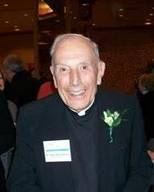 From his humble beginnings at St. Gerard Parochial School, Monsignor Dino Lorenzetti has accomplished a great deal in the service of Our Lord and others. He graduated from Hutchinson Central High School and went on to receive a degree at the Chown Business School of Canisius College. His education continued when he entered Christ the King Seminary which was located at St. Bonaventure University in Olean, NY at that time.
Dino J. Lorenzetti was born July 23, 1921 and with a mere 20 years of life under his belt, began his time of service to our country in the U.S. Army Air Corps during WWII from 1941 to 1945. He served in the United States, Africa, and Italy.
On May 30, 1953, he was ordained to the priesthood. He served as Associate Pastor at Holy Cross in Buffalo, Our Lady of Lourdes in Buffalo, St. Mary of Sorrows in Buffalo, Christ the King in Snyder, and St. Louis in Buffalo. In addition to his assignments as associate pastor and later pastor for several parishes, he served as the director of the diocesan Office of Family Life for nearly 20 years. Monsignor Lorenzetti also served on the advisory board of the National Family Life Bureau, was a moderator for the Foundation of International Cooperation and for the Diocesan Guild of Catholic Physicians, a member of the New York State Catholic Committee, and was active on the Interfaith Committee for the Buffalo Diocese. He also lectured for the Air Force, Army, and Navy in the Alaskan Command on education and family life. In January of 1968 he was given the Papal Honor of Very Reverend Monsignor.
Monsignor Lorenzetti went on to become Pastor at Holy Cross in Buffalo from July 1968 to June 1975. He then became the Pastor of Our Lady of the Sacred Heart in Orchard Park from March 1977 to July 1996. He officially retired in 1996, however, he has remained very active. Monsignor Lorenzetti lives at the O'Hara Residence for retired priests but travels the diocese to celebrate Mass and offer spiritual guidance, lightening the burden of his fellow priests whenever and wherever he is needed.
In 1992 Monsignor Lorenzetti received the Cure of Ars Award from Christ the King Seminary. This award celebrates the care of souls in the spirit of St. John Vianney who was the pastor, or Cure, of a small town in France called Ars. Monsignor Lorenzetti has been dedicated to the care of souls for 56 years and he shows no sign of slowing down. Among other distinctions, he has received the St. John Neumann Award from the Federation of Catholic School Parents, the Judge John D. Hillery Scholarship Foundation Award, the St. Christopher Award from the Catholic Youth Organization, the Spirit of Mercy Award from Mount Mercy Academy, and the Mater Christi Award from Immaculata Academy. On January 28, 2010, he was awarded the Bishop's Medal at the Making a Difference Dinner celebrating Catholic Schools. This award is well deserved as Monsignor Lorenzetti has influenced the lives of so many Catholic School Children in such a positive way.
Both his parents are deceased and Monsignor Lorenzetti has a brother and a sister. Both are married with children. He has many hobbies including travel, reading, and being interested in just about everything and everyone whom he encounters.
"The best part of my priesthood," Monsignor Lorenzetti shares, "would be administrating the Sacraments, preaching, and witnessing the gospel to the best of my ability." He continues, "To a vocation candidate I would say that in my 56 years in Priesthood, I have had many challenges and attractions to the married life, yet in no way would I exchange the joy of my vocation for any other."
A man who has been blessed with many years of life, Monsignor Dino Lorenzetti uses those years to bring God's people closer to Him. When preaching at Mass, he is often heard saying, "I love all you beautiful people!" - and he really means it! He has a great sense of humor and is always positive and optimistic. Monsignor David LiPuma recently remarked that, "Monsignor Lorenzetti is the kind of priest that others look up to and say, ‘That's the kind of priest I want to be!'" He truly believes and lives the ideal that it is better to serve than to be served.
January 2010 Priest of the Month - REV. SEAN DiMARIA
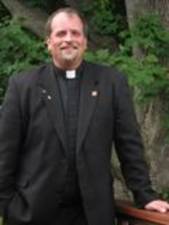 "Be honest with yourself" is the advice Father Sean DiMaria would give to anyone interested in becoming a priest. He knows from experience that following God's will and not your own is the only path to true happiness. Father Sean remembers well feeling called by God to be a priest as early as seven years old when he made his First Communion. Inspired then by Father Charles Slisz, he thought, "I want to do what he does, I want to be like him." Like a lot of men who feel called to the priesthood early in life, Father Sean didn't answer "Yes" right away.
The earliest years of his life were spent in South Buffalo. Baptized at Holy Family Parish, he went on to attend kindergarten at St. Agatha. The DiMaria family then moved to North Buffalo and became parishioners of Holy Spirit. Sean attended PS 81 for grades 1-5 and then he, along with his parents, older sister Joan and younger brother Mark, moved once again, this time to Lake View. His father passed away in 2008 and his mother still resides in Lake View as a parishioner of Our Lady of Perpetual Help. He attended the parish school, Southtowns Catholic, for grades 6-8 and graduated from Frontier High School in 1985.
Having been involved in the Lake View Fire Department since he was 16 years old, Sean set out to answer the call he had always felt to a life of service. He officially joined after graduating from high school at the age of 18. Along with his involvement at the fire station, he worked at Wendy's Food System, Inc. and then with his brother at Kruszka Flooring Co. He was employed at Sorrento Cheese from 1990 to 1996.
After high school, he fell away from the Catholic Church and the fire department filled his need for a sense of community. He remarked that it was during this time he felt he grew from a boy into a man. As good as it seemed to be, there was still something missing. He decided to make Mission at his parish and that became a turning point in his life. Not necessarily right away, but as time went on he felt that experience led him back to the Catholic Church. He remembers feeling embarrassed to start attending Mass again after having been away so long but he did return and he began to get involved. He taught Confirmation class in the parish and was inspired once more by a priest. Father Jim Bastian got him thinking again about the possibility of becoming a priest, a thought that never really left him completely.
Entering the seminary meant spending more time in school. Sean had never been a strong student and the thought of going back was not appealing. After discussing the possibility of priesthood with a friend, she told him he should at least look into it. They went to the Catholic Center in downtown Buffalo to talk to someone but it was closed. Feeling it was an omen, Sean thought that would be the end of it. His friend Kristen had other thoughts and drove him to Christ the King Seminary where he was able to speak to Monsignor Fred Leising. The rest, as they say, is history.
He attended Wadhams Hall College Seminary for four years of undergraduate Study. As daunting as it seemed, Sean described it as a wonderful experience. He really enjoyed his time there and felt he gained a great deal from it. The next four years were spent at Christ the King Seminary in East Aurora. He was assigned to St. Paul's in Kenmore for a summer and the following year as a deacon.
Ordained to the priesthood on May 28, 2005 Father Sean remembers thinking, "It's finally here!" He said there was a lot to remember during the whole ceremony but he felt absolutely sure he was doing what God had called him to do from the time of his First Communion. Ordained with him were Father Marko Ilnitskyi and Father Darrell Duffy. His first assignment was SS. Peter and Paul Parish in Hamburg. He spent three years there as parochial vicar and then moved to his current assignment as pastor of SS. Brendan and Jude Parish with worship sites in Almond and Alfred as well as Blessed Sacrament Parish in Andover.
Father Sean enjoys celebrating the Sacraments, especially the Eucharist. He finds the demands on his time to be great now that he is pastor of three worship sites. He knows it's important to carve out time for prayer no matter how busy you may become. He sometimes worries that his prayer life suffers with all the constraints on his time but he is conscious of keeping his priorities in line. His dog, Riley, has been a great companion and keeps him busy as well. When he gets the time, he loves to read and enjoys following hockey and sometimes football and other sports.
As stated earlier, he feels that vocation candidates should be honest with themselves. They shouldn't be afraid to look into the priesthood if they feel they are being called. He remembers feeling a great deal of support while he was in the seminary. The faculty and staff are there to help but seminarians should always feel they can leave if they don't think becoming a priest is what God is calling them to do. The seminary is a great place to discern the call to priesthood and it should be viewed not so much as a final commitment but rather as a continuation of a person's search. Father Sean feels it's tough for guys in today's world to consider priesthood because the culture emphasizes materialism and selfishness. He recommends, "If you want a life that's beautiful, look to serve God and others. You'll receive a lot of graces and blessings and you're sure to find real peace and happiness."
December 2009 Priest of the Month - REV. MSGR. DAVID G. LiPUMA
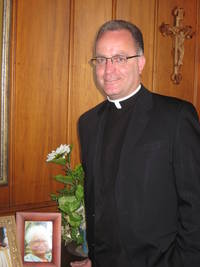 Monsignor David LiPuma will tell you that he probably wouldn't be where he is today if it was not for his grandmother, Grace LiPuma. She truly lived her Catholic faith by incorporating the Gospel values in all she did. She lived next door to David, his parents and two older brothers, and attended daily Mass. From the time he could walk, David would join her. She took young David by the hand and led him to Christ. Looking back, time spent at daily Mass was very influential in his decision to become a priest, as were prayer and time spent together as a family around the dinner table.
As far back as Father David can remember he was involved in one way or another at his parish. He was baptized in 1960 at Our Lady of Pompeii Parish by the then newly ordained Monsignor Robert Wurtz. From childhood, his life was enhanced by great models of priesthood. Monsignor Wurtz, who was there from the beginning, later became a great friend and mentor. Another positive role model was one of the Associate priests who served at Our Lady of Pompeii, Father John Sardina. One Mother's Day before David had even made his First Communion, Father Sardina took him by the hand and led him to the sacristy. He put him in a surplice and cassock and David joined his two older brothers as an altar server. From that point on he recalls that he wanted to become a priest. He later told Father Sardina that he put him in his first surplice and cassock and he is still wearing it to this day! He attended elementary school at Our Lady of Pompeii and went on to St. Mary's High School, also in Lancaster. During elementary school and high school, he worked as a paperboy.
After high school, he entered Wadhams Hall Seminary-College in Ogdensburg. Tragically, while he was there his mother passed away after a battle with cancer. Five months later, his father died from a heart attack. His grandmother then became both mother and father to David and his two older brothers.
He furthered his education at the North American College in Rome, Italy, where he studied at the Pontifical Gregorian University and San Anselmo University. On his ordination day, July 25, 1987, Father David remembers leaning over to hold the hand of his then 87 year old grandmother. He thought, "You're the one who led me by the hand to this church and now you're here to see this!" She lived to be 104 years old, almost twenty years after Father David's ordination. He smiles as he recalls that she wanted to make sure he was well grounded in the priesthood before going on to her eternal reward. That year there were five men ordained to the priesthood by then Bishop Edward D. Head. Each man was ordained on a separate day in his home parish.
After ordaining Father David, Bishop Head assigned him to serve as parochial vicar at St. Leo the Great Parish where he spent three years. He was then assigned parochial vicar and assistant to Bishop Edward M. Grosz at St. Philip the Apostle Parish in Cheektowaga where he spent another three years.
In 1993, he became acting director of the Office of Worship and Catechumenate. He became director in 1995. Father David was given an additional assignment in 1993 as chaplain to the Carmelite Nuns at the Monastery of the Little Flower of Jesus on Carmel Road in Buffalo. To this day he celebrates Mass there and it is one of the highlights of his priesthood. The Carmelite Sisters are very dear to Father David and they hold a very special place in his life and ministry as a priest.
Bishop Henry J. Mansell announced in 1997 that he was appointing Father David LiPuma to the positions of secretary to the bishop and vice chancellor. Eleven years later, Father LiPuma still serves in that capacity. Bishop Edward U. Kmiec bestowed upon Father David the title Monsignor in 2008. Having joined many years ago, he became a fourth degree Knight of Columbus in 2008 as well.
Monsignor LiPuma enjoys many aspects of his priesthood. When he was assigned to parish life, he loved the give and take with people. Greeting people at the doors of church, being with people during good times and in their struggles, getting to know them and becoming a part of their lives were all extremely rewarding aspects. He finds being secretary to the bishop a very unique ministry. Father David enjoys visiting the parishes of the diocese with the bishop for Confirmations and other special occasions. He views parish life as the heart of the diocese. His admiration is great for the priests who minister in our parishes day in and day out working with people and being present and Christ-like to them often quietly and without a lot of recognition. As a priest you get to bring Christ to the people through the Sacraments, and most especially in the Sacrament of the Eucharist and you, in turn, bring the people to Christ as they grow in their faith and knowledge of God and the Church. He feels it is a great life!
The priesthood also has its challenges, especially in the very secularized society in which we live today. Father David realizes it is important to be real with people and sometimes difficult to deal with so many different personalities. You have to be secure in yourself and realize that you can't please everyone. Fr. David finds it disappointing that fewer and fewer Catholics participate in the Sacrament of Reconciliation. It is so healing and helpful and yet people have lost sight of its value. There are so many distractions in people's lives. A real challenge of priesthood, according to Father David, is trying to help people see the Church as relevant in their lives. He believes that if people felt more connected to the Church, they would be more interested in coming and being a part of it.
Physical exercise is an important part of reducing stress for Father David and walking provides much needed relief. He also enjoys spending time with family and friends and traveling.
All in all, Monsignor David LiPuma finds his life as a priest to be very satisfying and meaningful. As a Catholic who believes in the body, blood, soul, and divinity of Jesus Christ in the Eucharist, being called to the priesthood is an honor and a privilege. At the end of the day it's rewarding to be able to say you have given your life to God. He often finds that he helps people in ways that he isn't always aware of just by being present to them. Father David believes that a good prayer life is irreplaceable. One's relationship with Christ is the most important connection he will ever have and spending time in prayer is the best way to nurture that bond. Without it, priests as well as lay people can become empty and ineffective.
If you've ever seen him in action, you can't help but appreciate all that it takes to make the events of the bishop look so seamless and smooth. Led by the hand of his grandmother to Christ, he now lends a hand as a servant of Christ to others.
November 2009 Priest of the Month - REV. MICHAEL UEBLER
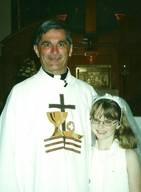 After completing an Associates of Science Degree in Engineering Science at Erie Community College, Michael G. Uebler was all set to go to the University at Buffalo or Syracuse University to complete his studies for a career in Chemical Engineering when thoughts of the priesthood started to surface. Deciding to look into this first, he entered Wadhams Hall Seminary College in Ogdensburg, NY and eight years later was ordained a priest by then Bishop Edward Head.
Reverend Michael Uebler or "Father Mike" as he is known grew up in Cheektowaga along with three brothers and three sisters. He attended Infant of Prague Elementary School and Bishop Neuman High School. The Franciscan Sisters from Williamsville taught him at both schools. Later, Father Mike would teach at St. Mary's High School in Lancaster with the same Franciscan Sisters. Even to this day, one of his parishioners, Sister Pat Hartley, is a great help to him. He expresses much gratitude for the presence of the Franciscan Sisters in his life.
Ordained on December 12, 1982, Father Mike's first assignment was to St. Edmund's Parish in Tonawanda as a Parochial Vicar. Youth ministry was his main responsibility. This led to a teaching position which lasted for nine years at St. Mary's High School in Lancaster. While there, he worked in Campus Ministry, directed Student Services and Student Retreats, and taught New Testament. One of Father Mike's greatest joys is performing wedding ceremonies for his former students.
His next assignment, after St. Mary's High School, was as pastor in Arcade and East Arcade for seven years. He was impressed by how important Church was to the people in that area and he loved being part of those small communities.
Presently, Father Mike is the pastor of St. Francis of Assisi Parish in Tonawanda. He feels that this parish is a very important part of the City of Tonawanda. He visits the school every day and works closely with the Generations of Faith Program. Father Mike enjoys sharing in people's lives through the sacraments and fortunately there is a lot of sacramental work at St. Francis. How fitting that he should become pastor of a parish that shares the name of the order of Sisters who influenced his life so positively!
Father Mike's second cousin, Luke Uebler, is presently studying at St. Mark's Seminary/Gannon University in Erie, PA. Father Mike enjoys the priesthood and is very happy to have answered "Yes" to God's call. He hopes and prays that Luke and all those studying for the priesthood will experience that same joy.
October 2009 Priest of the Month - REV. MSGR. RUPERT WRIGHT
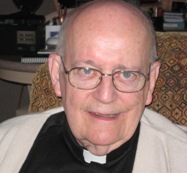 A self described "people person," Monsignor Rupert Wright loves his priesthood which is certainly evident in the number of other priests as well as lay people he has positively influenced.
He was born on January 16, 1930 and grew up in Jamestown, NY. The first-born son of an English-Irish father, Rupert Aloysius Wright, and an Irish mother, Catherine Barrett Wright, he would later be joined by two brothers, Richard and Julian. His father operated a clothing business, Wright's Fashions, and the family lived in the same home in which his mother, Catherine, was raised. Eventually, Richard became an orthodontist. He and his wife Carolyn live in Fredonia, NY. Julian, who died suddenly at the age of 50 in 1986, was owner and manager of the family business, now called Wright's Suburban Stores in downtown Jamestown, the Lakewood Mall and the Millcrest Mall in Erie, PA.
Young Rupert attended SS. Peter and Paul Parochial School in Jamestown. The Sisters of Mercy, who taught him throughout elementary school, had a great influence on his formation leading to his priestly vocation. He attended Jamestown High School and was accepted at Georgetown University to study Law. Two factors came into play which changed his plans concerning Georgetown. First, he received a state scholarship which restricted the colleges he could attend to those in New York State. Second, and probably most importantly, he attended a men's retreat at the Columban Center in Derby, NY toward the end of his senior year in high school where he felt he was being called to the priesthood. Monsignor Wright considers senior year in high school to be a very "touchable moment" in life for most as it is then that people begin to seriously consider what they would like to further study and some day become. He enrolled in Niagara University for two years in the College of Arts and Sciences and then entered the Seminary of Our Lady of Angels located on the campus of Niagara University. The Seminary predates the university itself. He received his Bachelor of Arts degree in 1952 and after four years as a seminarian, was ordained a priest on May 26, 1956 at St. Joseph's New Cathedral by Most Reverend Joseph A. Burke, D. D.
Father Wright's first assignment was to the Missionary Apostolate. He was named Chaplain of Cattaraugus and Allegany Indian Reservations and Administrator of St. Isidore Parish in East Otto. In Lent of 1957, he was assigned to St. Stephen Parish on Grand Island as an associate to Monsignor Edward Schwegler. After Monsignor Schwegler was critically hurt in an automobile accident, the young Father Wright became the administrator and ran the parish for five years. For the next five years he was Parochial Vicar at St. Mary Magdalene at Fillmore and Urban on the east side of Buffalo. At the time, it was an old German Catholic parish of 1,000 families but changing times have resulted in its current status as the Antioch Baptist Church. From Buffalo's East Side, he moved to South Buffalo in 1968 as Parochial Vicar at St. John the Evangelist. The pastor at St. John's was ill and Father Wright was challenged to supervise the building of a new convent.
While serving as Parochial Vicar at the various parishes, Father Wright took on additional responsibilities in the diocese. He became the Diocesan Director of the Legion of Mary from 1967-1973, a member of the Senate of Priests in 1970, serving as its president from 1973-74. In 1973 Bishop Head appointed Father Wright to a one year term on the College of Consultants. At that same time he was serving on the Priests' Retirement Board and a year later on the Priests' Personnel Board.
He suffered deep personal loss in 1973 with the death of his mother and in 1975 with the death of his father. 1975 also brought good news when Father Wright was appointed by Bishop Head to his first pastorate at St. James Major in Westfield and then in 1977 as the Coordinator of the Priests' Personnel Board. He received his first papal honor in 1980 when he became "Reverend Monsignor" Rupert Wright. In 1982 he went on to become the second pastor of St. Amelia Parish in Tonawanda, one of the largest parishes in the Buffalo Diocese. He continued to serve the diocese outside of his busy life as pastor in 1982 by becoming a member of the Diocesan Finance Council. From 1985-86 he served on the Pastoral Council. From 1984-89 he was a member of the Priests' Council and from 1984-86 was Coordinator of Region 17 (now referred to as "Vicariates" rather than "Regions"). In 1986 he became a member of the Television Advisory Board. Also, that year he would experience the tragic and sudden death of his younger brother, Julian.
He served as pastor to the 3,000 families of St. Amelia's for 12 years. By that time it had become the second largest parish in the diocese. In 1994 at the age of 64, Monsignor Wright moved on to become pastor of the largest parish in the diocese, St. Gregory the Great, with its 5,000 families. Some were surprised that he would want the responsibility of such a large parish but he commented that, "In this day and age, it's easier to run a big parish than a small one. There are pressures, yes, but you have bigger staffs and a bigger pool of volunteers." No doubt, his earlier experience of running parishes when the pastors became unable to do so, prepared him well. He was very appreciative of the help he received at the parishes he served and never hesitated in listening to good advice. He cited God as the most important thing and only reason for parish administration and organizations.
A humble, inspirational, lovable, priest, Monsignor Wright has a way of bringing out the best in people as he brings them closer to God and His Son Jesus Christ. St. Gregory the Great was fortunate to have Monsignor Wright as their pastor for 12 wonderful years. While he was at St. Greg's he received several awards: The Cure of Ars Award from Christ the King Seminary in 1997 and both the Bishop's Medal from Most Reverend Edward U. Kmiec and the Humanitarian of the Year Award from the Brothers of Mercy in 2005. In 2006, as he celebrated 50 years of priesthood, the "Celebrate Catholic Education" Medal was presented to him at the 6th annual Celebrate Catholic Education Dinner.
Retired July 16, 2006, Monsignor Wright lives at the O'Hara Residence, a retirement home for priests. He enjoys the companionship of the other retired priests in a setting where they have their own apartments yet come together to share meals and prayer. They have a genuine care and concern for one another. Monsignor Wright still helps at St. Andrew Parish in Kenmore whenever he can. He considers the best part of priesthood to be saying Mass and administering the Sacraments. He feels that the Sacraments are not emphasized enough and therefore can be overlooked in their importance. Looking back, the most challenging part of priesthood was keeping up with the many ministries he was responsible for as pastor. He felt pressured to ration his time so he could fit everything in.
To those who may be interested in the priesthood, Monsignor Wright advises a good prayer life. He reminds them that they will always be drawn to be married and have a family so there are certain things they will have to do without. If they can relate well to people (as Monsignor Wright surely does), they will find the warmth and love of a family in their parishioners through the grace and blessing of God.
September 2009 Priest of the Month - REV. JAMES KIRKPATRICK
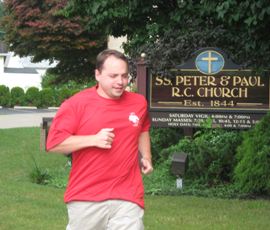 Having just completed his first year of priesthood, Father Jim Kirkpatrick expressed his happiness at having answered "yes" when God called. SS. Peter and Paul in Hamburg is his first assignment as a priest. Spending a year in a large parish has given him lots of experience saying Mass, hearing confessions, baptizing, and presiding at weddings and funerals.
Growing up in Sanborn, NY, Jim was greatly influenced by Father Herold Nuwer who was then pastor of Immaculate Conception Church in Ransomville. From the time Jim was about ten years old until he was well into his seminary studies, Father Nuwer was the pastor at his hometown parish. Jim was youngest of the five children born to Judy and Jim Kirkpatrick. Welcoming him into the world on July 21, 1979 were his sister, Jamie and three brothers, Dennis, Billy, and Greg. He attended Colonial Village Elementary School and Niagara Wheatfield Jr. and Sr. High School. He then went on to Canisius College and spent one semester as a Biology major. After that he switched to Political Science. He thought he would become a teacher or professor some day.
Jim worked the same steady job summers and school breaks from the age of seventeen until he entered the seminary. He was employed at Yankee Doodle Brochure Distributors, a local family owned business. The owner, who was also a parishioner, asked Father Nuwer if he knew of a reliable young person who would make a good employee. He recommended Jim who held that job for the next seven years distributing brochures all over Western New York.
About halfway through his junior year in college, Jim felt called to the priesthood. He had thought about it before, having discussed the idea with Father Nuwer, his mother, and grandmother. Looking back, he remembered knowing lots of great priests when he was growing up. It was appealing to Jim to serve God like they did. He spent time praying about his future, talking to friends and family, as well as Father Leon Biernat, the vocation director at the time. After graduating from Canisius College in May of 2002, he entered Christ the King Seminary in August of the same year. Although still somewhat unsure about becoming a priest, he was willing to give it a more serious look.
Jim's pastoral year was spent at St. John the Baptist Parish in Lockport. He was assigned as a deacon to St. Benedict Parish in Eggertsville. His first summer assignment as a seminarian was to St. Vincent de Paul Parish in North Evans. He had very positive experiences at all the parishes he was involved with. On ordination day, May 17, 2008, Father Jim remembers being very happy. He was just taking it all in, absorbing all that was going on, and enjoying being in the moment. Bishop Edward U. Kmiec ordained him and two of his classmates, Father Jim Fugle and atheF. Bob Zilliox. Father Jim Kirkpatrick was thrilled to share the day with two of his good friends.
Father Jim enjoys the company of the people he serves at SS. Peter and Paul and is happy to be a part of their lives. He finds it a real privilege to be with people during important moments such as their weddings, baptisms, and even funerals. It's comforting to know that when they look back on these times they will remember the priest who celebrated their joys with them and mourned their losses.
Priesthood has its challenges and for Father Jim it is sometimes difficult to counsel those who need help. While he is very knowledgeable in many areas, his experience is limited by his youth. This is a challenge that will surely dissipate with time.
Father Jim enjoys the company of his fellow priests, especially his classmates, on his days off. He joins them for lunch and sometimes a movie. He also spends time with his parents, siblings, as well as four nieces and two nephews when he gets the chance. He likes to play video games, assemble and paint models, read and write short stories. He enjoys running as a way to stay in shape and alleviate stress. Father Jim follows college football, baseball, soccer, and auto racing.
To those considering the priesthood, Father Jim advises listening to God as well as trusted family and friends. He encourages everyone to develop a good prayer life, especially those discerning priesthood. He feels people should always take decisions, large and small, to prayer and not just think about them analytically. If men allowed the influences of society to pull them away from what they felt called to be, no one would become a priest! For Father Jim, the priesthood has given him the opportunity to make a positive impact on society, particularly those to whom he ministers. So far it has been a wonderful life and it has given him opportunities to do things he would not have otherwise done like ministry to prisoners and the poor. He finds it a humbling experience to preside at the Liturgy of the Eucharist.
Having expressed the desire to be a teacher and a writer, Father Jim has joyfully discovered that through his priesthood he is able to be both. Being open to God's plan has led him to great happiness. Father Jim feels that it is extremely fulfilling to be a priest and that there is nothing else he would rather do.
August 2009 Priest of the Month - ST. JOHN VIANNEY
 Because our Holy Father, Pope Benedict XVI has declared this the year of the priest, our featured priest for the month of August will be…
|
ST. JOHN (Jean-Baptiste-Marie) VIANNEY The Curé of Ars Patron Saint of Parish Priests |
On May 8, 1786 John Vianney was born in the quiet town of Dardilly, France, close to Lyons. His was a simple life. He was the son of Matthew and Marie Beluze Vianney, farmers in their small town. His education was limited to a smattering of several different subjects and he found the study of Latin to be particularly difficult. As the violence of the Revolution aged on, Catholicism was outlawed causing priests to flee for their lives and Mass to be celebrated in secret wherever possible. John's father, Matthew, often harbored priests on the run and the family would sometimes set out in the middle of the night to attend Mass in a nearby barn.
Although his education was lacking, he was extremely advanced in matters of spirituality. His love and admiration for those brave, holy priests planted seeds of a vocation in young John's heart. The bells of Notre Dame rang out on April 18, 1803 announcing the resurrection of Catholicism in France. This opened the door for John and others to study for the priesthood. In 1813, after only two months of study in the major-seminary, he was dismissed for his inability to master Latin. With a little help from Father Bailey, Curé (Pastor) of the church that the Vianney family attended in nearby Escully, John was readmitted to the seminary andonce again he was dismissed. Father Bailey pleaded with the Vicar-General, citing John's great devotion to prayer and the Church. John was allowed to continue his studies. With much help and some compassion for his academic weaknesses, John was ordained to the priesthood on August 13, 1815 by Monsignor Simon who was Bishop of Grenoble.
Father John's first assignment was to Escully to assist Father Bailey, the priest who first recognized and encouraged his vocation, urged him to persevere when things seemed impossible, and interceded when others had dismissed the idea of him ever becoming a priest. Father Bailey was a true mentor and friend to Father John. In 1817 Father Bailey died leaving Father John Vianney extremely distraught. He later wrote, "I have seen some beautiful souls, but none so beautiful!" He mentioned his mentor's name in prayers at Mass every day.
In February of 1818, Father John Vianney became the Curé of Ars, a small town in France. Twenty-two miles from Lyons with only sixty families, Ars was considered the Siberia of the diocese. As Father Vianney spent time visiting those sixty families, he came to realize that most of them had become lax in the practice and beliefs of their Catholic faith. This disturbed him greatly and he began to work the teachings and truths of the Catechism of the Catholic Church into his homilies. At first, his attempts were met with much anger and criticism because the parishioners had become comfortable with their sinful ways of life and resistant to change. With much prayer and fasting, Father Vianney was able to elicit, through God, the conversions he so desired. He would often spend hours in front of the Blessed Sacrament, deny himself food, and sleep on the floor in an effort to attain graces and blessings for his parishioners.
As time passed, taverns started closing and people began to desire more virtuous, holy lives for themselves. This pleased the Curé of Ars a great deal but it did not come without cost. There were those who remained defiant and insisted on making trouble for Father Vianney by sending letters of false accusation to the Bishop's office and causing inquiries to be made concerning his behavior. Later in his life, Vianney wrote, "If on my arrival in Ars I had foreseen all that I was to suffer there, I would have died on the spot."
People experiencing conversions started coming to him in droves seeking the sacrament of confession as well as his advice and insight into their problems. They began coming first from his parish, then from all of France and eventually other parts of the world. During the last ten years of his life, he spent from sixteen to eighteen hours a day in the confessional. His bishop forbade him to attend the annual retreats of the diocesan clergy because of "the souls awaiting him yonder." The number of visitors to his confessional reached twenty thousand a year in 1855. By 1859, the last year of his life, the number grew to 100,000. So profound the enlightening was his advice, people sometimes waited three days to have him hear their confessions. With his blessing and encouragement, Mother Marie de la Providence founded the Helpers of the Holy Souls.
In spite of his humble beginnings and lack of education, Father John Vianney transformed the lives and souls of so many people from all walks of life. He remained humble and dedicated to prayer and fasting throughout his life. It has been said that his was the fuel he used to continue his ministry to so many. He died on August 4, 1859.
Many miracles were attributed to him including obtaining money for his charities and food for the orphans in his care, supernatural knowledge of the past and future as witnessed in his advice during confession, and healing the sick, especially children. He was quoted as saying, "Man is a beggar who needs to ask God for everything...a pure soul can ask everything from God, even miracles, and He will refuse him nothing." His greatest miracle of all was the way he lived and served God during his life. His greatest motivation was not saving his own soul but the souls of others. Clearly though, his own soul was purified beyond imagination in the process.
Pope Pius IX proclaimed him Venerable on October 3, 1874 and on January 8, 1905 he was enrolled among the Blessed. Pope Pius X declared him to be a model for all parish priests and he was canonized a saint in 1929 by Pope Pius XI. His feast day is celebrated on the date of his death, August 4, and so it is fitting that this holy, patient, gentle, insightful, exemplary priest be honored as our priest of the month for August.
July 2009 Priest of the Month - REV. MSGR. LEO McCARTHY
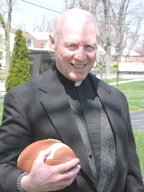 On November 19, 1932 a servant of God was born. Leo McCarthy became the eighth child in a family that would eventually grow to twelve. Leo started life in Springbrook, NY, was baptized, made his First Communion and completed his first four years of school at St. Vincent Parish. His father referred to him as the "wonder boy" because he said he always "wondered what that boy" would become.
His family then moved to Alden, NY where St. John the Baptist Parish became like a second home to him. He had a strong Catholic family. His father and his grandfather on his mother's side greatly influenced who he would eventually become. Catholicism was woven into everything they did. The pastor of St. John the Baptist parish at that time was Father Bertrum Trautman, whose nephew would later become Bishop Trautman. Father Trautman had a great impact on Leo's young life, especially while serving as an altar boy. After his eighth grade graduation he entered the Minor Seminary called St. Joseph the Little Flower where he boarded because of the distance between Alden and Buffalo. Monsignor Paul Juenker was an exceptional mentor for the young Leo at the Minor Seminary.
He went right from the Minor Seminary to the Major Seminary of St. Bonaventure. While at Bonaventure, his father passed away at the young age of 57. Leo was able to visit him shortly before he died. His father told him not to leave the seminary to take care of the family because God would provide and he would better serve people as a priest.
He was ordained at St. Joseph's Cathedral by Bishop Burke on February 21, 1959. In those days, the men were ordained but then had to return to the seminary for a few more months to finish their education before being assigned. In that interim they could say Mass but could not hear confessions. As he lay prostrate on the floor of the Cathedral during his ordination ceremony, Monsignor Leo recalled that when he was about four years old his father told his older brother "Bud" that when he became a priest he would buy him his first chalice. Little Leo told his father that it was not Bud but he who would eventually become the priest. His father told him it would be a cold day before he would be ordained. The 21st of February turned out to be quite bitter and stormy and many people didn't even make it to the ordination due to the weather. It was indeed a cold day just as his father had predicted!
During the summers between the years of school in the Minor and Major Seminary, Monsignor Leo worked as a dishwasher in a restaurant, did various neighborhood jobs such as cutting lawns and bringing wood to stores earning one cent for each piece he delivered. He worked at a lumber mill and did dry walling and roofing. It was even more backbreaking work in those days because they didn't have the equipment that exists today.
After his ordination, Monsignor Leo recalled that Monsignor Richard Nugent had a very positive impact in his life as a priest. Monsignor Leo's mother (another incredible influence in his life) gave him a very special blessing the morning of his first Mass before they left for St. John the Baptist Church. He cherishes that blessing to this day.
Monsignor Leo's first assignment as a priest was at St. Mary in Little Valley where he spent one year. He then spent five years at St. Teresa's in South Buffalo and then went to St. James in Depew. While at these parishes, he became very involved with the youth. He coached football, track, and various other sports. Being musically inclined, Monsignor Leo led the St. Teresa Boys Choir, "The Savios". Their recordings can be found on CD today. He was in charge of the altar servers at these parishes as well.
He was "temporarily" assigned to St. Joseph's Cathedral for the next ten years where he continued to reach out to the youth in a positive way through sports and music. While at the Cathedral, he became involved in the Police Athletic League (PAL) where he once again took up coaching as a way to reach the youth. He explained that he didn't go to be one of them, rather he went so they could be one with him. While at the Cathedral, Monsignor Leo was chaplain for the boy scouts, the Buffalo Police and Erie County Sheriffs, the Port of Buffalo, the Catholic telephone and postal employees, and also served as Great Lakes area chaplain.
During his priesthood he was very interested in promoting vocations and was a vocation counselor in South Buffalo as well as at St. Mary High School in Lancaster. He was the Holy Name Moderator for the West Side of Buffalo and eventually became the Diocesan Moderator. He was very involved in the Serra Club of Buffalo whose main focus is promoting vocations to the priesthood and religious life. This came about because of his involvement with the altar servers. He believes that bringing boys into that atmosphere at church has a great impact on them.
He recalled a time when he was an altar server. He loved to serve Mass and one day, arriving early, decided to try on the priest's vestments. He was checking his look in the mirror when he noticed the Mother Superior, who was principal of the school, standing behind him. Her first response was, "Leo, what are you doing??!" Too scared to answer, he didn't say a word. Then she asked him if he wanted to be a priest and he responded, "No, I want to be the pope!"
Monsignor Leo couldn't recall a time when he didn't want to be a priest. He noted that priests don't really need altar servers, it's the altar servers who need the priests. The Mother Superior who found him dressed as a priest at such a young age supported him in many ways and encouraged him. She told him she would be an old nun hobbling down the aisle with her cane at his ordination. As it turned out, she was in the hospital at the time, and after his ordination Monsignor Leo made it a point to visit her and give her his blessing. She couldn't come to him so he went to her. Years later, at her request, he also presided at her funeral Mass.
After his time at the Cathedral, Monsignor Leo was assigned his first pastorate at St. Matthew Church on the east side of Buffalo. Here he also had a choir and headed up the altar servers. When asked about the most challenging part of priesthood, he recalled an incident while coaching inner city children where there was not a lot of structure in the families. Sometimes he would have only a few kids show up for a practice and sometimes more. One day a man approached who seemed to be under the influence of both drugs and alcohol. He was swearing out loud and disrupting the practice. One of the boys said to Monsignor Leo while they were in a huddle, "We don't talk like that, do we, Father!" That kind of response made the challenges seem worthwhile.
It was also challenging, as a pastor, to maintain the Catholic schools but worth the effort. The financial aspects of keeping a school running can be overwhelming, yet Monsignor Leo noted that Catholic schools are about more than just money, they are about the heart and soul of the young. He insisted that anyone who wanted their children to attend Catholic school and couldn't afford it should come and see him. He always found a way to make it work for them.
Back in the seminary, Monsignor Leo expressed a desire to become a missionary priest. Both Monsignor Juenker and Monsignor Leo's father encouraged him to see the missionary work that needed to be done right here in his own back yard. His assignments, especially at St. Matthew's in the central city, made him realize the truth in that advice. He remained there for ten years and then it was on to his next assignment as pastor of Immaculate Conception in Wellsville where he stayed for seven and a half years. St. Joseph's in Batavia was home for the next thirteen years where, of course, he became involved with the choir, altar servers, and coaching.
He reluctantly retired from St. Joseph's and is now living at Blessed Sacrament Parish on Claremont Avenue in Tonawanda. Still a very vibrant, active priest, he makes time to mentor the youth. On February 21, 2009 Monsignor Leo McCarthy celebrated fifty years of priesthood. He considers the heart and summit of the priesthood to be the celebration of Mass. One of the greatest rewards for him is the opportunity to be present to the youth who so desperately need good role models. He considers it a blessing to be able to give back to the community, most especially the youth, the enthusiasm and joy he receives from his life as a priest.
On advising young men to consider the priesthood he tells them not to worry so much about what they want to be but rather, pray to know what God wants them to be. So many times people are afraid to follow God's will because they think they will not be happy. Monsignor Leo then asks, "Why would God, who loves you so much, want you to do something that will make you unhappy?" Exemplifying many of the caring, nurturing qualities of Pope John Paul II, he did, in a way, finally become a pope!
June 2009 Priest of the Month - REV. MSGR. FREDERICK D. LEISING, Ph.D.
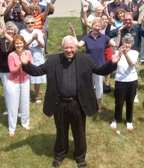 I began my life in the Clarence Center / Swormville area of Erie County. So, my roots were agrarian, both of my grandparents being farmers. I am the eldest of five children. My father was a block / bricklayer and carpenter. My mother was a housewife. I had two sisters and two brothers. One brother and sister are deceased, dying together in an auto accident in 1964. My father died in 2005. My mother still lives.
St. Mary, Swormville was my original parish. I attended several grammar schools since my dad's work led to frequent moves. I graduated from eighth grade from St. Mary, Swormville. I spent six years as a boarder and student at the Diocesan Preparatory Seminary, 654 Dodge Street in Buffalo. I then spent six years at St. John Vianney Seminary in East Aurora. Post ordination I matriculated in graduate studies in philosophy at Notre Dame University. I have two graduate degrees; one in theology and one in philosophy.
I was ordained on May 29, 1971 at St. Joseph New Cathedral by Bishop James A. McNulty. My first Assignment was as parochial vicar at Fourteen Holy Helpers parish in West Seneca. In 1976, I went to Batavia and taught at Notre Dame High School for a decade. I then became pastor at Assumption, Portageville and St. Mary, Canaseraga, for one year.
Sent to Christ the King Seminary, in 1987, I was Director of Formation for seminarians, Vice-Rector and instructor in philosophy. In 1990, I became seminary Rector for six years.
In 1996, I was made pastor at St. Mary, Lancaster and in 2003, pastor of Nativity of the Blessed Virgin Mary, Clarence; my current assignment.
I enjoy golf and hiking in the summers and I am an avid reader.
The best component of priesthood is meeting and serving a wide variety of people, especially in liturgical settings. Those most challenging component of being a priest is relating profoundly with people through their experiences of loss, rupture, suffering and tragedy.
I became a priest to minister to people in a multitude of ways, as well as to cumulatively grow in embracing the mystery of life. I encourage eligible candidates for priesthood. It is a rewarding life that persistently challenges you to grow into Christ and the communities you serve.
May 2009 Priest of the Month - REV. LEON J. BIERNAT
 This month marks the 17th anniversary of Father Leon J. Biernat's ordination to the Priesthood. His main focus has been bringing young people closer to Christ and His Church. Whether through altar serving, the Life Teen program or various other clubs and organizations he either started or became involved in, young Catholics have benefited from his boundless energy and zeal for the Faith.
The son of Leon and the late Sophie Biernat and brother of Cathy, who is married with two children, Father Leon is a product of the Black Rock section of Buffalo and most especially, Assumption Parish. He received all of his sacraments at the very parish where his family has belonged since the late 1800's. Father Leon graduated from Assumption Grammar School (now Our Lady of Black Rock), Riverside High School, and received a bachelor of science degree in Accounting from Canisius College in 1987.
He entered Christ the King Seminary upon finishing college and graduated with a Master of Divinity Degree in 1991. He was ordained a Deacon on June 22, 1991 at St. Joseph's Cathedral and assigned to Nativity Parish on Main Street in Clarence (Harris Hill). On May 30, 1992, he was ordained a Priest at his home parish and assigned to serve as parochial vicar at Holy Spirit Parish in North Buffalo on June 12, 1992.
After serving three years at Holy Spirit, Father Leon was transferred to St. Amelia Parish in Tonawanda. When he arrived at St. Amelia's there was a small Life Teen program of 20 young people. Four years later as he left the parish there were over 250 high school teens in a four day a week program of weekly teen Masses, education nights, socials, athletic teams, teen prayer groups, trips, and retreats. His success was recognized as he was honored by the Diocesan Union of the Holy Name Societies in 1998 and the Town of Tonawanda which in 1999 presented Father Leon with the Joseph Allen Jr. Award for Outstanding Service to Youth.
On February 19, 1999, Father Leon was appointed Director of Vocations by Bishop Henry Mansell. He joyfully began the ministry of promoting and encouraging men to consider a vocation to the Priesthood and Consecrated Life. With a great deal of energy and enthusiasm, he embarked on new and innovative ways of emphasizing the attractiveness of a life lived for Jesus Christ. Father Leon established both the St. Joseph Club for High School aged young men and the Response Club for college aged men to discern a call to the priesthood. He embarked on billboard campaigns, television and radio advertising, and even lighted signs at HSBC arena and at the Galleria Mall. For about eight years he traveled extensively to parishes, parochial schools, Catholic high schools, parish religious education programs, Confirmation programs, and college campuses to let young men everywhere know that God is calling and that they should "be not afraid" to answer.
In addition, Father Leon helped form new initiatives across the State of New York for Vocation Promotion including a program for parents to understand church vocations and an annual retreat for college men wishing to discern the Priesthood. The Altar Server of the Year Award was enhanced greatly by Father Leon as it grew into a large scale luncheon at the Buffalo Convention Center immediately following the Mass with our Bishop at St. Joseph's Cathedral.
The advice Father Leon gives to those who show an interest in the priesthood is generally to pray, get involved in parish activities and an age appropriate group to increase awareness of what priesthood is all about. When speaking to teens, he encourages them to enjoy high school, play sports, get involved in clubs, date, etc.; with college aged men he advises them to pursue their field of interest while discerning; and for adults Father Leon encourages the idea of setting a time line in order to put some sort of limit on making the decision whether or not to enter the seminary. Once in the seminary, Father Leon advises men to give it at least a year as this too is part of the discernment process.
As a result of his efforts and accomplishments, Father Leon has received much recognition. The Serra Club, a worldwide Catholic lay organization of some 25,000 men and women, honored Father Leon with their Blessed Junipero Serra Award in 2002. This award is given to one who has made outstanding contributions to the Priesthood. He was also honored as the 2002 Am-Pol Eagle Citizen of the Year for his contributions to religion, as well as by the General Pulaski Association of the Niagara Frontier for his contributions to Polonia.
On the national level in the area of Priesthood Vocations, Father Leon served from 2005 to 2007 as the Vice President of the National Conference of Diocesan Vocation Directors. He also served as a faculty member for the Permanent Diaconate Formation Program and on the Board of Trustees at Christ the King Seminary for nine years. He served as chaplain and trustee for Cardinal O'Hara High School for three years.
In 2006, by appointment of Bishop Edward Kmiec, Father Leon handed over the reins of Vocation Director to Father Walter Szczesny and returned to parish life. Taking his vitality and dedication to the youth with him, he began as pastor of Our Lady of Pompeii Parish in Lancaster where he currently resides. Since his arrival, the parish has grown in ministry and attendance. He established youth ministry as his first agenda item and has lead the way in a defense for human life. Parish participation at the Annual Life Chain has increased from half a dozen to more than 140. In addition to his parish responsibilities, he serves on the Board of Trustees of St. Mary's High School and on the Town of Lancaster Youth Board. He successfully led the merger between Our Lady of Pompeii and SS. Peter and Paul in Depew; a merger which was heralded as a great success by the local media.
For Father Leon, a good game of racquetball is just the thing to relieve stress. He also enjoys photography and entertaining friends. On his day off he likes to reconnect with other priest friends and enjoys time in the company of his father helping with whatever needs to be done at home.
Father Leon finds celebrating the Eucharist and the other sacraments to be the most rewarding part of priesthood. He considers balancing the spiritual call as priest with the administrational responsibilities of the parish to be the most challenging part of priesthood. Father Leon Biernat continues to be a model for people young and old. He is a happy and vibrant priest who is a wonderful example of God's love and care.
April 2009 Priest of the Month - REV. PAUL D. SEIL
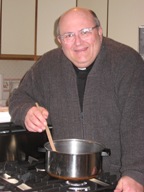 Growing up, Paul D. Seil experienced a great deal of South Buffalo. He was baptized at Holy Family Church, made his First Communion and Confirmation and attended school at St. Teresa's, and was eventually ordained at St. Thomas Aquinas. His father was a fire fighter and Paul, along with his parents and three sisters, moved to Boston, NY. He attended Eden Central High School and went on to St. Bonaventure University where he earned a B.A. in Theology in 1977.
After graduation, he worked in radio for a year in Niagara Falls. Paul also worked in the Department of Human Resources for the City of Buffalo as a Civil Servant for about six years. He considered the priesthood as a child in South Buffalo and again in high school and college. Since it seemed to be a persistent thought which kept returning, Paul decided to check it out. As a young person, he had been very positively influenced by Monsignor Leo Toomey and Monsignor Leo McCarthy. He was a member of the choir at St. Teresa's which was led by Monsignor McCarthy.
In 1984, at the age of 29, he entered Christ the King Seminary. On January 21, 1989, Father Paul Seil was ordained a priest at his home parish of St. Thomas Aquinas in South Buffalo. He had originally requested a spring ordination but none of the dates he submitted worked for then Bishop Edward Head. As it turned out, he ended up being ordained on the feast of St. Agnes which was very special because Father Paul had a Great Aunt Agnes with whom he was very close!
On the day of his ordination he remembers having a mix of emotions. He thought about his father who had passed away when Father Paul was just 21 years old and a senior in college. His Uncle Paul, for whom he was named, fought and died in France during WWII. Father Paul thought about him and how special it was to have his uncle's rosary which he still carries with him today. It brought him great comfort to be surrounded by his mother, sisters, and brothers-in-law. Family, past and present, were greatly on his mind on this special day. He has since gained six nephews and one niece. On the way to his ordination he rode with another priest. He went to that priest for confession so he could enter the priesthood with a clean heart as a gift to God.
While newly ordained, he put his previous media experience to use on a television show called "Real to Reel" from 1989 to the mid 90's. After that he became involved in the cooking show he currently hosts called, "Our Daily Bread" which is seen not only locally but in Boston, New York, and California as well. He always had an interest in cooking and has read a lot about it. His interest was enhanced when he spent a summer as a seminarian with Monsignor Sam Faiola who loved to cook.
He said his first Mass at St. Amelia's where he spent time during his pre-diaconate and diaconate years. Father Paul's first assignment was at St. Paul's in Kenmore where he spent two and a half years. He also helped during that time at Our Lady of the Rosary in Niagara Falls. He was then assigned to St. Amelia's from November 1991 to June 1994. After that he spent four years as a parochial vicar at Holy Spirit Church in Buffalo.
In 1998, ten years after becoming a priest, Bishop Henry Mansell gave him his first pastorate at St. Lawrence Church on the east side of Buffalo. While at St. Lawrence, Father Paul also functioned as the Director of the Office of Worship. Also, while at St. Lawrence, he truly appreciated the work done by the St. Vincent de Paul Society. The outreach of the parish was run by the lay St. Vincent de Paul group and Father Paul was very impressed by the wonderful service they provided for the people of the area. He spent over eight years as pastor of that parish. It was then that the Journey in Faith and Grace impacted his life. Eleven parishes in the area were brought down to three. It was a very difficult process but with fewer parishes came the opportunity for Father Paul to further his studies. He spent four months in Rome at the Pontifical North American College on an academic sabbatical in the Institution for Continuing Theology Education program.
March 2009 Priest of the Month - REV. JOSEPH VATTER
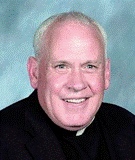 I am currently Pastor of my third parish assignment - All Saints Parish in Lockport. I've previously served as Pastor of St. Mary in Medina, and the Tri-Parish community of St. Mary in Belmont, St. Joseph in Scio and Sacred Heart in Angelica. I have also served as Parochial Vicar at St. Christopher in Tonawanda, SS. Peter and Paul in Jamestown, St. Martin of Tours in Buffalo Holy Trinity in Dunkirk, and St. Barnabas in Depew. I was ordained in 1978 by Bishop Edward Head.
There is no question the main reason I am a priest today is the effect the faith of my mother had on me as well as the priestly example and lifestyles of the parish priests in my home parish of St. Mary of the Assumption in Lancaster. My vocation was also nurtured by the Priests at the Diocesan Preparatory Seminary, Wadhams Hall, and St. John Vianney and Christ the King Seminaries. I would be remiss if I did not mention some of the guys I hung around with in the Seminary as well as my six year experience of working at Camp Turner as positive influences on my becoming a Priest.
Obviously, the priesthood I experienced in 1978 is quite different from the one that I am now living. The diminishing number of the fraternity has changed almost every aspect of priestly life but the call to serve is one thing that has not changed. I am sure that the many hats we wear, the time demanded upon us, the psycho-social makeup of the congregation can and does make the job a tad more stressful . . . but it also make the job so much more rewarding! People truly respect and appreciate all that you do for them.
I believe to be successful and to find life meaningful, the following elements are necessary:
- a solid prayer life which you grow into and grows as you do,
- a good spiritual director seen on a regular basis,
- close priest friends as well as close lay friends,
- outside interests and hobbies (for me they are golf, fishing, cooking and following various sports teams!)
I would also suggest attending as many study days or days of prayer as provided by the Diocese.
To anyone interested in becoming a priest, I would encourage you to really sit down and talk to priests you admire or who seem to have similar interests. I personally would tell you that being a priest is full of ups and downs, good days and bad days, as well as successes and failures. I would also tell you that priesthood can be fun . . . in fact the majority of the time it's a "riot" filled with many laughs but most importantly that you have to have the ability to laugh at yourself.
February 2009 Priest of the Month - REV. GREGORY DOBSON
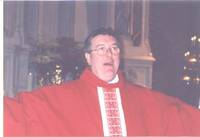 Born and raised in South Buffalo, Gregory J. Dobson was the first of Patrick and Margaret Dobson's six children. He attended St. Teresa School where the idea of becoming a priest led him to enter the Diocesan Preparatory Seminary after graduation from eighth grade. Looking back on the positive influences of his Catholic upbringing, he remembers being trained as an altar server by the austere Father Paul Durkin and recruited as a boy soprano for the Savios (the parish boys' choir) by the energetic and vigorous Fr. Leo McCarthy.
Deciding not to go directly into the priesthood, he earned a bachelor's degree in English and a master's degree in religious studies with a major in Scripture from Canisius College. The then "Mr. Dobson" was on the faculty at St. Martin's School in Buffalo (now known as Notre Dame Academy) where he taught junior high for eight years. He also served as vice principal, director of religious education, and director of the folk ensemble. It was during this time that his good friend, Father Louis Hendricks, took Greg "under his wings" and allowed him to move with him into his circle of ministry. Father Louis used this opportunity to share his insights on many aspects of priestly devotion.
Although he enjoyed teaching, the personal example of the wonderful priests who were so inspirational to him led him to enter Christ the King Seminary to complete his journey to the priesthood. While at the Seminary he was given a pastoral assignment at Queen of All Saints in Lackawanna. After being ordained to the diaconate in 1982, he served his assignment at St. Rose of Lima Parish in Buffalo. As a seminarian, he was attracted to Paul's letter to the Colossians - especially chapter three where he found the words that became the logo and theme of his ordination, "Dedicate yourselves to thankfulness."
Father Greg was ordained to the priesthood on July 14, 1983 by Bishop Edward D. Head at St. Martin of Tours Church. During his first 14 years as a priest, Father Greg served as parochial vicar in the following parishes: Our Lady of the Blessed Sacrament in Depew, St. Mary of the Assumption in Lancaster, and Our Lady of the Sacred Heart in Orchard Park. He also took on the responsibilities as chaplain for Villa Maria Academy. As a parochial vicar, he was motivated by the joyful Reverend Monsignor Dino Lorenzetti who saw his people as good and lovely.
As was evident in his previous career as a teacher, Father Greg really enjoys working with the youth. This was a significant component of his ministry in all three of his first assignments. He received the Moderator of the Year Award from the Buffalo Diocesan Youth Department in 1989 for his involvement while at St. Mary's in Lancaster. He also worked with a peer group ministry, conducted workshops and seminars for youth and teachers, and led Catholic Youth Organization (C.Y.O.) meetings and retreats. He assisted as a liturgical presider for the Life Teen group at Nativity Parish in Orchard Park, was active in Christian Drama with the Renaissance Theater Group, and served as the spiritual director for the Young Adult Ministry (Y.A.M.). Other highlights of his ministry to young Catholics include traveling with his parish youth group to World Youth Day in Denver in 1993 and twice to a sister parish in Mexico. Father Greg also served as a team member for the diocesan Christian Leadership Institute, an intensive leadership training program for young Catholics. Villa Maria Academy honored him with an award for Dedication and Service in 1997.
In 1995 he was invited to co-host the television program, Comfort My People, a weekly media ministry focused on Scripture reflections. He was the program's Scripture commentator for eleven years enjoying a wide following throughout western New York. In 1996 the diocese appointed him honorary chairperson of the Catholic Communication Campaign.
His first assignment as pastor came in 1997 with his appointment to St. Mary of the Angels Parish in Olean. With this assignment came the additional appointment as Episcopal Vicar of the Southern Cattaraugus Vicariate. This assignment gave new meaning to his nomenclature, "A Simple Country Priest."
In 2003 he assumed the pastorship of Sacred Heart Parish in Portville, a position he maintained until the 2007 merger with St. Mary's in Olean. A champion for Catholic education, he has previously served as Canonical Administrator for Southern Tier Catholic School and continues to serve on its school board as well as Archbishop Walsh High School's board.
Father Greg is a frequent lecturer and guest speaker at Catholic, ecumenical, and community events. His continuing education and his travels to Mexico, Puerto Rico, Europe, (most recently, Greece), the Middle East (with St. George's College in East Jerusalem) have given life to his homilies and lectures dealing with history, the Church, Scripture, culture, and social justice issues.
Some of the region's top civic citations have been bestowed upon Father Greg. For his work in fostering religious unity in the community, among them was the 2002 Unity Award by the Bahai Community.
He has served on several governing boards in the Olean area as well as chaplain to the Olean Knights of Columbus and was assistant Father Prior for Youth for the State Knights of Columbus. He is the chaplain for the Olean Police Department and the Ladies Ancient Order of Hibernians. In 2006 he was appointed to serve on the Diocesan Commission for the Journey in Faith and Grace.
His life has been a happy one; a grace, a good life. His priesthood has given him much joy and the opportunity to bring Christ to many situations - some happy, some not. The most challenging thing for him right now is being so far away from his family. His parish in Olean is an hour and a half drive from Buffalo. This makes it difficult to be with his family and his parish on special occasions such as Christmas and Easter when both would want him near. Overall he feels the priesthood is a beautiful life and an extremely meaningful vocation. Father Greg asserts, "We are a priestly people, graced and called to rejoice in the discovery of God's presence in our lives."
January 2009 Priest of the Month - REV. JAMES D. CIUPEK
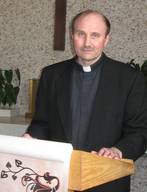 James D. Ciupek was born in Buffalo, New York and raised in Cheektowaga by two wonderful Catholic parents. He grew up with an older brother and two younger sisters and attended grade school at his home parish, Queen of Martyrs.
Jim's high school years were spent at Cheektowaga Central High. From there he went to Buffalo State College and received a Bachelor of Arts degree in Chemistry. After graduation, he left the Buffalo area to do graduate studies at Purdue University. In 1984, he received a Ph.D. in Chemistry and moved to St. Louis, Missouri to work as a research chemist for Monsanto Company.
He remembers feeling called to the priesthood as early as high school but put off answering the call until much later. While at Purdue University, he found himself becoming more and more involved in his local parish. He became an Extraordinary Minister and taught religious education. When Jim moved to St. Louis to work, he once again became very involved in the parish community.
He decided to look into the possibility of becoming a priest since thoughts of the priesthood seemed to be frequently on his mind. When he discussed this idea with a priest in St. Louis, Jim expressed his struggle with trying to choose between the priesthood and married life, as he couldn't decide which path he should follow. His priest gave him some wonderful advice. He told Jim to pray that one of those choices would grow stronger. He also told Jim that he would know when he had arrived at the plan God had in mind for him when he felt at peace with his decision.
Jim found a spiritual director and frequently spent time praying at the Carmelite Monastery in the presence of the Blessed Sacrament. After prayerful consideration, at the age of 33, Jim returned to Buffalo and entered Christ the King Seminary to begin studies for the priesthood. He received a Master of Divinity degree in May of 1996 and was ordained a Transitional Deacon the following June. Along with five other men, he was ordained to the priesthood on May 17, 1997 by Bishop Henry Mansell. Father Jim describes the experience as a time of nervousness and excitement as well as a day of great joy. He spent his first year as a priest at St. Gregory the Great Parish in Williamsville.
In 1998, he was assigned to the position of parochial vicar at SS. Peter and Paul Parish in Hamburg where he spent seven years. In June of 2005, Father Jim became the pastor of St. John the Baptist Parish in Alden where he currently resides.
For Father Jim, celebrating the Eucharist as well as helping people become more aware of a sense of God working in their lives are the best aspects of being a priest. The greatest challenge he sees as a priest, and more recently as a pastor, is the inability to meet all the ministerial needs of the people entrusted to his care. There are just not enough hours in the day to accomplish every task and address every concern.
To relieve stress and keep in good shape, Father Jim enjoys running, working out, and an occasional game of golf. On his days off, he spends time with his mother.
Overall, Father Jim feels the priesthood is a great opportunity to do something worthwhile with your life as you help people. When working in the corporate world as a chemist, Father Jim wondered how much of a positive contribution he was making in people's lives. He was earning a good salary, but not really feeling fulfilled. Now he has no doubt that he is living the life he was called to live. Father Jim sums it up by saying, "personally, there is nothing else I'd rather do than be a Priest."
December 2008 Priest of the Month - REV. WILLIAM QUINLIVAN
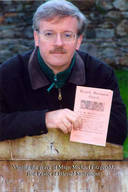 (Father Bill is currently Pastor of Blessed Sacrament Church in the Town of Tonawanda. He is a Priest Associate of St. Luke's Mission of Mercy on Buffalo's East Side and has recorded two CDs of original music.)
Call stories are always different, but the people being called usually respond the same to the Lord, from Abraham and Moses to my own vocation and, undoubtedly yours. "You want me to do WHAT??!!??" "Unworthy", "too young", "too difficult"...long before a popular TV show created the expression, "Yadda, yadda, yadda" in the 1990's, the Lord God had heard every excuse in the book. But through His grace, the book is still being written in our lives and discernment of the call. And He's still calling!
CHILDHOOD "NORMAL"? I'd love to say that my childhood was normal, but I've never been convinced that I understand what that word means. I was born into an Irish-American family, the fourth of six children. I grew up in the age of the "Brady Bunch" on television, and our three boy, three girl set up was kind of similar. Except that the Lord didn't provide us a maid or a dog. Our punch lines were better...and...we never had to squish our heads into those little boxes and look up and down as our family theme song played.
Television was one of the great fascinations of my childhood and I thought I might some day work in that field; as long as they never made me put my head in a little box. But Church was more important than even television. And from about the age of eleven, I had my first sense that God was showing me something in my heart that was His plan, His call.
Here's the story... Normal? Normal kids don't end up spending six or seven nights a week involved in parish activities. I know - I was there. Many of my acquaintances were adults, and elderly ones at that. The parish priest...rather frightening. And with all due respect to his immortal soul, it's a bit of a miracle that I ever ended up ordained. Tyrannical and volatile, a temper like a pit bull on caffeine. God rest his soul!! To be fair, he could be generous and kind and humorous and loving and his devotion to the Blessed Mother and Holy Eucharist could inspire a vocation! It was the humanity of the priesthood I had to learn from an early age. He was NOT Jesus Christ...but he worked for Him, with all his human foibles. And I worked for both of them...the Divine and the human!!!
MERCY, MERCY ME. My Aunt was a Sister of Mercy. She taught in the Rochester diocese for many years and died in 1974, the year I graduated from eighth grade at my Catholic grammar school. The Sisters were always at our house and the Mercy nuns were (and still are) family. After high school I worked at Buffalo's Mercy Hospital, again with Sisters of Mercy, wonderful women of God. When I got to seminary, there was a Mercy nun on the priestly formation team. When I walk in Lackawanna's Holy Cross Cemetery, I often visit the graves of my teachers and friends who were sisters. My respect for the call of women religious is, I believe, an important part of my vocation story. So, too, is my understanding of the mystery of married life. It wasn't until I realized that I could be a good and faithful husband and father to children that I could truly see the possibility of being "Father Bill" and a spiritual father to many children in the church. My own father worked tirelessly to support us and taught by example faithfulness and sacrifice...all with a smile on his face. He had married at 33 - the Irish don't rush to commitments!
A LONG STORY SHORT? My vocation did not take the direct route to the altar of God. When my best friend growing up, Father Ray Donohue, who lived across the street and was two years older - still is!) went away to college seminary at the start of my junior year of high school, I started to question whether I had just gotten caught up in the enthusiasm of his vocation. Hanging around with other friends, I suddenly found that none of them worked Bingo, sang in the choir at church, or knew the elderly of their parishes. From there, my vocational search truly began a new series of paths.
Music has always been a part of my life. From songs about papering parlors to music ministry experiences in church for more years that I want to count (but I'll try...36 years...ouch!). I've always loved to sing. My High School Musicals were a natural draw, long before the Disney Channel made millions on the concept. Theater was not to be my life (I can hardly memorize the sign of the cross...have an Etch-A-Sketch for a memory...if I turn my head things get erased!) but God was still calling.
My undergraduate degree was in Journalism, Broadcasting, and Speech from Buffalo State College. That TV thing still drew me. I attempted to sell some scripts for TV movies and series episodes that I wrote, but was to become experienced in rejection; rejection letters...and no response from most producers and studios. My only "success" was that I happened to find an address for comedy legend Joan Rivers and sent some jokes through the mail. She bought two - at a whopping $10 a piece. I continued to send lists of one-liners, and every time she bought a few, or several, four in about four years.
The Lord's sense of humor has me laughing now. My sense of humor has taken me through life's great disappointments and heartbreaks and makes my priesthood "no laughing matter" though I still love to make people laugh. And sing. And pray!
I changed jobs more times in the next seven years that you'd need to know. I was a file clerk, portrait photographer, freelance writer/reporter for local newspapers, and even an IRS taxpayer assistant. Finally, one day I realized that I had not stopped to ask God what HE wanted. I had gotten into the habit of asking and telling Him MY plans.
While reading Sister Briege McKenna's "Miracles Do Happen" I found a line that said, "God never forces anyone to do His will. You are completely free to say 'yes' or 'no.'" I remember that I sat upright in my bed and said to myself, "That's ME!" For all those years of wandering, people had said to me in just about every job I worked, "you probably should be a priest!" People at church said it to me most of my life but it wasn't until I was ready to do whatever the Lord asked and submit my will to His...that I almost instantly could say, "YES!" Ironically, once I was reminded that I was free to say, "no thanks;" I could only say yes.
GOD CALLS...AND PROVIDES. After I said yes, the story took on greater color and vibrancy, humor and music. And I have never doubted my vocation. April 29, 1995 I was ordained a priest and I can honestly say I found the life Christ had prepared for me. I more clearly heard the call that was always there. And the Lord gets the last laugh every day.
I've learned that our God always provides when we say yes... He does not promise a life without suffering in ministry. It does have a cost. It does call for sacrifice, dying to self daily. But that's basic and essential to all discipleship. That's what my parents did in their vocation of marriage. The Lord has given me a leading role, no more hiding in the chorus...there's not acting involved, but lots of singing...all for Him!!
November 2008 Priest of the Month - REV. MSGR. JOHN ZEITLER
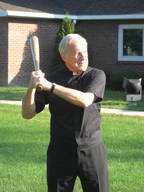 In 1932 John Zeitler entered the world and the family of John Baptist and Mary Schwabl Zeitler and their two daughters, Mary Ann and Jeanne. Mary passed away when John was an infant and for a year and a half his father, a Buffalo police officer, went on to raise the family alone. He remarried and his new wife, the former Bertha Butz, became the only mother young John really knew.
Early in his grammar school education at P.S. 63, John met and became close friends with his classmate, Joe Bissonette.Young Joe was later to become Father Joe Bissonette, the beloved priest who was murdered in his rectory in 1987. In both elementary school and later at Bennett High School, John excelled in sports. He played basketball, football, and baseball and was named All City in each of these sports at Bennett. In 2003 he was inducted into the Bennett High School Sports Hall of Fame and the Alumni Wall of Honor. He attended Michigan State University on a baseball scholarship and was captain of the College World Series finalists. John graduated in 1954 with a BA in Business.
Scouted by the Detroit Tigers, John played baseball for their farm system. He was sent first to the Jamestown Falcons and then called up to the Dunham Bulls.But the Army wanted him at this time to fulfill a previous commitment he had made to the ROTC Program. He served in the Artillery for six months at Fort Sill, Oklahoma, and then in Germany. Lieutenant John Zeitler returned from his active military duty in 1956. He reported back to the Detroit Tigers and was sent to the Florida State League where he played baseball for the remainder of the season. Now 24 years old and only playing class "D" baseball, John decided to give up a career in professional sports.
Enrolling in UB Law School, he completed the first year of study during the 1957-58 term. In May 1958, his boyhood friend, Joe Bissonette, was ordained a Catholic Priest. John recalls, "That was the year I said to Joe, ‘I'm not happy in law school.' And he said, ‘Why don't you try the seminary? Give the priesthood a try. You and I, we always thought alike.'" John Zeitler began his road to priesthood at St. Philip Neri, a school for late vocations in Boston. From there he went to Christ the King at St. Bonaventure Seminary and after one year of accelerated studies, was sent on for another four years of Theology studies by then Bishop Joseph Burke to the Collegium Canisianum in Innsbruck, Austria, a Pontifical Institute. He was ordained a priest on July 26, 1964 at the Church of the Sacred Heart in Innsbruck by Apostolic Administrator, Paulus Rusch, after which, he returned to Buffalo.
Father John's first assignment was on the Missionary Apostolate at St. Joseph's Parish in Bliss, NY for one year. During that year, both his mother and father died. He was interested in joining Father Joe Bissonette, who was teaching at Turner High School, but there were no openings available. He did, however, find his services were needed at Notre Dame High School in Batavia. For the next ten years, he taught Chemistry, Spanish, German, and English as well as completed his Masters Degree at Canisius College. In all, he spent 13 years at Notre Dame teaching and coaching baseball and golf.He was named Athletic Director and eventually Assistant Principal and Dean of Students. He was inducted into the Notre Dame High School Sports Hall of Fame. One of the young men who passed through the doors of Notre Dame High School while Father John taught there was our very own Vocation Director for the Diocese of Buffalo, Father Walter Szczesny
Father John's wish to be involved in Bishop Turner High School was granted when he was appointed principal in 1978. In 1980, he went to Blessed Sacrament Church on Delaware Avenue in Buffalo where he served for four years with the pastor, Monsignor Paul Juenker. In 1984, Father John went to the University of Buffalo Newman Center, located on the North Campus, where he stayed until 1990. It was while Father John was serving at UB that his lifelong friend, Father Joseph Bissonette, was murdered.
Father John asked then Bishop Edward Head to transfer him to a parish in 1990. He chose Our Lady of Perpetual Help in Lake View because it was close to Buffalo where he could be near his sisters. His sister Jeanne passed away in 2002 and his sister Mary Ann still lives in Amherst. Monsignor John Zeitler celebrated 40 years of priesthood in July of 2004 and currently remains the pastor of Our Lady of Perpetual Help Church.
His outstanding accomplishments have not gone unnoticed. Father John has received many awards and honors such as the St. Francis Fr. Justin Figas Award, The Cure of Ars Award from Christ the King Seminary, the Mater Christi Award from Immaculata Academy, and the Monsignor Nelson Baker Award from the Diocesan Youth Department. He has been inducted into several Halls of Fame including The W.N.Y. Baseball and The Harvard Cup, as well as those mentioned earlier. Along with his terrific athletic abilities, Father John has a fine singing voice. From 1978 to 1999 he enjoyed membership in the Buffalo Philharmonic Chorus.
Looking back, he reflects, "My life as a priest has been more than I had bargained for. By the Grace of God, I was always led to the right place. I am pleased to have served so many people over the years in His name. In following God's will, I feel I have completed my life and have honored my father and mother as well. I feel blessed that the Holy Spirit has guided me in every phase of my priesthood. As Jesus said, ‘Many are called but few are chosen', yet the decision that counts is the one made that leads to happiness and a sense of fulfillment. I was happy the first moment I made the decision to enter the seminary."
October 2008 Priest of the Month - REV. DAVID BAKER
 Father David Baker was ordained a Catholic priest on May 19, 2007. He is currently the parochial vicar at Queen of Heaven Church in West Seneca. Father Dave is a second-career vocation to the priesthood. He first studied mechanical engineering and worked at Cooper Turbocompressor, in Buffalo. He then spent two years as a computer network administrator at the University at Buffalo, which included supercomputer work for UB's Center For Computational Research.
Feeling drawn somehow to help the Diocese of Buffalo, he first inquired about the possibility of working for the diocese in the field of computers but there were no jobs available in that area. God had a different kind of involvement in mind for Father David.
It was while he was working at UB that Father Dave realized God was calling him to the priesthood - an invitation that had been made ten years earlier by his pastor, Monsignor Leo Hammerl. At the time, Father Dave had said, "Oh, Father, that's not for me. I want to date girls and work with computers." After doing both of those things for ten years, he realized that his pastor had been right after all. Father Dave always remained close to the Catholic Church through his college years and while working. He joined Quest Young Adult Ministry in the 1990's for social reasons but eventually took on a leadership role within the group. All these things pointed toward the priesthood.
So Father Dave switched from the study of Physics to the study of Metaphysics. In the seminary, he learned philosophy, languages, music history, and, of course, Scripture and theology. Along the way, he enjoyed ministry training at Buffalo General Hospital and the Franciscan Center, a South Buffalo shelter for homeless teens.
One of the greatest blessings of Father Dave's seminary formation was a chance to see the homeland of Jesus. He lived for a month in the Holy Land at the Tantur Ecumenical Institute and saw the whole country of Israel. (http://www.tantur.org/)
Despite having traveled abroad, Father Dave loves his hometown, the Diocese of Buffalo. He was born on the east side of Buffalo and grew up in Clarence, attending Clarence High School where he ran track and cross country for several years. His favorite event was the high jump.
When taking a break from ministry, Father Dave visits his family. He spends time with his mother, father, and younger sister, sharing a meal at least once a week. He also enjoys reading, acoustic guitar, soccer, and extreme skating. Spiritually, his favorite saint is Mother Frances Cabrini (http://www.mothercabrini.org/) and he has a strong devotion to the Sacred Heart of Jesus (http://www.sacredheartdevotion.com/). His favorite Bible verse is 1Peter 3:15, "Always be ready to give an explanation to anyone who asks you for a reason for your hope, but do it with gentleness and reverence..."
One of the most special moments Father David remembers about his ordination to the priesthood is when Bishop Edward Kmiec anointed his hands with oil. His ordination to the deaconate the year before had been similar in some ways and also very special but with the anointing of his hands Father Dave recalls experiencing, "a great cry of rejoicing in heaven that another priest had been ordained." He said it was as if he had been given a small glimpse of heaven at that moment.
Celebrating Mass, preaching and administering the Sacraments are, for Father Dave, the best parts of being a priest. When people receive the sacraments from him, they take those graces and blessings which flow from God, through him, to them, out into the whole world.
In describing a challenge of priesthood, Father Dave is disappointed with the poor image priests have in the secular culture and media. He feels that the way priesthood is portrayed is very misleading. He thinks they've got the wrong idea and he would like the priesthood to be shown in a better light, the way it really is.
For those who are considering a vocation to the priesthood, Father Dave is very encouraging and advises anyone who is even just thinking about it to give it a try. The time they spend in the seminary is part of their discernment, not the end of it. When asked about his vocation, he exclaims that, "It's a great life!" Father Dave is shown here enjoying a little extreme skating. To view Father Dave "on the job,", visit the home page of this website.
August 2008 Priest of the Month - REV. JOE GATTO
 Father Joseph Charles Paul Gatto was born in Dunkirk and attended Holy Trinity Roman Catholic grade school and Cardinal Mindszenty High School. Dunkirk is a small town, predominantly Catholic. Father Gatto was immersed in the traditions of our faith from an early age. He grew up in a Catholic household; his mother was of Polish descent and his father was Italian so the holidays and Church traditions were an important part of his youth. Celebrations included traditions of both sides of his family, such as Wigilia (meatless dinner) on Christmas Eve and the St. Joseph Table.
He was surrounded by wonderful priestly examples while at Cardinal Mindszenty. These men had a profound influence on his decision to become a priest. As Father Joe says, "they were coaches, they were teachers and they were school principals. They did your weddings. Not one of them left the priesthood. They were eight happy men. There were no facades about them. They gave me a sense that I wanted to be like them."
Father Gatto played four sports and dated during college at Wadhams Hall in Ogdensburg, NY. When he made the decision to become a priest, Bishop Edward Head asked him to attend Gregorian University in Rome, Italy, where he was trained by the Jesuits. He was ordained a priest on July 9, 1983. After briefly serving as administrator at St. Rose of Lima Parish in Forestville, Father Joe joined St. Leo the Great Parish in Amherst as parochial vicar. After he had served there for three years, Bishop Head asked him to serve as Associate Vocation Director for the Diocese. Father Joe also served as co-host of the "Real to Reel" television program for the Diocesan Office of Communication. He was later asked to return to Rome for his doctorate, which he earned in systematic theology from Gregorian University in 1994.
Father Joe has been teaching at Christ the King Seminary since 1990. At the Seminary, he has served as Vice-Rector, Director of Recruitment, Director of Formation, and Directory of Pre-Theology. He is currently an Adjunct Faculty Member.
While his Diocesan assignments have been fulfilling, it is parish ministry that has proved to be his true calling. He became pastor of St. John the Baptist in Lockport in 2002. During his tenure at St. John the Baptist, parish outreach was redefined. Father Joe is also committed to the parish school concept. St. John's merged with DeSales in the 1990's and now consists of a regional elementary school, the second largest in the Diocese. Furthermore, he is also committed to a "total picture" of education, beginning for all of us with baptism; for young couples and for all Catholics, including those separated from the Church. As a son of separated and later divorced parents, Father Gatto has a special dedication to separated and divorced Catholics.
On July 14, 2006 Father Joe became the fourth pastor at St. Gregory the Great. Those who know him, find him to be a very open person and very committed to family and friends. He lives a full life and is an avid skier, enjoys hunting, rides a motorcycle, loves to read, and is a big Buffalo and Cleveland Indians fan. Though his parents are deceased, his is very close to his two sisters.
July 2008 Priest of the Month - REV. MSGR. PAUL BURKARD
 I am Monsignor Paul Burkard. I was born in Buffalo, NY in September of 1943. My home parish is St. Mary in Swormville, which was then a small, rural parish. Today it is one of the largest and most quickly growing parishes in the Diocese of Buffalo, on the boundary between the Town of Clarence and Amherst.
I attended eight grades of elementary school at St. Mary's. After graduation from St. Mary's, I attended the Diocesan Preparatory Seminary on Dodge Street in Buffalo for high school and the first two years of college. In college, I was a Philosophy major and a Classics minor. After my second year of college, I entered St. John Vianney Seminary in East Aurora for my final two years of college and four years of theology. While I was working on my M.A. in Theology at St. John Vianney, I began a M.A. in Sociology at Catholic University in Washington, DC, taking classes during the summer sessions. I graduated from the seminary in May 1969.
I was ordained by Auxiliary Bishop Bernard J. McLaughlin on May 24, 1969. On that day, I had twenty-three diocesan classmates ordained with me. We were ordained in three different churches. One third of us were ordained at St. Joseph's New Cathedral on Delaware and Utica in Buffalo, one third of my classmates were ordained at St. Joseph's Old Cathedral on Franklin Street (presently our only cathedral) and one third of my classmates were ordained at Our Lady of Basilica in Lackawanna. In all of the excitement of ordination day, I think the question top-most on my mind was, "Will I be able to adequately serve the needs of the people that God will entrust to me in my first assignment as a priest?" I had chosen to become a priest because I wanted to serve God's people as best I possibly could and I thank God every day for the grace He gave me through all of my assignments to be of help to the people placed in my care.
My first assignment was at Annunciation Parish, Lafayette and Grant Streets on the West Side of Buffalo. I was assigned part-time to the parish and part-time to the parish high school. During that period, I became very interested in the local ecumenical ministry on the West Side of Buffalo called the Concerned Ecumenical Ministry. It was a group of fourteen Protestant and Catholic Churches who had banded together to provide better social services for people of the area.
In 1974, Bishop Edward Head assigned me to the faculty of Wadhams Hall Seminary College, Ogdensburg, NY. I spent eleven years teaching religious studies and sociology at Wadhams Hall and also held the position of Dean of Students and Vice Rector. I completed my M.A. in Sociology in May 1976.
In 1985, Bishop Head reassigned me to the faculty of Christ the King Seminary in East Aurora, as Vice Rector and Director of Formation. I held that position until 1987 when Bishop Head invited me to assume the responsibility of his Assistant for Vocations and Priestly Formation for the Diocese of Buffalo. In this position, I oversaw the seminary education of our students in training for priesthood and also headed up the recruiting program for vocations in the Diocese of Buffalo. I was then appointed by Bishop Mansell to be the Pastor of Our Lady of the Sacred Heart Parish in Orchard Park, a large parish with a wonderful school and vibrant liturgical life.
My family today consists of my 93-year old mother and four siblings. My mother lives in Williamsville. My brother and his wife live in Clarence, as does one of my sisters and her family. My youngest sister and her husband and family live in Hamburg and my older sister is the Minister General of the Franciscan Sisters across New York State and Pennsylvania. Her motherhouse is in Syracuse.
My present assignment is as Pastor of Our Lady of Victory Basilica in Lackawanna, President of Baker-Victory Services and Executive Vice President of the Homes of Charity. In this assignment, I work to continue the ministry begun by Father Nelson Baker in Lackawanna. With the help of 1,100 or more employees, we continue the social work, childcare, and specialized needs care for over 3,000 people in the Western New York area. My present ministry also includes my role as Vice Postulator for the cause of beatification and canonization for Father Baker.
I enjoy reading, gardening, and traveling. All of these help me to keep my life in balance. I also enjoy teaching and giving spiritual retreats and conferences whenever possible.
After all these years of priesthood (almost forty), I am happy to say that there is nothing I would have rather done with my life than to become a Catholic priest. I challenge young men in the Western New York area today to consider this vocation. I can't think of a better way to help God's people than as a priest in the Diocese of Buffalo.
June 2008 Priest of the Month - REV. JOSEPH ROGLIANO
 Born on Long Island, NY, in December, 1956, Joseph became the first son and fourth child in the Rogliano family. He moved, along with his parents and three older sisters, to the Buffalo area when he was six years old. He attended grade school at his home parish of St. Vincent de Paul in Springbrook. When he was just thirteen, he and his close knit Italian family experienced a great loss when his father passed away. Joe graduated from St. Mary's High School in Lancaster and continued studies at St. John Fisher College in Rochester. There he received a BS in Management and a BA in Psychology. He worked for Tops Markets and McDonalds through his high school and college years.
After graduation, Joe found employment at Marine Midland Bank as an interviewer in the human resources department. He vividly recalls one comment made by his supervisor during his one-year evaluation: "It would behoove you to interview and hire more with your head and less with your heart." Knowing that he was a "heart" person, this evaluation became one of two "seeds" which led him to consider altering the path of his life. The other occurred when he made Mission at St. Catherine of Siena Parish in West Seneca. He was deeply touched by this experience which, coupled with his employment evaluation, led him to consider the vocation of priesthood.
In the fall of 1980, Joe entered Christ the King Seminary. In the summer of 1981, he went to his first parish assignment at Queen of All Saints in Lackawanna. He thoroughly enjoyed the two summers he spent there. His next parish assignment was at St. Amelia in Tonawanda under the guidance of the pastor, Monsignor Rupert Wright. He served as a pre-deacon for a summer, and after graduation, his transitional deaconate year.
St. Joseph's Cathedral was the setting for his ordination to the deaconate on May 11, 1984. Less than a year later, Father Joe was ordained to the priesthood. At the time, it was customary for ordination to take place in the home parish of the candidate. Although St. Amelia's was not Father Joe's home parish, he asked his ordinary at the time, Bishop Edward Head, for permission to be ordained there. On April 19, 1985, he was ordained to the priesthood at St. Amelia Parish. Following ordination, Father Joe said his first Mass at St. Catherine of Siena in West Seneca, which was the parish he belonged to after his family moved out of Springbrook.
His first assignment as a priest was at St. Bernadette in Orchard Park where he spent three and a half years working with and learning from Monsignor Richard Nugent. He then went to St. Teresa in South Buffalo for six years, and was further groomed for ministry under the guidance of Father Ted Berg. His first taste of major fundraising came during his time at St. Teresa's where he had the privilege of seeing the church go through a complete restoration under the careful leadership of Father Berg.
After that assignment, Father Joe went to St. Gregory the Great in Williamsville, a wonderful opportunity for Father Joe to be reunited with his deacon mentor, a respected and admired friend, Monsignor Rupert Wright. He really enjoyed having the opportunity to minister with Monsignor Wright as a priest. While at St Greg's, in addition to many other ministries, he became very closely involved in a huge capital campaign, established to raise funds for a new ministry center and rectory. All three of his assignments brought him vast amounts of experience for what would lead to his first pastorate, St. Anthony in Lockport, given to him by Bishop Henry Mansell. Two years later, he was assigned the added responsibility of Pastor to nearby St. Joseph. At the time, it was referred to as "twinning" when two parishes shared one pastor. After seven and a half years in Lockport, Father Joe moved on to Fourteen Holy Helpers in West Seneca a larger suburban parish, complete with school, convent, and even a small cemetery.
Father Joe has been at Fourteen Holy Helpers for a little more than two years. Ordained for twenty-three years, he feels blessed to have enjoyed the company of the other priests with whom he has served. The best part of priesthood for Father Joe is when he gets to set aside the business of each week and celebrate weekend Masses. He loves to preach and interact with his parishioners. A real people person, he enjoys all kinds of parish functions, even BINGO, which he periodically works. As far as describing a challenge of priesthood, he notes that it is difficult to please all of the people all of the time, a reality that he and every priest often face.
Among the many interests Father Joe has are running and exercising. He finds working out a great way to relieve stress and stay healthy. Father Joe enjoys the Bills, Sabres, and pro golf. He recently took up golf and is committed to learning everything he can about the sport. He enjoys movies and books. He is a true "early bird," and sees morning as a wonderful time of day when everything is quiet and the hustle and bustle has not yet begun. Prayer, meditating, and reading suit him best at that time of day, as opposed to later in the day. A real "beach bum," he enjoys vacationing on Ocean City's Jersey Shore with his family and friends. Birthdays and many other celebrations keep Father Joe and his family closely connected.
If someone thinks he is being called to the priesthood, Father Joe feels he should not ignore it. It is best to listen carefully, in prayer and throughout the day, and keep the door open to the possibility. One should ask many questions of himself and others. He should spend time talking to priests, lay people, friends and family members to find out what they would think about him becoming a priest. Father Joe stresses that people always have to give up something no matter what path they choose in life. The grass will always look greener on the other side if they focus on what they have left behind rather than what they have gained. Following his heart to the priesthood, Father Joe inspires all those he serves with his outgoing, energetic and optimistic personality.